For millions of older Americans living on fixed incomes, keeping up with home repairs is a major challenge. When a roof begins to leak, a furnace dies in the dead of winter, or a steep set of porch steps becomes a severe fall hazard, the cost of fixing the problem can feel overwhelming. With Social Security checks and modest retirement savings stretched tight, taking out a standard bank loan with high interest rates is often impossible.
Fortunately, the Federal Government offers a critical safety net that many older adults are completely unaware of: USDA Rural Development Grants and Loans.
If you or a loved one are an older homeowner living in a small town or rural community, the U.S. Department of Agriculture (USDA) provides direct financial assistance specifically designed to help you fix safety hazards, install age-in-place accessibility features, and maintain a safe, warm, and secure home. Lets deep dive into “USDA grants for seniors: Eligibility, amounts, and how to apply”
READ MORE: How to Get a Free Bathroom Remodel for Seniors| Grants, Programs & Help
What are USDA Grants for Seniors?
When most people hear “USDA,” they think of farming subsidies, food stamps, or meat inspection stamps. However, the USDA Rural Development agency plays a massive role in residential housing across rural and semi-rural America.
The USDA recognizes that rural communities often lack affordable private credit options and have an aging housing stock. To prevent older adults from being forced out of their homes due to hazardous living conditions, the USDA administers specialized single-family housing assistance programs under Title V of the Housing Act of 1949.
| USDA Grants | USDA Loans |
|---|---|
| Outright financial award | Borrowed funds |
| No monthly payments | Fixed 1% interest rate |
| Must be age 62 or older | Available to adults age 18+ |
| Lifetime maximum of $10,000 | Borrow up to $40,000, repaid over 20 years |
| Intended to remove health and safety hazards | Can be used for safety improvements, home repairs, and modernization |
Common Misconceptions About USDA Grants
- Misconception #1: “USDA grants are only for farmers.”Fact: You do not need to own a farm, raise livestock, or work in agriculture. Any low-income homeowner residing in an eligible rural address can apply.
- Misconception #2: “It is 100% free money for any home renovation project.”Fact: USDA grants are strictly earmarked to remove health hazards or improve accessibility. They will not fund cosmetic upgrades like granite countertops or new carpet.
- Misconception #3: “I have to give my home to the government.”Fact: The USDA does not take ownership of your property. They simply place a soft 3-year residency requirement on grant funds to ensure people don’t flip the home immediately after repairs.
Does USDA Really Offer Grants for Seniors?
Yes—the USDA actively awards direct financial grants to qualified seniors. However, it is essential to understand that not everyone gets a full grant automatically.
The flagship grant initiative is the Section 504 Home Repair Program (officially known as the Single Family Housing Repair Loans & Grants program).
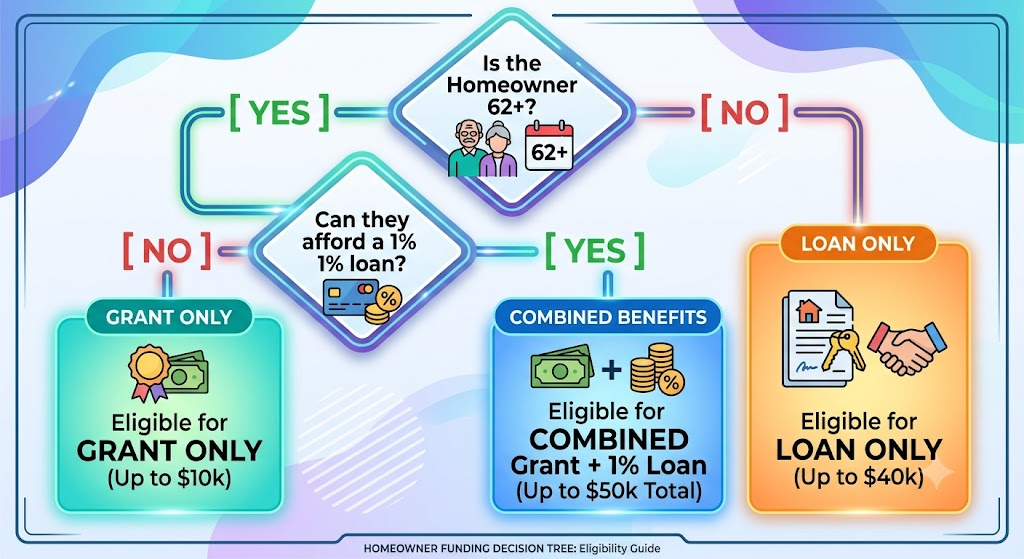
The grant component is strictly reserved for homeowners who meet three core conditions:
- Age Requirement: You must be at least 62 years old at the time of application.
- Income Requirement: Your total household income must be below the Very-Low Income limit for your county (typically 50% or less of the Area Median Income).
- Repayment Inability: You must show that your household budget cannot afford to repay even a low-interest 1% loan.
If you are 62+ and have a small amount of room in your monthly budget, the USDA may offer you a combination package—for example, a $7,000 grant paired with a $5,000 loan to cover a major project like a full roof and heating replacement.
READ MORE: Does HUD Offer Grants For Senior Citizens?
USDA Section 504 Home Repair Grant Explained
The Section 504 Home Repair Program is the primary driver of federal home repair aid for elderly Americans. Let’s examine the funding caps, rules, and allowed uses established by the USDA.
| Section 504 Funding Category | Amount / Requirement |
|---|---|
| Maximum Lifetime Grant | $10,000 (up to $15,000 in a federally declared disaster area) |
| Maximum Direct Loan | $40,000 with a 1% fixed interest rate and a 20-year repayment term |
| Maximum Combined Assistance | $50,000 total (loan + grant combined) |
| Grant Retention Requirement | Recipient must occupy the home for at least 3 years after receiving the grant |
Covered Repair Categories
The Section 504 grant is strictly designed to make the dwelling safe, sanitary, and functional. Covered expenses generally fall into two categories:
1. Aging-in-Place & Accessibility Upgrades
- Wheelchair Ramps: Installing custom wooden or aluminum ramps for exterior doors.
- Bathroom Safety: Replacing high-step bathtubs with walk-in showers or roll-in stalls.
- Support Fixtures: Mounting heavy-duty grab bars near toilets and showers.
- Doorway Expansion: Widening interior and exterior door frames to accommodate walkers or motorized wheelchairs.
- Flooring Modifications: Eliminating hazardous threshold steps and laying non-slip flooring.
2. Critical Health & Safety Hazards
- Roofing: Total roof tear-offs and replacements to stop structural leaks and ceiling collapses.
- Heating & Cooling (HVAC): Replacing dangerous or non-working furnaces, boilers, heat pumps, and leaking water heaters.
- Electrical Upgrades: Replacing dangerous knob-and-tube wiring, overloaded fuse boxes, or sparking panels to prevent structure fires.
- Plumbing & Water: Fixing broken main water lines, corroded pipes, or failing water heaters.
- Septic Systems & Wells: Repairing or replacing backed-up septic tanks, drain fields, or contaminated well-water pumps.
- Structural Hazards: Securing crumbling foundations, replacing rotted subfloors, and repairing dangerous porch steps.
Who Qualifies for USDA Grants
Eligibility for USDA grants is defined by several strict parameters including age, income, property location, and financial status. These criteria are designed to ensure that the limited federal funds are directed toward those with the greatest need who have no other options for financing.
| Eligibility Category | Requirement Detail |
| Age | Must be 62 years of age or older to qualify for a grant |
| Income | Must be “very-low-income,” typically defined as 50% or less of the Area Median Income (AMI) |
| Residency | Must be the homeowner and occupy the house as a primary residence |
| Location | The property must be located in an eligible rural area as defined by the USDA |
| Financial Status | Must demonstrate an inability to obtain affordable credit from other sources |
Detailed Eligibility Breakdown:
Lack of Affordable Credit: You must certify that you cannot obtain reasonable credit from traditional banks or credit unions.
Age: For grant consideration, you must be at least 62 years old on the date the application is signed. (Homeowners age 18 to 61 qualify only for the 1% interest loan).
Income Limits (County-Specific): You must be categorized as “Very Low Income”. USDA calculates this based on 50% of the median income in your specific county, adjusted for household size. For example, in a rural Midwestern county, the 1-person limit might be $28,000/year, whereas in a rural Western county with a higher cost of living, it might be $36,000/year.
Property Ownership: You must own the home. Acceptable proof includes a recorded deed, a fee simple title, or a long-term leasehold. Life estates and land contracts may qualify under specific circumstances if approved by USDA legal counsel.
Primary Residency: Mobile homes, single-family detached homes, townhomes, and manufactured housing are eligible as long as you live in the home year-round. Vacation homes, rental properties, and investment units are strictly excluded.
READ MORE: Salvation Army Free Car Program (Eligibility & How to Apply)
What Is Considered a Rural Area?
A common point of confusion for older adults is the definition of “rural”. Many people assume a rural area must be miles out in the countryside surrounded by farm fields. In reality, the USDA’s definition of rural is surprisingly broad.
Qualifying Rural Communities
- Open countryside and agricultural areas
- Towns and villages with populations under 10,000
- Selected small cities with populations between 10,000 and 35,000
- Outer suburban fringes that lack urban density
Examples of Qualifying Locations
- A small former mining town of 8,000 residents in Pennsylvania.
- A historic farming village of 2,500 people in Iowa.
- An unincorporated township on the outer boundary of a major metro area in Texas.
- A coastal fishing community of 12,000 residents in Oregon.
Pro Tip: Before ruling yourself out, check your address on the official USDA Rural Housing Eligibility Map (eligibility.sc.egov.usda.gov). Millions of homeowners living in outlying suburbs are surprised to find their neighborhood falls inside an eligible rural zone!
How Much Money Can Seniors Receive in USDA Grants?
The financial assistance provided by the USDA is capped by lifetime limits and project-specific maximums. According to USDA guidance, these amounts are subject to change based on federal appropriations and policy updates, so verifying current limits with a local office is essential.
| Funding Type | Maximum Lifetime Limit | Interest Rate | Repayment Terms |
| Standard Grant | $10,000 | 0% | Non-repayable (if kept 3 years) |
| Disaster Grant | $15,000 | 0% | Non-repayable (if kept 3 years) |
| Standard Loan | $40,000 | 1% Fixed | Repayable over 20 years |
| Combination | $50,000 | Hybrid | Mix of grant and loan terms |
A key feature of the grant is the three-year occupancy rule. If the homeowner sells the property within three years of receiving the grant, the full amount must be repaid to the government. This rule ensures that the funds are used to help people remain in their homes rather than being used to flip properties or increase the value of a home intended for immediate sale.
The loan component is exceptionally favorable, with a fixed 1% interest rate. For example, a $10,000 loan results in a monthly payment of approximately $45.99. If a senior homeowner needs $20,000 in repairs but can only afford to repay a $10,000 loan, the USDA may provide a $10,000 grant and a $10,000 loan to bridge the gap.
READ MORE: Free Bathroom Remodel for Seniors
What Home Repairs Does USDA Cover?
The USDA Section 504 Home Repair Program helps eligible homeowners pay for essential repairs that remove health and safety hazards, improve accessibility, or address major structural issues. Funding is intended for necessary repairs—not cosmetic upgrades.
| Eligible Home Repairs | Examples |
| Roof Repairs & Replacement | Roof leaks, damaged shingles, roof decking, and structural roof repairs |
| Heating Systems | Furnaces, boilers, heat pumps, and water heater replacement or repair |
| Electrical Safety Upgrades | Electrical rewiring, breaker panel upgrades, GFCI installation, and other code-related safety improvements |
| Plumbing Repairs | Broken water pipes, leaking plumbing, drain lines, and water supply line replacement |
| Septic & Well Systems | Septic tank replacement, drain field repairs, well pump replacement, and water system repairs |
| Accessibility Improvements | Wheelchair ramps, handrails, exterior steps, widened doorways, and other mobility modifications |
| Accessible Bathroom Upgrades | Walk-in tubs, roll-in showers, grab bars, raised toilets, and other accessibility features |
| Structural Repairs | Foundation stabilization, sill plate replacement, floor joist repairs, and structural reinforcement |
| Windows & Doors | Replacing damaged or rotted windows and doors that create health or safety risks |
| Hazard Removal | Severe mold remediation and removal of hazardous materials that threaten occupant safety |
Repairs USDA Usually Won’t Pay For
Section 504 funds cannot be used for luxury, cosmetic, or recreational improvements that are not necessary to protect the home’s health, safety, or livability.
| Ineligible Expenses | Why They’re Not Covered |
| Swimming Pools, Hot Tubs & Saunas | Considered luxury or recreational amenities |
| High-End Cosmetic Remodeling | Decorative upgrades such as granite countertops, custom cabinetry, or designer finishes |
| Decorative Landscaping | Flower beds, ornamental landscaping, and decorative fencing |
| Recreational Decks & Patios | Outdoor entertainment spaces not required for accessibility or safety |
| Home Additions or Expansions | Additional rooms or square footage unless medically necessary for accessibility |
| Detached Buildings | Garages, workshops, storage sheds, and other separate structures |
| Luxury Flooring | Hardwood refinishing, premium tile, and other aesthetic flooring upgrades |
READ MORE: Free Roof Replacement Grants for Seniors — Help & How to Apply
Step-by-Step Application Process
Navigating a government application can feel intimidating, but taking it step-by-step makes the process straightforward.
1. Verify Property & Income Eligibility
Use the online USDA Eligibility Map to confirm your property falls in an eligible zone. Compare your gross household income against your county’s 50% Area Median Income limit.
2. Contact Your Local USDA Rural Development Office
Find your state’s USDA Rural Development field office online. Speaking directly with a local housing specialist ensures you receive guidance tailored to your county’s current budget allocation.
3. Gather Income and Property Documentation
Prepare your financial and ownership paperwork ahead of time. Missing documents are the primary reason application processing is delayed.
4. Solicit Contractor Estimates
Contact licensed and insured contractors in your area. You must obtain itemized, written cost estimates detailing the specific safety repairs needed.
5. Complete Form RD 410-4
Fill out the official Form RD 410-4 along with supporting disclosures.
6. Property Inspection & USDA Approval
A USDA housing inspector will evaluate your home to verify that the requested repairs address legitimate health or safety hazards. Once approved, funds are disbursed directly to contractors as milestones are completed.
READ MORE: Best 6 Anti Aging Supplements for Seniors: Reviews, Comparison & Buying Guide
Required Documents
Having your paperwork organized accelerates approval. Assemble a binder containing the following required items:
| Document Category | Specific Items Needed |
| Personal Identification | • Driver’s license, state ID, or passport • Social Security cards for all household members |
| Proof of Age | • Birth certificate or state ID verifying age 62+ |
| Proof of Income | • Social Security benefit statements (Form SSA-1099) • Pension statements, IRA distributions, or annuity records • Most recent 2 years of Federal Tax Returns (Form 1040) • 2–3 months of complete bank statements |
| Proof of Ownership | • Recorded Warranty Deed, Quitclaim Deed, or Title • Most recent property tax bill and proof of paid taxes |
| Home Insurance & Utility | • Current homeowner’s insurance declaration page • Recent electric, heating, or municipal water bill |
| Contractor Work Bids | • Detailed, signed quotes from licensed/insured contractors |
USDA Grants vs Other Senior Assistance Programs
The USDA is not the only government entity that provides housing relief. Comparing your options helps you find the right support.
| Feature / Program | USDA Section 504 | HUD (CDBG / HOME) | Weatherization (WAP) | LIHEAP | VA Housing Grants |
| Target Audience | Low-income rural homeowners 62+ | Low-income urban/suburban residents | Low-income renters & homeowners | Low-income energy bill payers | Disabled veterans & service members |
| Primary Benefit | Up to $10k grant for repairs | Flexible repair grants/loans | Insulation, air sealing, HVAC | Heating/cooling bill aid | SAH/SHA home adapt grants |
| Geographic Focus | Rural areas (<35k pop) | Cities & urban counties | Nationwide | Nationwide | Nationwide |
| Repayment? | None (if held 3 yrs) | Varies by municipality | None | None | None |
READ MORE: Can Seniors Get Free Window Replacement Grants
Can Seniors Combine USDA Grants with Other Programs?
Yes! Stacking assistance programs is an effective way for low-income seniors to complete major home overhauls.
Ideal Stacking Combinations
- USDA Grant + Weatherization Assistance Program (WAP): Use your $10,000 USDA grant for structural repairs (like replacing a rotting roof), while WAP covers attic insulation, window sealing, and HVAC upgrades at zero cost.
- USDA Grant + Area Agency on Aging (AAA): Local Area Agencies on Aging often have small local pots of grant money ($1,000–$3,000) for minor accessibility additions, like grab bars or ramp materials.
- USDA Grant + LIHEAP: If your furnace breaks down, LIHEAP Crisis Intervention can supply emergency heating units or partial repair funds, while the USDA covers structural ductwork or chimney repairs.
USDA Grants for Veterans and Disabled Seniors
Older veterans and seniors living with physical disabilities receive special consideration under federal housing rules.
- Priority Processing: While all eligible applications are processed in order of receipt, local USDA offices give high consideration to health emergency cases and disabled seniors facing severe living hazards.
- Combining with VA SAH/SHA Grants: Disabled veterans who qualify for the VA’s Specially Adapted Housing (SAH) or Special Home Adaptation (SHA) grants can use USDA Section 504 grants to cover general structural home repairs while VA grants fund complex medical adaptations.
- Disability Access Features: If a senior family member has lost mobility, Section 504 grant funds can pay for roll-in showers, lowered kitchen counters, widened doorways, and ramp installations.
Common Reasons Applications Are Denied
Understanding common refusal triggers helps you present a strong application.
| Denial Reason | Explanation | How to Avoid It |
| Income Exceeds Limit | Household income is slightly above 50% AMI. | Deduct allowable medical expenses, prescription costs, and Medicare premiums to lower net income. |
| Ineligible Location | Property falls within an urban zip code. | Check the USDA eligibility map before submitting. |
| Title / Ownership Issues | Property deed is in probate, co-owned by distant heirs, or lacks clear title. | Clear property title issues with a local legal aid attorney before applying. |
| Incomplete Application | Missing tax documents, bank statements, or contractor bids. | Use an application checklist to double-check all documents before turning in your packet. |
| Requested Work Disallowed | Contractor bid includes cosmetic remodels. | Request itemized bids focused strictly on health, safety, and accessibility. |
READ MORE: Best Wireless Earbuds for Senior Runners: Top Picks
Tips to Improve Approval Chances
- Focus strictly on safety: Frame every repair request around health, safety, and functional independence.
- Include supporting medical notes: A letter from your primary physician explaining how repairs (e.g., walk-in shower or wheelchair ramp) support your health significantly strengthens your case.
- Submit complete contractor bids: Bids must detail scope, materials, and labor costs clearly on official contractor letterhead.
- Apply early in the federal fiscal year: Turn in applications in October or November as new federal funding pools open.
- Work with a local non-profit advocate: Community Action Agencies and local housing counselors can assist you with paperwork at no charge.
Common USDA Grant Scams: How to Protect Yourself
Important: Scammers frequently impersonate government agencies to steal money or personal information. If someone claims they can “guarantee” you a USDA grant or asks you to pay to receive government assistance, it’s almost certainly a scam.
Warning Signs of a USDA Grant Scam
| 🚩 Red Flag | What It Means |
| Unexpected social media or text messages | You receive a Facebook message, text, or direct message claiming you’ve been selected for a USDA grant without applying. |
| Requests for upfront fees | Someone asks you to pay an “application fee,” “processing fee,” or “tax” before you can receive grant money. |
| Unusual payment methods | You’re instructed to pay using gift cards, Green Dot cards, Bitcoin, cryptocurrency, wire transfers, or other hard-to-trace payment methods. |
| Fake government websites | The website looks official but doesn’t use a .gov domain or imitates a federal agency. |
| High-pressure tactics | You’re told to act immediately or risk losing “guaranteed” grant funding. Legitimate USDA programs do not use pressure tactics. |
How to Stay Safe
- USDA does not charge application fees for Section 504 Home Repair Grants or Loans.
- Never pay anyone to “unlock,” “expedite,” or “guarantee” a USDA grant.
- Verify communications carefully. Official USDA emails come from addresses ending in .gov.
- Apply only through official USDA Rural Development offices or authorized program partners.
- If something sounds too good to be true, verify it directly with USDA before sharing personal or financial information.
Remember: Legitimate USDA assistance is based on eligibility and available funding—no one can guarantee you’ll receive a grant in exchange for a fee.
FAQs
What is the USDA Section 504 Home Repair Grant?
The Section 504 Home Repair Grant is a federal assistance program offered by USDA Rural Development. It provides funds to help low-income elderly homeowners repair, improve, or modernize their homes to remove health and safety risks.
Who qualifies for USDA home repair grants?
Very-low-income homeowners in eligible rural areas qualify for USDA repair help; grants are reserved for those age 62 or older who cannot afford to repay a 1% loan.
Do USDA grants have to be repaid?
No, as long as you fulfill the residency requirement. Grants do not require repayment unless you sell or transfer ownership of the property within 3 years of receiving the funds.
How much money can seniors get from USDA grants?
Under typical Section 504 rules, seniors may receive grants of up to $10,000 (lifetime cap) and loans up to $40,000; combined assistance often reaches $50,000 in standard settings (caps vary in disaster or pilot programs).
What repairs are covered by USDA senior grants?
Grants must be used to remove health and safety hazards — e.g., failing roof, unsafe wiring, broken HVAC, failing septic/well systems, and accessibility modifications. Cosmetic upgrades normally don’t qualify.
How do I apply for USDA home repair grants?
Confirm your home’s eligibility on the USDA map, collect proof of income and homeownership, request written contractor bids, and submit Form RD 410-4 through your local USDA Rural Development field office.
Are USDA grants repaid if I sell my house?
Grants typically do not require repayment unless the house is sold or the owner moves within a certain period (local requirements apply — verify with your RD office). Check the specific terms on your grant paperwork.
Sources & how this was verified
All program rules, income/area eligibility, dollar caps, and process points above were checked against official USDA Rural Development program pages and recent USDA materials. Where I name caps and age rules I label them as USDA guidance (verified Feb 24, 2026) below.
- USDA — Single Family Housing: Repair Loans & Grants (Section 504) — USDA program overview and intake guidance. (USDA guidance — verified Feb 24, 2026).
- USDA — Single Family Housing Repair Loans and Grants (program factsheet / pdf) — details on eligibility, loan/grant amounts, and rules (includes the 1% loan and $10,000 grant guidance). (USDA guidance — verified Feb 24, 2026).
- USDA GovDelivery bulletin (USDA Rural Development summary, Jan 22, 2026) — summarized caps and repayment note for grants. (Verified Feb 24, 2026).
- USDA — Single Family Housing Rural Disaster Home Repair Grants — separate disaster grant program and example caps. (Verified Feb 24, 2026).
- USDA newsroom / success stories and state director quotes (used to paraphrase expert comments about program priorities and disaster responses). (Verified Feb 24, 2026).


Pingback: Grants for Seniors on Social Security: USA 2026 Guide - Free Senior Grants
Pingback: Free Roof Repair Grants for Seniors: USA Guide (2026) - Free Senior Grants