If you’re 60 or older and worried about high heating or cooling bills, the Weatherization Assistance Program (WAP) may help at no cost by improving your home’s insulation, sealing air leaks, and making heating systems safer and more efficient. This guide explains, in plain language, how income limits affect whether a senior (homeowner or renter) can get weatherization help. You’ll learn the federal rule of thumb, why states sometimes use different cutoffs, what income counts, the documents you’ll need, and exact next steps to apply. Where helpful I’ll show concrete numbers from federal guidance and sample state examples (California, Texas, New York) so you can quickly see whether your household looks likely to qualify.
Key official notes: the Department of Energy (DOE) considers households at or below 200% of the federal poverty level eligible, while some states use LIHEAP or a percent of state median income instead — see sources from DOE and HHS below.
Can Seniors Qualify for WAP: Quick checklist
- Household income: Compare your annual or monthly household income to the numbers in the comparison table below (or 200% of the federal poverty level as a quick test).
- Age priority: Seniors (age 60+) are often prioritized on waitlists even if eligibility is borderline.
- Program receipt: If anyone in the household receives SSI, TANF, SNAP, or HEAP/LIHEAP, you may be categorically eligible.
- Housing status: Both homeowners and many renters qualify (landlord permissions may be required for some measures).
- Documents to gather: Social Security/SSI award letter, last 2–3 months of bank statements or pay stubs, photo ID, proof of address, lease/mortgage — see full checklist below.
READ MORE: Free Home Repair for Seniors | Grants, Programs & Help Near You
What the Weatherization Assistance (WAP) Program does for seniors
The Weatherization Assistance Program (WAP) is a federal energy-efficiency program run by the U.S. Department of Energy (DOE). It provides free weatherization work (insulation, air sealing, furnace repairs, efficient appliances, etc.) for qualified low-income households. The goal is to cut home heating and cooling costs and improve safety. All services are provided at no cost to the homeowner or renter. WAP is available in every state through local agencies. Seniors aged 60+ are among the highest priority groups for WAP. DOE explicitly notes, “Priority is given to the elderly, families with … disabilities, [and] families with children”. That means many states will serve senior applicants first if they qualify.
According to the National Council on Aging, WAP serves roughly 35,000 homes per year nationwide and helps “lower energy bills, save energy, and make homes more comfortable.” Seniors benefit because the upgrades can cut heating and cooling costs by 10–20% on average. Even before applying, remember: WAP is not a repair program. It fixes only energy-related issues (like insulation or a leaky furnace), not general home repairs.
WAP Eligibility Requirement: Who qualifies
- Age & priority: Being 60+ generally improves your priority on local waitlists, but age alone does not automatically qualify you. Priority is commonly given to seniors, people with disabilities, and families with young children.
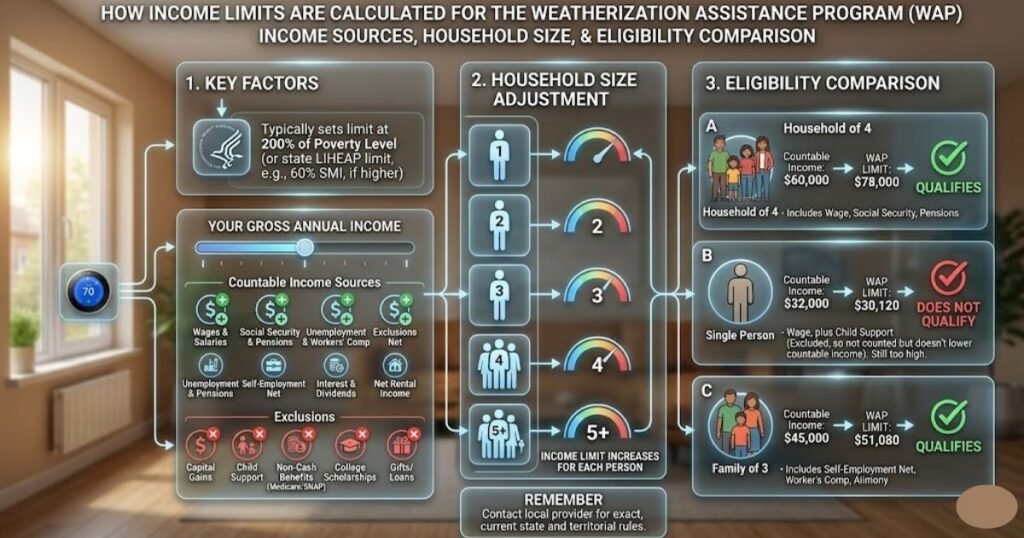
- Income rules: Under DOE guidance, a standard threshold is 200% of the federal poverty level (FPL). Some states instead use LIHEAP rules (for example, a percent of state median income) or lower/higher percentages states decide.
- Household composition: Household size matters, income limits rise with each person. Count everyone who lives in the home and shares income.
- Categorical eligibility: If you already get certain benefits (SSI, SNAP, Temporary Assistance, or HEAP/LIHEAP in some places), you may be automatically eligible or placed at the top of a list. Always tell the agency if someone in the household gets these benefits.
Age threshold: There is no minimum or maximum age. Both homeowners and renters (including tenants of mobile homes and senior housing) can apply. That said, most WAP programs specifically prioritize seniors (often defined as 60+) for scheduling and funding. In practice, if two applications are identical except one is age 65 and one is age 45, the 65-year-old would usually be served first.
READ MORE: Can Seniors Get Free Window Replacement Grants
Weatherization Assistance Program Income Limits for Seniors 2026
WAP Federal Income Limits
By DOE rules, WAP’s baseline income cap is 200% of FPL (Federal Poverty Level). For example, using the 2024 guidelines, that means about $30,120/year for a 1-person household, $40,880 for 2 people, $51,640 for 3 people, etc. Each additional person adds roughly $10,760. (FPL updates yearly; you should check the latest poverty chart.) These figures are often used by smaller states.
State WAP income limits
However, states are allowed to use higher limits based on the LIHEAP rule of 60% of state median income. In practice, each state can choose its eligibility threshold (between 110% FPL minimum and up to 250% or more of FPL). This means income limits vary widely by state. For example, New York uses 60% of the State Median Income as the WAP cutoff, which is higher than 200% FPL for a one- or two-person household. (New York’s official program page states: “at or below 60% of state median income… with priority given to seniors”.) California’s state-run low-income energy program actually uses 250% of FPL for its income cap (roughly $39,125 for one person in 2025). Texas sticks with 200% FPL as its limit.
Below is a comparison table with some sample limits for 1-person households in different programs:
| Program / Location | Household size | Income limit (annual) | Who’s prioritized | Notes (how income counted) |
| Federal guideline (DOE) | 1 | ~$30,120 (2024) | Seniors, disabled | Counted: wages, SS, pensions; excludes rare gifts. |
| California ESA (2025) | 1 | $39,125 | Seniors prioritized | State uses 250% FPL cap (much higher limit). |
| Texas WAP (2024) | 1 | ~$30,120 | Low-income & high-burden households | Uses 200% FPL; local rules may vary. |
| New York (sample) | 1 | ~$40,000 (est.) | Seniors & families with children | 60% of NY state median (see NY guidelines). |
Table: Income limits are higher in high-cost states. Federal guideline is shown for a single-person household (2024). State numbers are approximate examples and can depend on the latest state charts.
The exact numbers above (and your state’s) can change yearly. Always check your state’s WAP or LIHEAP office for current figures. Differences arise because state medians and cost of living vary. For instance, a $40,000 annual income might be under the limit in expensive areas like California, but above the cap in a lower-cost state that uses 200% FPL.
READ MORE: Government Grants for Seniors: The Complete, Up-to-Date U.S. Guide
How WAP Calculates Household Income
What counts (commonly included):
- Wages, salaries, tips (before taxes).
- Social Security (SS) and Social Security Disability Insurance (SSDI) — usually counted as income.
- Pensions and retirement annuities.
- Unemployment and worker’s comp.
- Some state programs count non-cash benefits differently; always confirm.
Common exclusions or deductions (varies by program):
- Non-recurring gifts (large one-time gifts may be excluded).
- Certain medical expenses (some LIHEAP rules allow deductions for high medical costs, which lowers countable income).
- In-kind benefits (like SNAP benefits) are usually NOT counted as income.
How to do the math — sample step-by-step (single senior household):
- Total monthly SS income: $1,360.
- Part-time wages: $400/month.
- Small pension: $150/month.
Monthly gross income = $1,360 + $400 + $150 = $1,910. Annualize: $1,910 × 12 = $22,920. Compare to the federal 200% FPL annual cutoff ($31,920 for one person in 2026). This household would fall below the federal 200% FPL threshold and likely meet the DOE guideline. (Remember: state HEAP/LIHEAP or local rules could differ.)
Senior couple example: Mr. and Mrs. Green, both 70, have combined Social Security of $2,500/month ($30,000/yr total) and no other income. For a 2-person household, the 200% FPL limit (~$40,880) easily covers $30,000, so they also qualify under federal guidelines.
How income sources are documented: When you apply, be prepared to show official proof. This usually includes recent pay stubs or Social Security award letters for each income source. Utilities and weather bills are not counted as income, but you may also need to show a recent utility bill for verification. We cover the full list of documents below.
READ MORE: USDA grants for seniors: Eligibility, amounts, and how to apply
WAP Documentation you’ll need
Before applying, gather paperwork that proves your income and household status. A local WAP agency will typically ask for:
- Income documentation: Last 12 months of pay stubs (if you or anyone in the home works), recent Social Security (SSA) or SSI award letters, pension or VA benefit statements, and the most recent tax return (if any).
- Proof of benefits: If you receive public aid (SSDI, Medicaid, SNAP, HEAP/LIHEAP, etc.), bring award letters or account statements. Households on SSI or HEAP are often automatically eligible.
- Identity documents: Photo ID (driver’s license or state ID) for each adult in the household, and Social Security numbers or card.
- Housing information: Lease agreement or mortgage statement. (If renting, the landlord may need to sign off on weatherization work.) Property tax or deed can show ownership.
- Utility bills: A recent electricity or gas bill may be requested just to verify your residence.
Quick checklist – Gather these: Recent pay stubs or SS award letter; benefit letters (SSI, SSDI, SNAP/HEAP); photo ID; lease/mortgage or deed; recent utility bill.
Putting together these documents in advance speeds up the process. DOE’s guidance even notes that local providers will ask specifically for “proof of income for the prior year, such as pay stubs or social security payments”. Having everything ready can move you up the waitlist faster.
WAP Step-by-step Application Process
- Find your local WAP provider. The DOE WAP site and state housing/energy offices list local subrecipients. Call your state or county energy office to ask about weatherization and to request an application.
- Fill out the intake form and submit documents. Provide income documentation and proof of residence. Use the checklist above.
- Pre-screen & waitlist. Many local offices pre-screen for income and priority. Seniors are often prioritized, but programs can have waitlists because funding is limited.
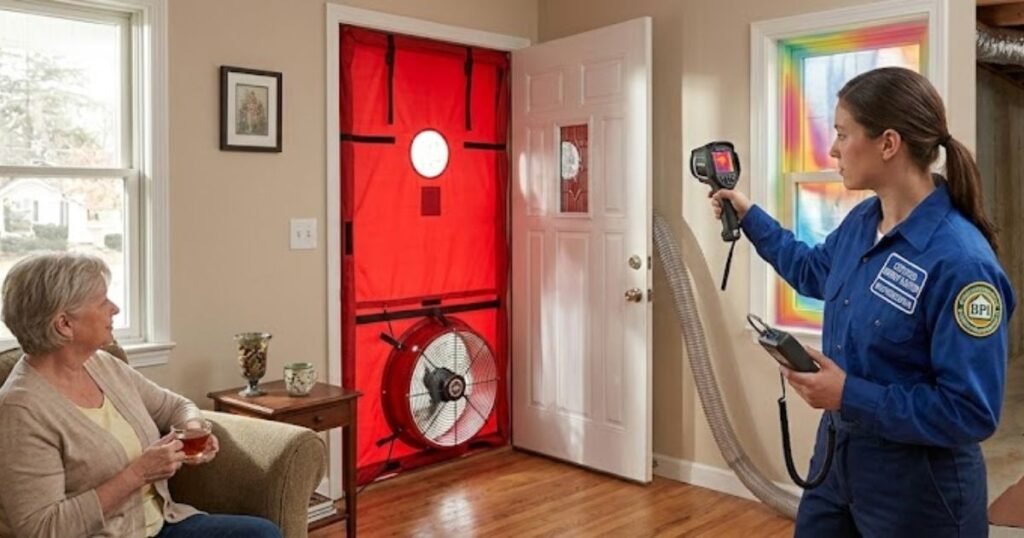
- Home energy audit / inspection. If approved, an auditor will visit to determine which measures will save the most energy.
- Work scheduling & installation. Weatherization measures are scheduled; expect several visits for installation and follow-up safety checks.
- Follow up & education. Agencies usually offer simple energy-saving tips after installation.
Typical wait times: Vary widely from a few weeks (if local funding is strong and you’re prioritized) to many months in high-demand areas. Seniors with documented high energy burden or safety risks may be moved up the list.
READ MORE: Salvation Army Free Car Program (Eligibility & How to Apply)
FAQs
What are the income limits for the Weatherization Assistance Program for seniors?
Income limits vary. The DOE baseline is 200% of the federal poverty level (2026: $31,920 annually for a single person). Some states use LIHEAP/HEAP rules or a percent of state median income, which can raise or lower the dollar cutoff. Check your local WAP or LIHEAP office for the exact limit in your county.
Can seniors on Social Security qualify for weatherization assistance?
Yes. Social Security (SS) counts as income, but many seniors on SS still fall below 200% FPL or meet LIHEAP thresholds. If you receive SSI or HEAP, you may be categorically eligible. Bring your SSA award letter when you apply — it speeds verification.
How does the Weatherization Assistance Program calculate household income?
Programs usually count gross wages, Social Security/SSI, pensions, and unemployment. Some programs allow deductions (e.g., large medical expenses) that reduce countable income. States may use monthly or annual calculations; follow the instructions on your local application.
Do income limits for weatherization assistance change by state?
Yes. States can adopt DOE’s 200% FPL, LIHEAP/HEAP caps (sometimes tied to state median income), or program-specific limits. That’s why a household eligible in one state might not meet another state’s rules. Always confirm with the local WAP office.
How do I apply for weatherization assistance if I’m a senior homeowner?
Call your state housing or energy office or the local community action agency listed on your state’s WAP page. Ask for a weatherization intake packet, gather ID, proof of income (SSA award letter, pay stubs, bank statements), and a utility bill, then submit the application. Request to be placed in a senior priority category if available.
Conclusion
Weatherizing your home can save hundreds of dollars a year in heating and cooling costs. Good news: as a senior with modest income, you likely qualify for the Weatherization Assistance Program. Use the before-you-apply checklist above, gather your paperwork, and reach out to the local weatherization office or Community Action Agency in your county. The upgrades are free and worth the wait. For now, double-check the latest income guidelines on your state’s WAP or LIHEAP website (programs update annually), and mark this page’s date. Then, apply and share this information with others who may benefit. Seniors and disabled households are high priority, so take action today.
Sources: Official program pages from the U.S. Department of Energy and state WAP offices (DOE 2025; NY HCR 2025) provide income rules and guidelines. State agencies should be consulted for exact current limits and application details.