The preservation of safe, sanitary, and functional housing for the aging population in rural America represents a critical intersection of federal policy, social welfare, and economic stability. Within this context, the United States Department of Agriculture (USDA) administers several programs designed to assist very-low-income homeowners, with a particular emphasis on senior citizens aged 62 and older.
The primary vehicle for this support is the Single Family Housing Repair Loans and Grants program, formally known as the Section 504 program. This initiative serves as a vital safety net for rural homeowners whose budgets cannot accommodate the escalating costs of urgent health and safety repairs. By providing low-interest loans and non-repayable grants, the USDA enables seniors to age in place, thereby avoiding the high costs associated with institutionalization and preventing the degradation of the rural housing stock.
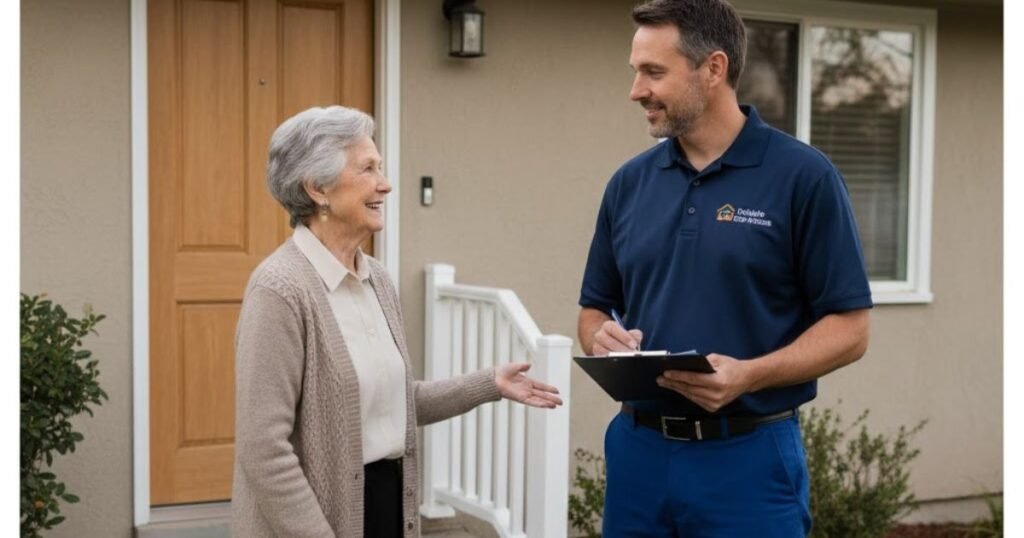
What USDA Grants for Senior
The USDA’s Single-Family Housing Section 504 Home Repair program provides two main types of help:
- 1% Repair Loans — low, fixed-rate loans (term up to 20 years) for very-low-income homeowners in rural areas to repair, improve, or modernize their homes and remove health/safety hazards.
- Grants for Seniors (age 62+) — grants intended only for homeowners age 62 or older who meet the very-low-income rule and can’t repay a loan; grant money is used specifically to remove health and safety hazards.
Why this matters: For many seniors on fixed incomes, a burst pipe, failing roof, or unsafe wiring can quickly become a crisis. USDA’s program is designed to cover those urgent, safety-critical repairs when other credit isn’t an option. (USDA guidance — verified Feb, 2026.)
READ MORE: Does HUD Offer Grants For Senior Citizens?
Who Qualifies for USDA Grants
Eligibility for USDA grants is defined by several strict parameters including age, income, property location, and financial status. These criteria are designed to ensure that the limited federal funds are directed toward those with the greatest need who have no other options for financing.
| Eligibility Category | Requirement Detail |
| Age | Must be 62 years of age or older to qualify for a grant |
| Income | Must be “very-low-income,” typically defined as 50% or less of the Area Median Income (AMI) |
| Residency | Must be the homeowner and occupy the house as a primary residence |
| Location | The property must be located in an eligible rural area as defined by the USDA |
| Financial Status | Must demonstrate an inability to obtain affordable credit from other sources |
One of the most nuanced aspects of eligibility is the income requirement. The USDA does not look solely at gross income; instead, it calculates “adjusted income”. This allows homeowners to subtract certain expenses, such as out-of-pocket medical costs for elderly household members or childcare expenses for younger dependents. This adjustment is vital for seniors because high healthcare costs often consume a significant portion of their fixed income, potentially making them eligible for a grant even if their gross income appears to be slightly above the threshold.
The “rural area” requirement is equally critical. The USDA generally defines rural areas as towns or unincorporated stretches of countryside with 35,000 residents or fewer. However, many areas on the outskirts of metropolitan regions still qualify. Homeowners are encouraged to use the official USDA eligibility map, where they can enter their specific address to receive an immediate determination of whether their property falls within a designated zone.
Typical Grant & Loan Amounts and Limits in USDA Grants
The financial assistance provided by the USDA is capped by lifetime limits and project-specific maximums. According to USDA guidance, these amounts are subject to change based on federal appropriations and policy updates, so verifying current limits with a local office is essential.
| Funding Type | Maximum Lifetime Limit | Interest Rate | Repayment Terms |
| Standard Grant | $10,000 | 0% | Non-repayable (if kept 3 years) |
| Disaster Grant | $15,000 | 0% | Non-repayable (if kept 3 years) |
| Standard Loan | $40,000 | 1% Fixed | Repayable over 20 years |
| Combination | $50,000 | Hybrid | Mix of grant and loan terms |
A key feature of the grant is the three-year occupancy rule. If the homeowner sells the property within three years of receiving the grant, the full amount must be repaid to the government. This rule ensures that the funds are used to help people remain in their homes rather than being used to flip properties or increase the value of a home intended for immediate sale.
The loan component is exceptionally favorable, with a fixed 1% interest rate. For example, a $10,000 loan results in a monthly payment of approximately $45.99. If a senior homeowner needs $20,000 in repairs but can only afford to repay a $10,000 loan, the USDA may provide a $10,000 grant and a $10,000 loan to bridge the gap.
READ MORE: Free Bathroom Remodel for Seniors
What You Can Use USDA Grants Money for
USDA funds are intended to remove health and safety hazards and to repair or modernize modest homes. Typical eligible uses include:
- Replacing a failing roof or rotten structural members
- Repairing/replacing a broken furnace, major plumbing, or electrical that’s a safety hazard
- Replacing a failing septic system or unsafe well components
- Accessibility modifications — ramps, grab bars, widened doors, bathroom conversions to help seniors age in place (when medically necessary)
- Weather-related repairs (in disaster scenarios, special disaster grants may apply)
What’s usually not covered: full luxury remodels, cosmetic-only upgrades, swimming pools, or additions that aren’t connected to health/safety or basic livability.
Step-by-step: How to check eligibility and apply for USDA Grant for Seniors
1) Find your local USDA Rural Development office
Call or search for the USDA Rural Development field office that covers your county. A phone call or short visit is the fastest way to start. Staff there will explain income limits, rural eligibility, and local forms.
2) Pre-qualification & intake
Ask the local office about pre-qualification or an informal intake. Typical forms used include the RD 3550-35 intake form and authorization to release income information.
3) Document Checklist for Homeowners
Gathering the necessary paperwork upfront can significantly expedite the process. The USDA requires comprehensive verification of identity, income, and homeownership.
| Document Category | Items to Include |
| Personal Identity | Government-issued photo ID (driver’s license/passport) and Social Security card |
| Proof of Age | Birth certificate or ID showing the applicant is 62+ (for grants) |
| Income Verification | Last 4 weeks of pay stubs (if working) and most recent benefit statements for Social Security or pensions |
| Tax Records | Last 2 years of signed Federal Income Tax Returns, including all W-2s and 1099s |
| Assets | Last 2 months of statements for all bank accounts |
| Property Proof | Copy of the recorded deed and the most recent property tax assessment |
| Insurance | Evidence of current homeowner’s hazard or flood insurance |
| Project Bids | Detailed, itemized quotes from licensed contractors for the specific repairs |
Applicants should be aware of strict timelines once they start the process. If the USDA requests additional information or missing documents, the homeowner typically has only 15 days to provide personal information and 30 days to provide contractor bids before the application is withdrawn from consideration.
4) Intake → application → inspection
After intake, the RD office may ask for a formal application packet, conduct a property inspection to document needed repairs, and request contractor estimates. The office confirms rural eligibility and income limits.
5) Approval & contractor selection
If approved, you’ll be given an award or a loan/grant offer. Your local RD specialist will explain whether funds are paid directly to contractors or suppliers, and whether there are any local packagers/nonprofit partners who can help manage the process.
Timeline:
Depends on demand and local staffing — prepare for several weeks to a few months from intake to funds being deployed. Disaster grants may move faster but also depend on federal declarations and local capacity. (Local RD office can give current estimates.)
READ MORE: Free Roof Replacement Grants for Seniors — Help & How to Apply
Other USDA programs & alternatives seniors should consider
The Section 504 program is the most prominent, but it is not the only option for rural homeowners. Depending on the situation, other federal, state, or nonprofit programs may be more suitable or can be used in conjunction with USDA funds.
Rural Disaster Home Repair Grants
For homeowners whose primary residence was damaged by a natural disaster since 2022, the USDA offers specialized grants. These can provide up to $40,675 in some pilot areas or $15,000 in standard declared disaster zones. These funds can cover repair costs incurred even before the application was filed, as well as site preparation for manufactured homes.
Weatherization Assistance Program (WAP)
Administered by the Department of Energy, this program provides free energy-efficiency upgrades. Seniors are given priority for services like attic insulation, air sealing, and furnace tuning. This is an excellent companion to a USDA grant, as it helps lower monthly utility bills while the USDA focuses on structural hazards.
HUD and Nonprofit Programs
- HUD Title 1 Loans: These can be used for smaller repairs and do not require the home to be in a rural area.
- FHA 203(k): This program allows homeowners to finance up to $35,000 into their mortgage for rehabilitation work.
- Rebuilding Together: A national nonprofit that uses volunteers to provide free home modifications for low-income seniors and veterans.
Habitat for Humanity: Many local affiliates have home preservation programs that offer sliding-scale fees for essential repairs.
Cost estimate ranges & real price examples
Contractor pricing in 2026 reflects significant increases in labor and materials. When planning a USDA project, it is helpful to have a realistic understanding of national average costs for the most common senior home modifications.
| Repair/Modification | 2026 Average Cost Range | Key Factors |
| Roof Replacement | $5,870 – $13,224 | Based on standard 1,500 sq. ft. asphalt shingle roof |
| Furnace Replacement | $3,500 – $7,500 | Varies by fuel type (gas vs. electric) and efficiency rating |
| Wheelchair Ramp | $1,121 – $3,590 | Cost depends on length and material (wood vs. aluminum) |
| Walk-in Shower | $6,000 – $12,000 | Includes removing existing tub and installing safety features |
| Grab Bar Install | $150 – $500 | Pricing for 2-3 professionally installed bars including labor |
For example, a senior living in an older home with an aging roof and a failing furnace might find that the total cost exceeds $15,000. In this scenario, they might apply for the $10,000 USDA grant to cover the majority of the roof and a 1% loan to cover the furnace replacement. Because the loan is spread over 20 years at such a low interest rate, the monthly payment remains affordable on a Social Security budget.
READ MORE: Can Seniors Get Free Window Replacement Grants
FAQs
Who qualifies for USDA home repair grants?
Very-low-income homeowners in eligible rural areas qualify for USDA repair help; grants are reserved for those age 62 or older who cannot afford to repay a 1% loan (USDA guidance — verified Feb 24, 2026).
How much money can seniors get from USDA grants?
Under typical Section 504 rules, seniors may receive grants of up to $10,000 (lifetime cap) and loans up to $40,000; combined assistance often reaches $50,000 in standard settings (caps vary in disaster or pilot programs). (USDA guidance — verified Feb 24, 2026.)
What repairs are covered by USDA senior grants?
Grants must be used to remove health and safety hazards — e.g., failing roof, unsafe wiring, broken HVAC, failing septic/well systems, and accessibility modifications. Cosmetic upgrades normally don’t qualify.
How do I apply for a USDA Section 504 grant?
Contact your local USDA Rural Development field office for a pre-qualification and intake (forms such as RD 3550-35). Bring ID, income proof, property info, and contractor estimates. The RD office will guide you through inspection, application, and approval steps.
Are USDA grants repaid if I sell my house?
Grants typically do not require repayment unless the house is sold or the owner moves within a certain period (local requirements apply — verify with your RD office). Check the specific terms on your grant paperwork.
Sources & how this was verified
All program rules, income/area eligibility, dollar caps, and process points above were checked against official USDA Rural Development program pages and recent USDA materials. Where I name caps and age rules I label them as USDA guidance (verified Feb 24, 2026) below.
- USDA — Single Family Housing: Repair Loans & Grants (Section 504) — USDA program overview and intake guidance. (USDA guidance — verified Feb 24, 2026).
- USDA — Single Family Housing Repair Loans and Grants (program factsheet / pdf) — details on eligibility, loan/grant amounts, and rules (includes the 1% loan and $10,000 grant guidance). (USDA guidance — verified Feb 24, 2026).
- USDA GovDelivery bulletin (USDA Rural Development summary, Jan 22, 2026) — summarized caps and repayment note for grants. (Verified Feb 24, 2026).
- USDA — Single Family Housing Rural Disaster Home Repair Grants — separate disaster grant program and example caps. (Verified Feb 24, 2026).
- USDA newsroom / success stories and state director quotes (used to paraphrase expert comments about program priorities and disaster responses). (Verified Feb 24, 2026).