For many Americans, the arrival of the “golden years” isn’t just about slowing down it’s about finally having the time to see the wonders we’ve only ever viewed on postcards or television screens. Whether it’s the misty mornings in the Great Smoky Mountains, the painted sunsets of the Grand Canyon, or the quiet history preserved at a local colonial battlefield, our federal lands offer a lifetime of exploration.
The Senior Lifetime National Park Pass is perhaps the greatest gift the federal government offers to older adults. It is part of the “America the Beautiful – National Parks and Federal Recreational Lands Pass” series, and it acts as a permanent key to over 2,000 federal recreation sites across the country.
If you are looking for an affordable way to travel, stay active, and connect with nature, understanding the national park senior pass is your first step. In this guide, we will walk through everything you need to know from the senior pass cost to the tiny details that help you make the most of your investment. Lets deep dive into “Senior Lifetime National Park Pass: Cost, Eligibility, & How to Apply”
READ MORE: Best OTC Hearing Aids for Tinnitus (2026) | Affordable & Effective Picks
What Is the Senior Lifetime National Park Pass?
The Senior Lifetime National Park Pass is a specialized permit issued by the federal government to U.S. citizens and permanent residents who are 62 years of age or older. While many people call it the “National Park Pass,” it actually covers much more than just the 63 major National Parks.
This pass is part of the interagency America the Beautiful senior pass program. When you hold this card, you aren’t just a visitor; you are a valued guest of the American public land system. The pass covers “standard amenity fees.” In plain English, this means the entrance fees you would normally pay at the gate are waived for you and, in many cases, the people traveling with you in your vehicle.
It is valid at sites managed by six different federal agencies:
- National Park Service (NPS)
- U.S. Forest Service (USFS)
- U.S. Fish and Wildlife Service (FWS)
- Bureau of Land Management (BLM)
- Bureau of Reclamation
- U.S. Army Corps of Engineers
Because it is a “lifetime” pass, once you buy it, you never have to worry about renewal or price increases again. It is yours for as long as you live, making it one of the best values in the travel world.
READ MORE: LiDAR ECOVACS Goat Lawn Mowers for Seniors: Review, Comparison & Top Picks
Senior Lifetime National Park Pass: Who Is Eligible?
The requirements for the national park pass for seniors are straightforward, but they are strictly enforced to ensure the program remains available for those it was intended to serve.
Age Requirement
You must be at least 62 years old on the day you apply. If you are 61 and turning 62 next month, you’ll need to wait until your birthday to submit your application or visit a park office.
Citizenship and Residency
The pass is available to:
- U.S. Citizens
- U.S. Permanent Residents (Green Card holders)
Necessary Documentation
To prove your eligibility, you will need to provide a valid form of identification that shows your birth date and your status as a citizen or resident. Accepted documents include:
- A valid U.S. State-issued Driver’s License
- A U.S. Passport
- A Birth Certificate
- A Permanent Resident Card (Green Card)
National Park Pass How Much Does It Cost?
Price is often the first question people ask, and for good reason seniors on a fixed income need to know their money is being spent wisely. There are currently two versions of the senior pass cost structure:
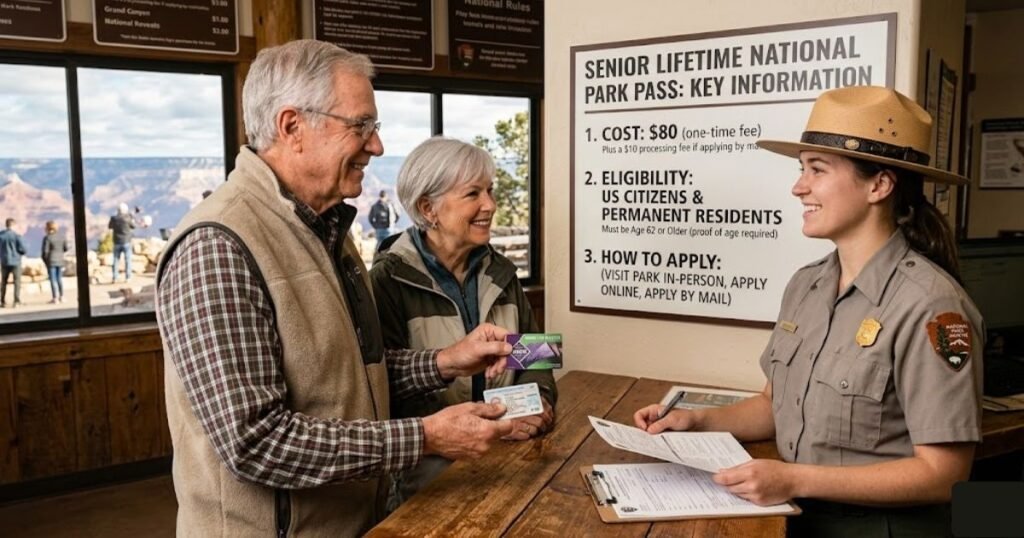
- The Senior Lifetime Pass: This costs $80. This is a one-time payment. Once you have the physical card in your hand, you are set for life.
- The Senior Annual Pass: This costs $20. This pass is valid for exactly one year from the month of purchase.
Why choose one over the other?
Most people choose the Senior Lifetime National Park Pass because it pays for itself very quickly. For example, the entrance fee for a single vehicle at Yellowstone or Yosemite is typically $35. If you visit just three major parks in your entire life, the lifetime pass has already saved you money.
However, if you are unsure how much you will travel this year, you can opt for the $20 annual pass. A wonderful feature of this program is that the annual pass can be upgraded. If you buy four annual passes over four years, you can trade them in for a Lifetime Pass at no additional cost (essentially “paying as you go” toward the $80 total).
Note: If you purchase your pass online or via mail, there is an additional $10 processing fee. To avoid this fee, you can buy the pass in person at a participating federal recreation site.
READ MORE: Robotic Vacuum for Seniors: Best Features, Comparison, Reviews, and Buying Guide
National Park Pass What Does the Pass Cover?
One of the biggest misconceptions about the lifetime national park pass for seniors is that it only works at “National Parks” like Zion or the Everglades. In reality, it opens the doors to thousands of locations.
Entrance and Amenity Fees
At sites that charge a “per vehicle” fee, the pass covers the pass owner and all passengers in a single, private, non-commercial vehicle. At sites that charge a “per person” fee, the pass covers the pass owner plus three additional adults (children under 16 are usually free anyway).
Expanded Amenity Discounts
This is where the pass really shines for seniors who love to camp or boat. The pass often provides a 50% discount on “expanded amenity fees.” This can include:
- Camping: Many federal campgrounds offer half-off nightly rates for senior pass holders.
- Swimming: Fees for developed swimming areas.
- Boat Launching: Fees for using ramps at federal lakes and rivers.
- Guided Tours: At some locations, you may get a discount on ranger-led tours (though this varies by site).
Where You Can Use It:
- National Parks: The “crown jewels” like Acadia, Olympic, and Arches.
- National Forests: Perfect for scenic drives and picnic areas.
- Wildlife Refuges: Great for birdwatching and photography.
- National Monuments: Historical and cultural sites like Statue of Liberty or Little Bighorn.
- Bureau of Land Management Lands: Vast landscapes in the American West.
READ MORE: Best Smart TV for Seniors in 2026: Easy to Use & Large Screen Picks
How to Get the Senior Lifetime Pass
Getting your hands on a pass is a simple process. You can choose the method that is most convenient for your lifestyle.
Step 1: Check Your Eligibility
Ensure you have your ID ready and that you meet the 62+ age requirement.
Step 2: Choose Your Method
- In-Person (Recommended): This is the fastest way. You walk into a federal recreation site (like a National Park entrance station or a Forest Service office), show your ID, pay your $80, and walk out with your pass. There is no processing fee for in-person purchases.
- Online: You can visit the official USGS (U.S. Geological Survey) Store online. You will need to upload a digital copy of your ID. Keep in mind there is a $10 processing fee and it will take a few weeks for the physical card to arrive in the mail.
- By Mail: You can download an application from the USGS website, print it, and mail it in with a copy of your ID and a check or credit card information. This also carries a $10 processing fee.
Step 3: Keep It Safe
Once you receive your card, sign the back immediately. It is non-transferable, meaning you cannot lend it to a friend or family member.
Senior Lifetime Pass vs. Senior Annual Pass
Deciding which version to buy depends on your travel habits. Here is a quick comparison to help you decide:
| Feature | Senior Lifetime Pass | Senior Annual Pass |
| Cost | $80 (one-time) | $20 (per year) |
| Duration | For your entire life | 12 months |
| Best For | Frequent travelers & “bucket list” explorers | Occasional visitors or those testing the waters |
| Upgrade Option | N/A | Can be traded in toward a Lifetime Pass |
| Value | Pays for itself in ~2.5 visits | Great for a single road trip |
For most seniors, the Senior Lifetime National Park Pass is the winner. It removes the “should we go?” hesitation because the entrance is already paid for. It encourages you to take that Sunday drive through a National Forest or stop at a historic site you’ve passed a dozen times.
READ MORE: Best Wireless TV Headphones for Seniors (2026) – Clear Sound & Easy Setup
Is the Senior Lifetime Pass Worth It?
If you are a senior living in the United States, the answer is an overwhelming yes.
Think of the pass as a membership to the world’s largest and most beautiful outdoor gym, museum, and cathedral combined. Beyond the financial savings, the pass encourages a healthy, active lifestyle. Walking the trails of a National Park or even just enjoying a picnic by a federally managed lake has proven benefits for mental health, cardiovascular wellness, and stress reduction.
Furthermore, it is a way to create memories with grandchildren. While the pass is for you, it usually covers everyone in your car. Being the “cool grandparent” who can get the whole family into the Grand Canyon for free is a pretty great feeling.
Even if you only plan to visit one park per year, the 50% discount on camping and other amenities can save you hundreds of dollars over a decade. It is a one-time investment in your own quality of life.
Common Mistakes to Avoid
To make sure your trip goes smoothly, avoid these common pitfalls:
- Forgetting Your ID: Even if you have the pass, many rangers are required to ask for a photo ID to verify that you are the person named on the back of the card. Always keep them together.
- Assuming Everything is Free: The pass covers entrance and standard fees. It does not usually cover “concessionaire” fees. For example, if a private company runs a boat tour or a gift shop inside the park, your pass likely won’t provide a discount there.
- Not Checking for “Timed Entry”: Some very popular parks (like Arches or Rocky Mountain) now require a “Timed Entry Reservation” during peak months. Having a pass does not exempt you from needing a reservation. Always check the park’s official website (nps.gov) before you leave.
- Losing the Pass: Unlike a credit card, you can’t just “cancel and replace” a lost pass easily. If you lose it, you will likely have to buy a new one. Keep it in a dedicated spot in your wallet or glove box.
- Confusing it with the Access Pass: If you have a permanent disability, you may be eligible for the Access Pass, which is free. Do not buy a Senior Pass until you check if you qualify for the Access Pass first!
READ MORE: Best Wireless Earbuds for Senior Runners: 2026 Top Picks
Helpful Tips for Seniors
Traveling as an older adult comes with its own set of considerations. Here are some tips to make your “America the Beautiful” experience even better:
- Ask for the “Access Guide”: Most National Parks offer accessibility guides for those with mobility challenges. Many trails are paved or “boardwalked” to accommodate wheelchairs and walkers.
- Visit During the “Shoulder Seasons”: To avoid the heat and the massive crowds, try visiting parks in the late spring or early fall. The weather is milder, and the atmosphere is much more peaceful.
- Talk to the Rangers: Park rangers love to share their knowledge. Ask them, “What is a good spot for a senior to enjoy the view without a long hike?” They often know the best hidden gems that are easily accessible by car.
- Use the 50% Camping Discount: If you enjoy RVing or tent camping, prioritize federal campgrounds over private ones. Your Senior Pass makes federal sites incredibly affordable often as low as $10 or $15 a night.
- Store It Safely: Some people find that the plastic cards can become brittle over years of heat in a car. Keep yours in your wallet rather than leaving it on the dashboard.
Conclusion
The Senior Lifetime National Park Pass is more than just a piece of plastic; it’s an invitation to explore the heritage and natural splendor of the United States. For a one-time cost of $80, you gain a lifetime of access to the most breathtaking landscapes on earth.
Whether you are planning a cross-country RV trek or just want to enjoy the local wildlife refuge on the weekends, this pass is a practical, budget-friendly tool for every American senior. We encourage you to gather your documents, head to the nearest park office or the online USGS store, and claim your pass. The trails are waiting, the history is calling, and the best part of your journey may be just around the corner.
READ MORE: Salvation Army Free Car Program (Eligibility & How to Apply)
Frequently Asked Questions
How much is a senior lifetime national park pass?
The Senior Lifetime National Park Pass costs a one-time fee of $80. If you purchase it online or through the mail, there is an additional $10 processing fee, bringing the total to $90. If you buy it in person at a federal recreation site, there is no processing fee.
Who qualifies for the senior national park pass?
To qualify, you must be a U.S. citizen or permanent resident and be at least 62 years of age. You will need to provide proof of age and residency/citizenship (such as a driver’s license or passport) when you apply.
What is the difference between the senior annual pass and lifetime pass?
The Senior Annual Pass costs $20 and is valid for one year. The Senior Lifetime Pass costs $80 and never expires. The lifetime pass is generally the better value for frequent travelers, while the annual pass is a good entry-level option that can later be upgraded.
Does the senior national park pass cover camping fees?
Yes, in many cases! At many federal recreation sites, the pass provides a 50% discount on expanded amenity fees, which includes most federal campgrounds. However, it does not cover fees for private campgrounds or “concessionaire-managed” sites within the parks.
Where can I buy the America the Beautiful senior pass?
You can buy the pass in person at most federal recreation sites that charge an entrance fee. You can also buy it online via the official USGS Store or by mail using an official application form. Buying in person is the fastest and cheapest way as it avoids the $10 processing fee.