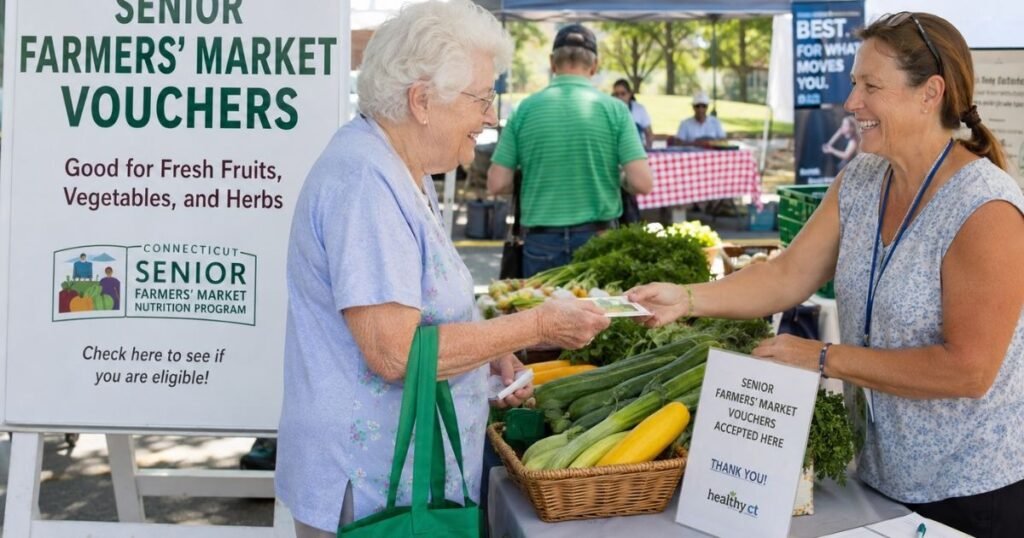
For many older adults, food costs can add up quickly, especially when trying to eat well on a fixed income. Fresh fruits, vegetables, herbs, and other healthy foods are not always easy to fit into a monthly budget. That is one reason senior farmers market vouchers can matter so much. The USDA’s Senior Farmers Market Nutrition Program is designed to help low-income seniors buy locally grown fruits, vegetables, honey, and herbs from participating farmers markets, roadside stands, and community-supported agriculture programs.
That help can be especially valuable at a time when food affordability remains a concern for many households. USDA’s Economic Research Service reported that 13.7% of U.S. households were food insecure at some point in 2024, which is one reason programs that improve access to fresh food continue to be important. Lets deep dive into ‘Senior Farmers Market Vouchers: Eligibility, Benefits, and How to Apply”
What Are Senior Farmers Market Vouchers?
At its core, the USDA farmers market program is a federal-state partnership created to accomplish two wonderful goals at once: providing healthy food assistance for seniors and supporting local agricultural communities. Funded primarily by the United States Department of Agriculture (USDA) through the Farm Bill, grants are awarded to states, U.S. territories, and federally recognized Indian Tribal Governments. These entities then work closely with local area agencies on aging, health departments, or agricultural extensions to distribute benefits directly to residents.
For many years, this program operated using physical paper booklets filled with farmers market coupons for seniors. An older adult would walk up to a farm stand, tear out a coupon worth a specific dollar amount (usually $2 or $5), and hand it over to the grower.
While paper coupons are still used in a few select regions, the program has undergone a massive, modern transformation. Most states now issue these benefits electronically. Depending on where you live, you might receive a reusable plastic card containing an embedded QR code, or you might be directed to use a secure smartphone application like the Homegrown Benefits app. When you buy your produce, the farmer simply scans your card or phone screen, and the exact cost is deducted from your seasonal balance.
No matter whether your local program uses paper vouchers or electronic smart cards, the primary objective remains unchanged: providing vital food vouchers for older adults so they can enjoy the abundant health benefits of fresh, local agriculture.
READ MORE: $3000 Senior Assistance Program Application
How the Senior Farmers Market Vouchers Works
While each state or tribal government administers its own version of the USDA farmers market program, the broad mechanics follow a highly predictable seasonal pattern. Because farmers markets operate primarily when crops are actively growing and harvesting, this program is distinctly seasonal.
The journey generally follows five basic phases:
- Eligibility Check: You review the current age and income requirements for your specific county or state to see if you qualify.
- Application Submission: You or your caregiver submit a formal application during the local enrollment period, which typically opens in the spring.
- Benefit Distribution: Once approved, you are issued your seasonal allotment—either via a physical booklet of coupons, a plastic QR code card, or a digital app profile.
- Market Shopping: You visit an authorized, participating local farmers market, roadside stand, or Community Supported Agriculture (CSA) program.
- Redemption: You choose your eligible items and pay using your program benefits before the designated autumn expiration deadline.
Because funding for this program is limited by federal grant caps, benefits are distributed on a strictly first-come, first-served basis. This makes understanding the timeline and rules vital to securing your spot before local program capacities are exhausted.
READ MORE: How to Apply for SNAP Benefits as a Low-Income Older Adult
Who Can Qualify for Senior Farmers Market Vouchers?
To ensure these low-income senior nutrition benefits reach the households that need them most, the federal government establishes baseline eligibility boundaries. However, local state agencies have some flexibility in how they verify these criteria, so always treat these as a general framework and confirm details locally.
Generally speaking, three main criteria dictate whether you qualify for senior farmers market vouchers:
1. The Age Requirement
To receive these benefits, an applicant must be at least 60 years of age on the exact day they submit their application. In some specific states, the wording allows individuals who will turn 60 by the end of the current calendar year to apply, but the baseline rule across the country is reaching your 60th birthday.
2. The Income Limits
The program is specifically designed to provide fresh produce help for seniors who have a limited or fixed income. To qualify, your total household income before taxes (gross income) cannot exceed 185% of the Federal Poverty Guidelines.
Because these guidelines are adjusted every single year to account for inflation, the income thresholds fluctuate. For the current 2026 program season, the income limits across the 48 contiguous United States, Washington D.C., and U.S. territories are structured as follows:
| Household Size | Maximum Annual Income | Maximum Monthly Income | Maximum Weekly Income |
| 1 Person | $29,526 | $2,461 | $568 |
| 2 People | $40,034 | $3,337 | $770 |
| 3 People | $50,542 | $4,212 | $972 |
| 4 People | $61,050 | $5,088 | $1,175 |
| Each Add’l Member | + $10,508 | + $876 | + $203 |
Note: Income limits are slightly higher for residents of Alaska and Hawaii due to the elevated baseline cost of living in those states.
3. Categorical Eligibility (Pre-Qualification)
In many states, if you are already enrolled in specific public assistance programs, the application process is streamlined because you have already proven your income level is below the program’s threshold. You still must fill out the program application, but you are often fast-tracked if you already receive:
- Supplemental Nutrition Assistance Program (SNAP / Food Stamps)
- Supplemental Security Income (SSI)
- Medicaid
- The Commodity Supplemental Food Program (CSFP / Food for Seniors)
READ MORE: Low Income Home Energy Assistance Program: LIHEAP Benefits and How to Apply
What Can Seniors Buy With the Senior Farmers Market Vouchers?
One of the most important aspects of utilizing this senior food assistance resource correctly is knowing exactly what items are approved. The USDA rules state that all items purchased must be locally grown, unprocessed agricultural commodities. The word “local” usually means grown within your home state or an immediately neighboring county just across the state line.
Here is a handy breakdown of what you can and cannot buy at the market with your benefits:
Approved Foods Include:
- Fresh Fruits: Apples, berries, peaches, melons, plums, pears, cherries, and any other fruit native to your regional growing climate.
- Fresh Vegetables: Tomatoes, sweet corn, leafy greens, squash, broccoli, peppers, potatoes, carrots, onions, and green beans.
- Fresh-Cut Herbs: Basil, cilantro, parsley, dill, mint, rosemary, and thyme.
- Raw Honey: Pure, locally harvested honey from local apiaries (allowed by federal rules, though a tiny handful of states opt out, so double-check locally).
Non-Eligible Foods Include:
- Processed or Dried Items: Dried fruits, fruit leathers, roasted nuts, or dried herbs.
- Baked Goods & Prepared Foods: Pies, breads, cookies, jams, jellies, pickles, cider, or hot meals sold at the market.
- Animal Products: Eggs, milk, cheese, butter, yogurt, meats, poultry, or seafood.
- Out-of-State Prohibited Items: You cannot use your vouchers to buy tropical items that cannot grow in your region, such as bananas, pineapples, or oranges at a Northern farmers market.
READ MORE: Free Food for Seniors: Where to Find Help and Assistance
Where Seniors Can Use the Senior Farmers Market Vouchers
Your senior farmers market vouchers are not accepted at traditional commercial supermarkets, big-box grocery stores, or convenience stores. Instead, they are intended to be spent directly within the local food system.
You can redeem your benefits at:
- Authorized Farmers Markets: Organized community markets where multiple regional growers gather to sell directly to the public.
- Approved Roadside Stands: Smaller, permanent or semi-permanent individual farm stands operated by a single certified grower.
- Community Supported Agriculture (CSA) Programs: Programs where you sign up to receive a regular “share” or box of fresh produce directly from a local farm throughout the season.
How to Spot an Approved Vendor
Not every single vendor at a farmers market is authorized to accept these vouchers. To ensure the farmer gets reimbursed by the government, they must complete a formal training and certification process.
Look for bright, clearly posted signs or posters at the vendor’s booth that say something like “SFMNP Benefits Accepted Here” or feature the logo of your state’s Department of Agriculture or Department on Aging. If you do not see a sign, simply ask the vendor directly: “Do you accept the senior farmers market electronic cards or coupons?” They are incredibly accustomed to this question and will gladly guide you.
READ MORE: Kohl’s Senior Citizens Discount: Eligibility, Savings, and How It Works
How to Apply for Senior Farmers Market Vouchers?
Because each region manages its own distribution allocation, the exact process can differ depending on your zip code. However, following a systematic approach will ensure you do not miss out on your benefits.
1.Locate Your Local Lead Agency:
Identify the specific organization handling the program in your county. This is typically your local Area Agency on Aging (AAA), your county Health Department, or your state Department of Agriculture. You can find this out by calling the Eldercare Locator at 1-800-677-1116 or visiting your state government’s official website.
2.Verify the Application Window:
Mark your calendar with your local program dates. Enrollment windows vary widely: some states open applications as early as April, while others launch in June. For example, in Ohio, applications close in late May, whereas Maryland opens applications at the start of June.
3.Gather Your Required Paperwork:
Collect the documents needed to verify your age, identity, and physical residency. Having these organized beforehand prevents delays that could cause you to miss the first-come, first-served funding allocation.
4.Complete and Submit the Application:
Fill out the form completely. Many states now offer convenient online shopper portals where you or a caregiver can apply digitally in minutes. If you prefer paper, you can request an application be mailed to you or visit a local senior center for in-person assistance.
5.Receive and Activate Your Benefits:
Wait for approval notifications. If you applied online, a confirmation pop-up or email will arrive swiftly. Your physical smart card or coupon booklet will either be mailed directly to your home address within 4 to 6 weeks or made available for pick-up at a designated local senior center.
6.Spend Your Funds Before the Fall Deadline:
Take your card, phone app, or coupons to an authorized market. Ensure you spend the entire balance before your state’s autumn expiration date which is commonly November 30 across most jurisdictions. Unspent balances do not roll over to the next year.
Documents Seniors May Need for Farmers Market Vouchers
When you fill out your application, you will need to verify that you meet the program guidelines. While some states allow you to “self-attest” (meaning you sign a paper declaring under penalty of law that your statements are true), many require physical or digital documentation.
Keep a folder with these common documents handy:
- Proof of Age and Identity: A valid driver’s license, state-issued identification card, birth certificate, or passport.
- Proof of Physical Address: A recent utility bill, bank statement, or official piece of mail showing your name and your current residential address within the participating county. (P.O. Boxes are usually not accepted as proof of residency).
- Proof of Household Income: Recent tax returns, Social Security benefit award letters, pension statements, or pay stubs for every single earning adult living under your roof.
- Existing Program Cards: If you plan to pre-qualify using categorical eligibility, have your SNAP EBT card, Medicaid card, or SSI verification documents ready to show.
READ MORE: Senior Lifetime National Park Pass: Cost, Eligibility, & How to Apply
Tips for Getting the Most Value From Your Vouchers
Once you have your farmers market coupons for seniors or your electronic benefit card in hand, it is time for the fun part: heading out to the market! To maximize your spending power and get the absolute best food for your kitchen, keep these expert shopping tips in mind:
Shop Early in the Morning
Farmers markets are famous for their lively, bustling environments, and the best items go quickly. Chefs, restaurant owners, and enthusiastic locals often arrive right when the market opens. By shopping early, you get first pick of the most pristine berries, the freshest greens, and the rarest heirloom tomatoes. Plus, morning temperatures are much cooler and more comfortable for walking.
Chat With the Farmers
The people standing behind the tables grew the food themselves—they are an absolute wealth of knowledge! Do not hesitate to ask them questions like:
- “Which of these varieties is the sweetest?”
- “How do you recommend cooking this specific squash?”
- “Was this picked this morning?”
Building a friendly relationship with local growers makes shopping a joyful community experience.
Buy What Is in Peak Season
Produce is cheapest and most flavorful when it is naturally in season. In late spring, focus on strawberries, spinach, peas, and radishes. In mid-summer, shift your focus to sweet corn, juicy tomatoes, peaches, and peppers. By late autumn, maximize your remaining funds on storage-friendly crops like apples, pumpkins, sweet potatoes, and winter squash.
Understand the Math for Electronic Benefits
If your state uses the modern electronic card system (like the Homegrown Benefits system), your funds can be spent down to the exact penny, just like a standard debit card. If you buy $4.32 worth of zucchini, exactly $4.32 is deducted from your balance.
However, if your state still uses paper coupons, farmers cannot give you cash back as change. If you use a $5 paper coupon on a $4 bundle of carrots, you lose that remaining dollar. To maximize paper coupons, always try to bundle items together to hit an even dollar amount.
Focus on Shelf-Life and Proper Storage
To prevent food waste, balance your basket between items that must be eaten immediately (like ripe berries or delicate peaches) and hearty items that can sit happily on your counter or in your pantry for weeks (like onions, potatoes, garlic, and winter squash). When you get home, wash your berries only right before you eat them, as moisture triggers mold growth in the refrigerator.
READ MORE: Salvation Army Free Car Program (Eligibility & How to Apply)
Common Mistakes to Avoid
Many seniors miss out on benefits because of small, avoidable mistakes. Watch out for these:
- Missing the application deadline
- Bringing the wrong documents
- Assuming every market accepts vouchers
- Forgetting to check the expiration date
- Not asking questions when rules are unclear
Since local agencies administer the program, the details can differ from place to place. A quick phone call before applying or shopping can prevent a lot of frustration.
Are Senior Farmers Market Vouchers the Same in Every State?
Because the SFMNP is a state-administered program, there is considerable variation across geographical borders. While the foundational federal rule states that participants must be low-income and at least 60 years old, the specific financial payout and distribution methods depend heavily on local funding.
The total seasonal amount allotted to each senior varies from state to state:
- Ohio: Eligible seniors receive a total seasonal benefit of $50, distributed digitally or via card.
- Maryland: Older adults are provided a one-time annual benefit card loaded with $35.
- Louisiana: Qualified individuals receive a food benefits card loaded with $30 for the season.
Furthermore, state growing seasons differ dramatically. A program in Maine or Wisconsin might only run from June through October, while a program in California, Florida, or Texas might feature a significantly longer redemption timeline due to warmer agricultural climates. Always reach out to your local senior services department to get the exact rules governing your specific neighborhood.
The Senior Farmers’ Market Nutrition Program does much more than save money at the register—it creates a powerful win-win that strengthens the health of older adults and boosts local agriculture.
| Benefits for Seniors | Benefits for Farmers & Communities |
| Better Health: Access to fresh, nutrient-dense produce that reduces chronic disease risks. | Direct Income: Financial support goes straight into the pockets of neighborhood growers. |
| Budget Relief: Stretches limited, fixed incomes further. | Economic Boost: Keeps agricultural dollars circulating entirely within the local community. |
| Social Connection: Encourages seniors to get outside, visit the market, and combat isolation. | Sustainability: Supports family-owned farms and helps preserve regional green spaces. |
READ MORE: Best Smart TV for Seniors in 2026: Easy to Use & Large Screen Picks
What to Do If a Senior Is Denied by Mistake
If you or your loved one submits an application and receives a denial letter, do not panic or feel discouraged. Mistakes happen—paperwork gets misplaced, numbers are occasionally misread, or an entry field might have been accidentally skipped.
Take these immediate steps to resolve the issue:
- Read the Denial Letter Thoroughly: The agency is legally required to provide a written explanation stating exactly why the application was turned down (e.g., income over the limit, missing proof of address, outside the county).
- Contact the Local Program Admin: Call the phone number listed on the notice. Speak with a program representative in a calm, friendly manner. Ask them to review your file: “I noticed I was denied due to missing documents, but I have my Social Security letter right here. Can I resubmit this to correct my file?”
- File an Official Appeal: Every state must maintain a formal fair hearing process for the SFMNP. If you genuinely meet the criteria and believe an administrative error occurred, you have the right to request a hearing to have your eligibility re-evaluated.
Final Thoughts
Your health is an invaluable asset, and eating fresh, wholesome food is one of the best ways to protect it as you age. The senior farmers market vouchers program is a dignified, community-centered resource designed to make healthy eating accessible to everyone, regardless of their financial circumstances.
If you are 60 or older and meet the income guidelines, or if you are looking out for an elderly parent or neighbor, please do not let this opportunity pass you by. Reach out to your local Area Agency on Aging, your community senior center, or your state’s Department of Agriculture today. Find out exactly when the current application window opens, get enrolled early, and look forward to a vibrant season filled with delicious, fresh, locally grown meals!
Frequently Asked Questions (FAQ)
What are senior farmers market vouchers used for?
Senior farmers market vouchers are used to buy approved fresh foods from participating farmers markets, roadside stands, and community-supported agriculture programs. USDA says the program focuses on locally grown fruits, vegetables, honey, and herbs.
Who qualifies for senior farmers market vouchers?
USDA generally says eligible seniors are at least 60 years old and have household income at or below 185% of the federal poverty income guidelines. Local rules may also affect eligibility.
Where can seniors use farmers market vouchers?
They are usually used at participating farmers markets, roadside stands, and approved community-supported agriculture programs. It is smart to confirm participation before shopping.
What foods can be bought with senior farmers market vouchers?
Approved items usually include locally grown fruits, vegetables, honey, and herbs. Exact rules can vary by location.
How do I apply for senior farmers market vouchers in my area?
Start by contacting your state, territory, or Tribal agency that administers the program. USDA says local agencies can explain eligibility, application steps, and how to apply.