Millions of American retirees are “house rich but cash poor.” Their home may be worth $400,000 or more, yet their monthly income from Social Security and savings barely covers groceries, prescriptions, and utility bills. It’s a frustrating position: the wealth is there, it’s just locked inside four walls.
A reverse mortgage is one tool that can unlock that equity without requiring you to sell your home or take on a monthly payment. For some retirees, it’s a genuine lifeline that improves cash flow and peace of mind. For others, it’s an expensive mistake that shrinks the inheritance they hoped to leave behind.
This guide walks through the reverse mortgage pros and cons for retirees in plain, honest language, no sales pitch, no scare tactics. By the end, you’ll understand how these loans work, what they cost, who they help, and how to compare them against alternatives before you sign anything. Lets deep dive into “Reverse Mortgage Pros and Cons for Retirees: USA 2026 Guide”
READ MORE: Home Equity Line of Credit vs Reverse Mortgage
What Is a Reverse Mortgage?
A reverse mortgage is a loan that lets homeowners age 62 and older convert part of their home equity into cash without selling the home or making monthly mortgage payments. Instead of you paying the lender, the lender pays you (as a lump sum, monthly payments, a line of credit, or some combination). The loan balance grows over time as interest and fees accrue, and it’s repaid when you sell the home, move out permanently, or pass away.
This is the opposite of a traditional “forward” mortgage, where you borrow money upfront and steadily pay down the balance over the years. With a reverse mortgage, the balance moves in the other direction it grows, and your home equity shrinks.
There are three main types:
- FHA-insured Home Equity Conversion Mortgage (HECM): The most common type, backed by the federal government through the Federal Housing Administration (FHA) and regulated by the U.S. Department of Housing and Urban Development (HUD). Over 90% of reverse mortgages in the U.S. are HECMs.
- Proprietary (jumbo) reverse mortgages: Private loans offered by individual lenders, typically for higher-value homes that exceed the FHA’s lending limit. These aren’t federally insured.
- Single-purpose reverse mortgages: Offered by some state and local government agencies or nonprofits for a specific purpose, such as home repairs or property taxes. These tend to be the lowest-cost option but are less widely available.
Because the HECM is the loan most retirees encounter, this guide focuses primarily on it.
Who Qualifies for a Reverse Mortgage?
Eligibility for a HECM is based on both the borrower and the property. Generally, you’ll need to meet these requirements:
- Be age 62 or older (if there’s a co-borrower, the youngest borrower’s age is used in calculations)
- Own the home outright or have significant equity — most lenders look for roughly 50% or more
- Use the home as your primary residence
- Live in an eligible property type: a single-family home, a 2–4 unit home (if you occupy one unit), an FHA-approved condominium, or certain manufactured homes that meet FHA standards
- Pass a financial assessment, which looks at your income, credit history, and ability to keep up with property taxes, insurance, and maintenance
- Complete HUD-approved counseling with an independent, third-party counselor before applying — this is mandatory, not optional, and is designed to make sure you understand the loan before committing
- Not be delinquent on any federal debt
Even after closing, you keep certain ongoing responsibilities: paying property taxes, maintaining homeowners insurance, keeping up with basic home maintenance, and complying with any HOA requirements. Falling behind on these can put the loan into default.
READ MORE: Reverse Mortgage Line of Credit Explained: Unlock Your Home Equity
How Does a Reverse Mortgage Work?
Once approved, you choose how to receive your funds:
- Lump sum: A single upfront payment (typically only available with a fixed interest rate)
- Monthly payments (tenure or term): Steady monthly income for as long as you live in the home, or for a set number of years
- Line of credit: Funds you draw on as needed; unused credit can grow over time
- Combination: A mix of the above, tailored to your needs
Interest accrues on whatever balance you’ve drawn, and it compounds meaning you eventually pay interest on interest already added to the loan. There are no required monthly mortgage payments, though you can make voluntary payments if you want to slow the growth of the balance.
The loan becomes due and payable when the last surviving borrower sells the home, moves out for more than 12 consecutive months (including for long-term care), or passes away. At that point, the home is typically sold to repay the loan, or the borrower/heirs can pay off the balance another way to keep the home.
Traditional Mortgage vs. Reverse Mortgage
| Feature | Traditional Mortgage | Reverse Mortgage (HECM) |
| Monthly payment | Required | Not required |
| Loan balance over time | Decreases | Increases |
| Home equity over time | Grows | Shrinks |
| Income requirements | Must qualify based on income/DTI | Financial assessment, not traditional income qualifying |
| Age requirement | None | 62+ |
| Repayment | Monthly, over loan term | Due when home is sold, borrower moves, or passes away |
| Ownership | Borrower retains title | Borrower retains title |
| Property taxes | Paid by borrower | Still paid by borrower |
| Homeowners insurance | Paid by borrower | Still paid by borrower |
| Interest | Charged on declining balance | Charged on growing balance |
READ MORE: Learn How to Check Your EBT Card Balance Online Step by Step
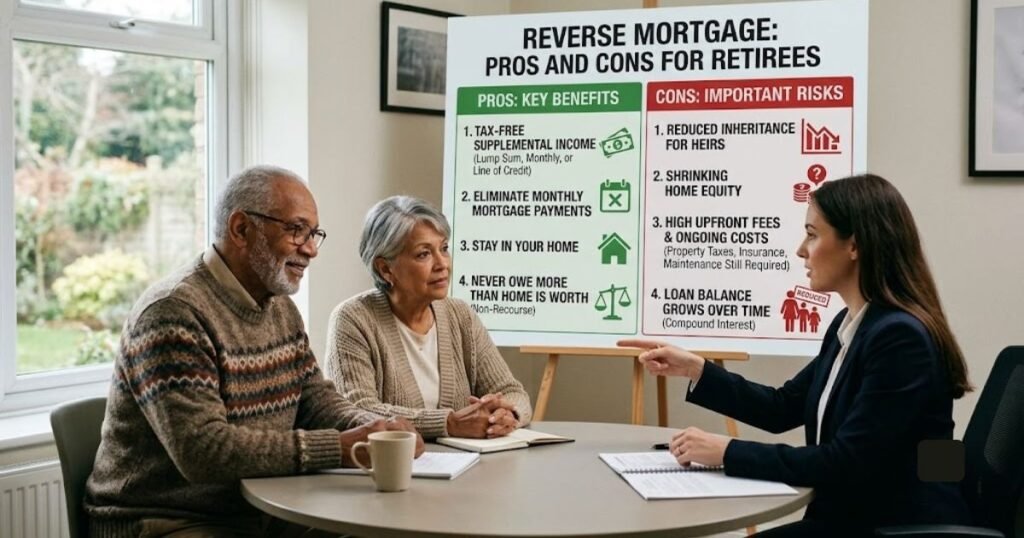
Reverse Mortgage Pros
1. No required monthly mortgage payments.
This is the headline benefit. As long as you meet loan obligations (taxes, insurance, maintenance, occupancy), you don’t owe a monthly payment on the loan itself which can free up hundreds of dollars a month for other expenses.
2. You stay in your home.
You keep the title and can continue living there as long as it remains your primary residence and you meet the loan terms.
3. Loan proceeds are generally not taxed as income.
Because it’s loan money, not earnings, reverse mortgage proceeds are typically not treated as taxable income by the IRS. (Always confirm your specific situation with a tax professional.)
4. Usually doesn’t affect Social Security or Medicare.
Reverse mortgage proceeds generally don’t count against these benefits. However, need-based programs like Medicaid or Supplemental Security Income (SSI) can be affected if you let cash accumulate in your bank account past program limits, so this is worth discussing with a benefits counselor.
5. Flexible ways to receive funds.
Lump sum, monthly payments, a line of credit, or a combination you can structure it around your actual needs.
6. Non-recourse loan protection.
By law, HECM borrowers (or their heirs) will never owe more than the home’s value when the loan is repaid, even if the loan balance has grown larger than the home is worth. FHA insurance covers that gap.
7. Improved retirement cash flow.
Extra funds can help cover medical costs, home modifications for aging in place, in-home care, or simply day-to-day living expenses on a fixed income.
8. Financial flexibility.
A reverse mortgage line of credit can serve as a backup source of funds, potentially reducing the need to sell investments during a market downturn.
Reverse Mortgage Cons
1. Interest grows over time and compounds.
Because there are no required payments, interest is added to the balance each month and then earns interest itself. Over 15–20 years, this can add up substantially.
2. Your home equity shrinks.
As the loan balance grows, the equity left for you or your heirs decreases, sometimes significantly if you live a long time in the home.
3. Upfront and ongoing costs.
Closing costs, an origination fee, and mortgage insurance premiums (explained below) can add tens of thousands of dollars to the loan balance.
4. Less inheritance for heirs.
Because the loan must be repaid from the home’s value, heirs may inherit little or no home equity, depending on how long the loan has been outstanding.
5. Property taxes and insurance are still your responsibility.
A reverse mortgage doesn’t eliminate these costs falling behind on them is one of the most common causes of default and foreclosure on reverse mortgages.
6. Ongoing maintenance obligations.
You must keep the home in reasonable condition; deferred maintenance can trigger a loan default.
7. Possible foreclosure.
If you fail to pay property taxes or insurance, don’t maintain the home, or move out for more than 12 months, the lender can call the loan due, potentially leading to foreclosure.
8. Complexity.
Reverse mortgages involve more moving parts than a standard loan — interest rate types, payment plan options, and non-recourse rules can be confusing without good counseling.
9. Not ideal if you plan to move soon.
Upfront costs are steep relative to short-term use; you generally need to stay several years to make the loan worthwhile.
10 .Impact on heirs’ plans.
If your children hoped to inherit the family home free and clear, a reverse mortgage changes that picture — they’ll need to repay the loan (usually by selling the home) to keep it, or the home is sold and any remaining equity goes to the estate.
READ MORE: SSDI vs. Retirement Benefits: What’s the Difference?
Reverse Mortgage Pros vs. Cons at a Glance
| Pros | Cons |
| No required monthly payments | Interest compounds over time |
| Stay in your home | Home equity shrinks |
| Proceeds generally not taxed | Significant upfront costs |
| Usually doesn’t affect Social Security/Medicare | May reduce inheritance |
| Flexible payment options | Still responsible for taxes and insurance |
| Non-recourse protection | Ongoing maintenance required |
| Improves retirement cash flow | Risk of default/foreclosure if obligations aren’t met |
| Adds financial flexibility | Complex terms; not ideal for short-term stays |
Costs of a Reverse Mortgage
HECM costs are federally regulated, which keeps them relatively predictable, but they’re still substantial:
- Initial (upfront) FHA mortgage insurance premium (MIP): 2% of the “maximum claim amount” (the lesser of your home’s appraised value or the current FHA HECM lending limit)
- Annual MIP: 0.5% per year, charged on the outstanding loan balance
- Origination fee: The greater of $2,500 or 2% of the first $200,000 of home value plus 1% of the value above that, capped at $6,000 by HUD regulation
- Closing costs: Appraisal, title insurance, recording fees, and other standard third-party charges, which vary by location
- Servicing fees: Some lenders charge a small monthly servicing fee (typically no more than $30) on loans with adjustable rates
- Interest: Accrues on the outstanding balance and compounds over the life of the loan
- Counseling fee: A modest fee (often $125–$200) for the required HUD-approved counseling session, sometimes waived for financial hardship
Most of these costs can be financed into the loan, so you typically don’t need cash upfront but doing so also reduces your net available proceeds. Lenders are required to disclose the Total Annual Loan Cost (TALC), a figure that estimates the all-in annual cost of the loan over different time horizons, which is one of the most useful tools for comparing offers.
READ MORE: Best Health Tracking Smartwatch for Seniors
Myths vs. Facts
| Myth | Fact |
| “The bank owns your house.” | You retain the title and ownership; the lender holds a lien, similar to any mortgage. |
| “You’ll lose your home immediately if you take a reverse mortgage.” | You can stay as long as you meet loan terms (taxes, insurance, maintenance, occupancy). |
| “Your children will inherit the debt.” | HECMs are non-recourse; heirs never owe more than the home is worth, and they aren’t personally liable for any shortfall. |
| “Reverse mortgage proceeds count as taxable income.” | Proceeds are loan funds, not income, and are generally not taxed (confirm with a tax advisor). |
| “Everyone qualifies.” | You must meet age, equity, residency, and financial assessment requirements, and complete HUD counseling. |
| “You never have to repay the loan.” | The loan becomes due when you sell, move out permanently, or pass away — it isn’t free money. |
When a Reverse Mortgage Makes Sense
A reverse mortgage tends to make the most sense when a retiree:
- Has limited monthly income but substantial home equity
- Plans to stay in the home long-term (ideally many years)
- Needs supplemental income to cover essential living costs
- Wants funds for home modifications that support aging in place
- Faces rising medical or long-term care expenses
- Wants a financial cushion (line of credit) without selling investments in a down market
When It May Be a Bad Idea
It’s often a poor fit when a retiree:
- Plans to move, downsize, or sell within the next few years
- Wants to preserve maximum home equity for heirs
- Already struggles to pay property taxes or insurance
- Has access to lower-cost options, like a HELOC, home equity loan, or family financial support
- Would be financially better off simply downsizing to a smaller, less expensive home
READ MORE: Best Flip Phone for Seniors: 7 Easy-to-Use Picks
Reverse Mortgage vs. Other Retirement Options
| Option | Monthly Payment | Eligibility | Typical Costs | Best For | Key Risk |
| Reverse Mortgage (HECM) | None required | Age 62+, sufficient equity | High upfront (MIP, origination, closing) | Aging in place, supplementing income | Shrinking equity, default risk |
| HELOC | Interest, sometimes principal | Credit/income-qualified | Low upfront, variable rate | Short-term or occasional borrowing | Variable payments, can be frozen/reduced by lender |
| Home Equity Loan | Fixed monthly | Credit/income-qualified | Moderate closing costs | One-time lump-sum need | Fixed payment obligation |
| Cash-Out Refinance | New fixed/adjustable payment | Credit/income-qualified | Closing costs on full new loan | Lowering rate while accessing equity | Resets loan term, adds monthly payment |
| Downsizing | None (or smaller mortgage) | N/A | Selling/moving costs | Freeing up equity, lower expenses | Emotional and logistical cost of moving |
| Selling the Home | None | N/A | Selling costs, capital gains considerations | Maximizing liquid cash | Loss of home, need alternate housing |
| Retirement Savings Withdrawals | None | Sufficient savings | Potential taxes/penalties | Those with adequate investment assets | Depletes savings, market timing risk |
Reverse Mortgage and Heirs
When the last borrower passes away or permanently leaves the home, the loan becomes due. Heirs generally have a few options:
- Sell the home: Pay off the loan balance from the sale proceeds; any remaining equity goes to the estate.
- Keep the home: Pay off the loan balance (often by refinancing into a traditional mortgage) to retain ownership.
- Walk away: If the loan balance exceeds the home’s value, heirs can let the lender take the home through the FHA’s non-recourse protection they won’t owe the difference.
Heirs typically have a set window (commonly around six months, with possible extensions) to decide and complete the process, so it’s important to loop family members in on the decision before you sign, not after.
Reverse Mortgage Checklist
Before applying, confirm you can check off each of these:
- ✔ Age requirement met (62+)
- ✔ Enough home equity to make the loan worthwhile
- ✔ Plan to stay in the home for the foreseeable future
- ✔ Comfortable continuing to pay property taxes
- ✔ Homeowners insurance is affordable and current
- ✔ You understand all fees and how the balance grows
- ✔ Family and heirs are informed and involved in the discussion
- ✔ You’ve compared at least one or two alternatives
- ✔ You’ve completed HUD-approved counseling
- ✔ You’ve reviewed the Total Annual Loan Cost (TALC) disclosure
Mistakes Retirees Should Avoid
- Skipping or rushing through HUD-approved counseling
- Not comparing offers from multiple lenders
- Taking the maximum lump sum when a line of credit would cost less over time
- Failing to budget for ongoing property taxes and insurance
- Not telling adult children or heirs about the loan
- Ignoring the Total Annual Loan Cost disclosure
- Assuming the loan is “free money” rather than a debt that grows
- Using proceeds for large discretionary purchases rather than genuine needs
- Not considering how a long hospital or care-facility stay could trigger loan repayment
- Signing with a lender who pressures you to decide quickly
- Overlooking how proceeds could affect Medicaid or SSI eligibility
Expert Tips
- Get counseling from more than one HUD-approved counselor’s perspective if you’re unsure.
- Consider a line of credit over a lump sum — unused credit can grow over time and you only pay interest on what you draw.
- Shop at least three lenders and compare TALC disclosures side by side.
- Set aside a portion of proceeds specifically for future property tax and insurance payments.
- Talk to a fee-only financial advisor who doesn’t earn a commission from the loan.
- Ask how the interest rate is structured (fixed vs. adjustable) and how that affects your balance growth.
- Review your long-term care plans a lengthy stay away from home can trigger repayment.
- Keep detailed records of loan documents and share copies with a trusted family member.
- Reassess your decision every few years as your health, home value, and needs change.
- If leaving an inheritance is a top priority, seriously weigh downsizing or a smaller home equity loan instead.
Reverse Mortgage Red Flags
Watch for these warning signs when shopping for a reverse mortgage:
- High-pressure sales tactics that push you to sign quickly or skip counseling
- Bundled financial products, such as being steered toward annuities or investments using loan proceeds
- Misleading promises, like claims that the loan is “free” or “risk-free”
- Requests for upfront payments beyond legitimate, disclosed closing costs
- Vague or evasive answers about ongoing obligations like taxes, insurance, and maintenance
If you encounter any of these, pause, and consider reporting the lender to HUD, the Consumer Financial Protection Bureau (CFPB), or your state’s attorney general.
Frequently Asked Questions
Is a reverse mortgage a good idea for retirees?
A reverse mortgage can be a good idea for retirees who have significant home equity, plan to stay in their home long-term, and need supplemental income or a financial cushion. It’s less suitable for those who want to preserve maximum inheritance, plan to move soon, or already struggle with housing costs.
What are the biggest disadvantages of a reverse mortgage?
The biggest drawbacks are the growing loan balance, shrinking home equity, and significant upfront costs like mortgage insurance and origination fees. Because interest compounds over time with no required payments, the debt can grow substantially over a decade or two.
Can I lose my house with a reverse mortgage?
Yes, but only under specific circumstances. You could face foreclosure if you fail to pay property taxes or homeowners insurance, don’t maintain the home, or move out of the property for more than 12 consecutive months.
Does a reverse mortgage affect Social Security or Medicare?
Generally, no. Reverse mortgage proceeds are loan funds, not income, so they typically don’t reduce Social Security retirement benefits or Medicare eligibility.
What happens to a reverse mortgage when the homeowner dies?
The loan becomes due when the last surviving borrower passes away. Heirs typically have a window of time (often around six months, with possible extensions) to sell the home and repay the loan, refinance and keep the home, or walk away if the balance exceeds the home’s value.
Conclusion
A reverse mortgage isn’t inherently good or bad — it’s a financial tool that fits some retirement situations better than others. On the plus side, it can eliminate monthly mortgage payments, unlock home equity, and add real flexibility to a fixed income, all while letting you stay in the home you love. On the other hand, the costs are real, the balance grows over time, and the impact on what you leave behind for heirs is significant.
Before moving forward, compare a reverse mortgage against alternatives like a HELOC, home equity loan, downsizing, or drawing from retirement savings. Talk openly with your family about what the loan means for them. And take full advantage of the required HUD-approved counseling session — it exists specifically to help you make this decision with clear eyes, not pressure. With the right information, you can decide whether a reverse mortgage genuinely fits your retirement plan, or whether another path serves you better.
This article is for general educational purposes and isn’t personalized financial or legal advice. Speak with a HUD-approved housing counselor, a licensed financial advisor, and/or an attorney about your specific situation before making a decision.