A leaking roof, a refrigerator that won’t keep medicine cold, or rising grocery bills can feel overwhelming on a fixed income. You’re not alone; many older Americans face similar struggles and don’t know where to look for help. This guide walks you through what “government grants for seniors” really are, the federal and local programs that commonly help with housing repairs, meals, medical support and more, and a plain-English, step-by-step process to apply. Bold takeaway: you don’t need to be tech-savvy or wealthy to access help, start with one call to your local Area Agency on Aging and follow the checklist later in this article.
What counts as a Government Grant for Seniors?
A grant is money you don’t pay back, awarded by a government agency (federal, state, tribal, or local) or sometimes by a government-funded program administered by nonprofits. Grants differ from other forms of public help:
- Grants — cash or reimbursements for a specific need (e.g., home safety repair) that do not need to be repaid.
- Benefits / entitlements — ongoing programs tied to eligibility (e.g., Social Security, Medicare).
- Vouchers / subsidies — government-funded credits for goods or services (e.g., rental assistance vouchers).
- Loans — money you must repay, sometimes with favorable terms for seniors.
Who gives grants? Small and large players: federal departments (housing, agriculture, veterans), state housing and aging offices, local governments, tribal programs, and community organizations that distribute government funds. For example, rural seniors may qualify for USDA repair grants; some federal funds are routed through state agencies and local Area Agencies on Aging. U.S. Department of Agriculture
Bold takeaway: when you read “government grant,” check who manages the money the application route will depend on whether it’s federal, state, or local.
READ MORE: USDA grants for seniors: Eligibility, amounts, and how to apply
Federal Grants for Elderly
Below are the major federal entry points where seniors and the people who help them commonly find resources. These are often the fastest ways to learn what’s available in your area.
1. Housing & home-repair grants
USDA Single Family Housing Repair Loans & Grants (Section 504)
Grants are available for homeowners age 62+ in eligible rural areas to remove health and safety hazards; loans and loans+grants are available for other repairs. Use this for critical items (septic, heating, accessibility ramps). U.S. Department of Agriculture
HUD programs and state housing agencies
While HUD more commonly insures loans (Title I, 203(k)), many HUD-funded programs and local community development block grants (CDBG) support home modifications or repairs through state/local partners. U.S. Department of Housing and Urban Development. Some housing grants are geographic (rural vs. urban) and have income limits check the program rules first.
2. Nutrition & meal programs
Older Americans Act (OAA) nutrition programs
funds are distributed to local programs (often Meals on Wheels or congregate meal sites) to provide home-delivered meals and nutrition counseling to adults 60+. These are not grants to seniors personally but are government-funded services delivered locally. Administration for Community Living.
Bold takeaway: if you can’t get to a meal site or afford food, OAA-funded meal delivery is a place to start.
3. Health & care support
Medicare covers certain home health services but does not cover long-term custodial care at home; Medicaid often covers long-term services for those who meet state income/asset rules. For short-term skilled services after illness or hospital stays, Medicare home health may help. Centers for Medicare & Medicaid Services. Medicare is limited for long-term care — ask your state Medicaid office or a benefits counselor about waivers or programs that pay for home care.
4. Veterans benefits
VA pensions + Aid & Attendance
Veterans and surviving spouses who qualify for a VA pension may be eligible for Aid & Attendance or Housebound allowances to help pay for in-home care or assisted living costs. These are pension benefits, not competitive grants, but they can significantly increase monthly payments. U.S. Department of Veterans Affairs
READ MORE: Does HUD Offer Grants For Senior Citizens?
How to Find Government Grants for Seniors: A Step-by-Step Search Strategy
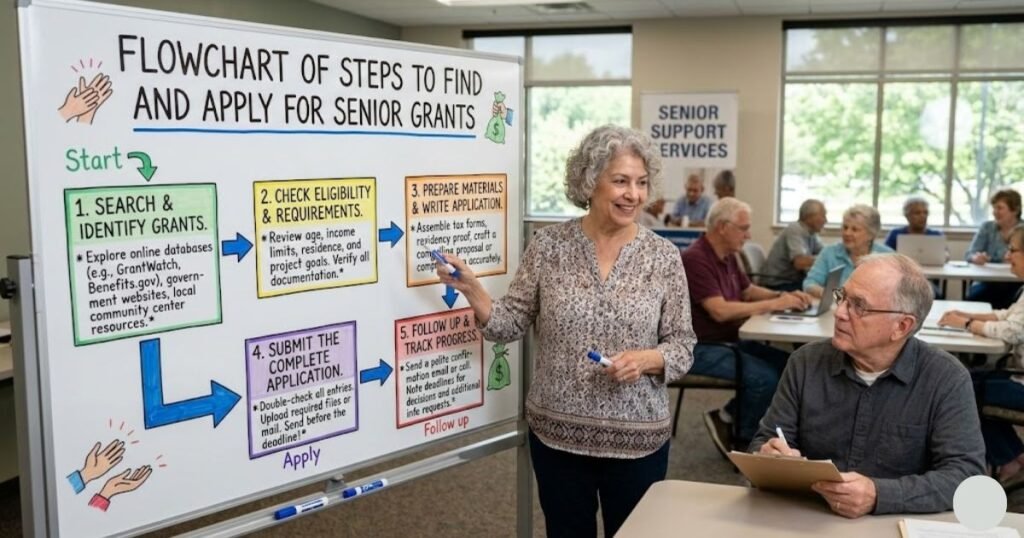
The decentralized nature of senior funding means that a senior in one county may have access to a “home repair grant” while a neighbor in the next county does not. Success in finding these funds depends on a local, methodical search strategy.
Step 1: Utilize Official Federal Portals
Before calling local offices, use the “Benefit Finder” at Benefits.gov or USA.gov/benefit-finder. These tools act as a digital screening process, asking about life events (like retirement or disability) to generate a customized list of over 1,000 potential programs. For those seeking housing help specifically, the USDA Rural Development website offers a property eligibility map to determine if a senior’s home is in a qualified “rural” zone.
Step 2: Contact the Area Agency on Aging (AAA)
The AAA is the “nerve center” for senior services in every community. These agencies are charged with administering the state and federal grants that fund local programs. They offer “Information and Assistance” (I&A) specialists who can identify block grants for emergency needs, such as a broken furnace or a need for legal representation.
Step 3: Engage the Eldercare Locator
Managed by the Administration for Community Living (soon ACFC), the Eldercare Locator (1-800-677-1116) is the primary public service for connecting seniors to their local AAA. Professional staff can provide direct referrals to “Aging and Disability Resource Centers” (ADRCs), which follow a “No Wrong Door” philosophy, ensuring that a single phone call can screen for multiple funding sources.
Sample checklist to gather before applying
- Photo ID (driver’s license, state ID)
- Social Security number or benefit documentation
- Proof of age (birth certificate, passport)
- Proof of income (Social Security statements, pension, recent bank statements)
- Proof of residence/property ownership (mortgage statement or deed for home-repair grants)
- Brief statement describing need and estimates/receipts (for repairs or medical equipment)
Tips: having these documents ready makes many applications straightforward scan or photocopy them and keep them in a single folder.
READ MORE: Salvation Army Free Car Program (Eligibility & How to Apply)
How to Apply for Grants for Seniors
A typical application looks like this:
- Read the instructions carefully. If it says “apply through the state,” don’t send materials to a federal office.
- Fill out identification fields first (name, birthdate, contact info). Make sure names match on all documents.
- Answer the “why we need funds” question succinctly: state the problem, the consequence if not fixed, and the requested outcome. Example language for a home-repair request:
“My roof leaks into the bedroom after heavy rain, causing mold and making it unsafe to use. I am 73 and on a fixed income (Social Security $1,100/month). I request funding to replace the roof to prevent health issues and permit me to live safely at home.” - Attach documents listed in the checklist. Missing documents are the most common reason for delays.
- Timeline expectations: grants can take weeks to months, depending on program and funding cycles. If it’s an emergency (e.g., no heat), ask the local AAA or emergency services about short-term funds or temporary fixes.
- Follow up: note who you spoke with, date and time, and what they promised. If you don’t hear back in the stated timeframe, call and reference your application ID.
Common pitfalls & how to avoid them
- Pitfall: sending incomplete income proof.
Fix: include a recent Social Security award letter, pension slips, or bank statements. - Pitfall: missing signatures or dates.
Fix: double-check every page before mailing or scanning. - Pitfall: sending to the wrong office.
Fix: confirm the mailing address or portal URL with the AAA or program rep.
Real example: Grants for Older Adults
The following case study illustrates the “multi-braid” funding approach often required to solve complex senior needs.
Case Study: The “Safety First” Home Modification
The Applicant: “Raymond,” a 69-year-old retired Air Force veteran living in rural Ohio on a fixed income of $1,800 a month. The Problem: Raymond’s roof had been leaking for two years, and his old bathtub had become a “slip-and-fall” hazard after a recent surgery. He had been denied a traditional home equity loan due to his debt-to-income ratio.
The Search Phase: Raymond contacted the Senior Resource Line in his state and was directed to his local Area Agency on Aging (AAA). The AAA specialist performed a “Comprehensive Needs Assessment” and identified three separate funding streams.
The Application Phase:
- USDA Section 504: Raymond applied for a $10,000 grant to address the leaking roof. He provided the required “Form RD 3550-1” (Authorization to Release Information) and a narrative explaining the health hazards of the mold.
- VA Coordination: Because Raymond was a veteran, the USDA office prioritized his application and partnered with a local “Veterans Assistance Program” to cover the gap between the $10,000 grant and the $16,000 cost of a full roof replacement.
- AAA Home Modification Fund: The local AAA used its Older Americans Act Title III-B funds to provide a “mini-grant” of $2,500 for the installation of grab bars and a roll-in shower, which were not covered by the USDA’s “major repair” focus.
The Outcome: Raymond received a total of $18,500 in assistance. He did not have to pay back the funds, provided he remained in the home for three years (the USDA “grant forgiveness” period). His monthly expenses decreased because the new roof improved energy efficiency, and he was able to “age in place” safely.
READ MORE: Can Seniors Get Free Window Replacement Grants
How to spot scams & protect your information
Scammers target seniors searching for grants. Red flags: unsolicited calls or emails claiming you “automatically qualify” but must pay a fee; pressure to act “today,” requests for full account numbers or remote access to your computer; asking you to pay a “processing fee” with gift cards.
Safe steps: never pay to apply for a government grant. When in doubt, hang up and call a trusted number your local Area Agency on Aging, your state consumer protection office, or the Eldercare Locator at 1-800-677-1116. If a caller claims to be from a government agency, ask for their name, office, and a public callback number; verify by calling the agency’s official number.
Bold takeaway: real government grants don’t require upfront fees or account transfers.
State & local tips — where to look next
Every state runs its own set of programs and may use federal funds differently. Quick ways to find local help:
- Call your state aging office or local Area Agency on Aging (AAAs handle intake, care management, and referrals).
- Dial 2-1-1 for non-emergency community resources (food, housing, utilities).
- Check your state housing agency for repair grants, weatherization, or low-interest loans.
- Community Action Agencies and faith-based groups often run small emergency grant pools
Bold takeaway: local agencies are the gateway one call often reveals multiple programs.
Accessible resource list
- Eldercare Locator: 1-800-677-1116 (Primary gateway to local AAAs)
- Social Security Administration: 1-800-772-1213 (For “Extra Help” and SSI)
- LIHEAP Hotline: 1-866-674-6327 (For energy bill assistance)
- National Elder Fraud Hotline: 1-833-372-8311 (To report scams)
- Medicare (SHIP) Assistance: 1-877-839-2675 (For one-on-one counseling)
- VA Benefits Help: 1-800-698-2411 (For veteran-specific grants)
- SNAP (Food Stamps) Info: Contact your local State Social Service Agency (Dial 2-1-1)
READ MORE: Habitat For Safe Seniors Free Ramp Program (Eligibility & How to Apply)
What government grants are available for seniors in the U.S.?
Grants commonly cover housing repairs/home modifications, nutrition programs, veteran pension add-ons, and occasionally utility or emergency funds. Availability varies by state and by whether the senior lives in a rural area (USDA) or qualifies for other targeted funds.
How do seniors apply for federal grants or government aid?
Confirm eligibility, gather ID and income docs, apply via the program’s official portal or through a local office (Area Agency on Aging, state housing agency), and follow up. Local AAAs can often help file forms.
Are seniors eligible for housing repair grants or home modification funds?
Yes — programs like USDA Section 504 offer grants to homeowners age 62+ in eligible rural areas; other state and local programs may support accessibility mods or repairs depending on income and need.
Can a senior get grants if they already receive Social Security or Medicare?
Often yes. Receiving Social Security or Medicare does not automatically disqualify you — many grants use income limits and specific eligibility rules, not benefit status alone.
How do I avoid scams when looking for grants for seniors?
Never pay to apply, verify program contact details via official government numbers, avoid pressure tactics, and call your Area Agency on Aging or state consumer protection office if unsur
READ MORE: Does Government Offer Free Solar Panel Grants for Seniors?
Closing
Finding and accessing government funds in 2026 requires patience and persistence, particularly as agencies like the ACL transition into the new ACFC structure. However, the money is there—billions of dollars have been allocated for the current fiscal year to ensure that older Americans can live with “independence, dignity, and choice”. Your local Area Agency on Aging is your most powerful ally in this journey. Call them today, ask for a benefits screening, and begin building your path toward financial and residential security.
Expert guidance
“Contacting your local Area Agency on Aging is one of the fastest, safest ways to find government-funded services and get help with applications. AAAs are federally funded to assist older adults and caregivers with navigation.”
Sources we consulted
U.S. Department of Agriculture (USDA); Administration for Community Living (ACL) / Eldercare Locator; U.S. Department of Housing and Urban Development (HUD); Centers for Medicare & Medicaid Services (CMS/Medicare); U.S. Department of Veterans Affairs (VA); Meals on Wheels America; USA.gov; state housing and Community Action Agencies.