Nobody plans on a car accident, a stroke, or a sudden diagnosis. But these things happen, and when they do, someone often has to make fast medical decisions on your behalf.
If you haven’t named that person in writing, your family may be left guessing or worse, disagreeing about what you would have wanted. A durable power of attorney for health care decisions solves this problem before it starts.
This document lets you choose, in advance, exactly who should speak for you if you’re unable to speak for yourself. It’s one of the simplest, most caring gifts you can give your family, because it takes the guesswork and the guilt out of an already painful moment.
This guide walks you through what a durable power of attorney for health care is, how it works, how to choose the right agent, and the steps to put one in place. Lets deep dive into “Durable Power of Attorney for Health Care Decisions: 2026 U.S. Guide”
Key Takeaways
- A durable power of attorney for health care lets you name a trusted person, called a health care agent, to make medical decisions for you if you can’t make them yourself.
- It’s different from a living will, which spells out your treatment wishes instead of naming a decision-maker.
- It only becomes active when a doctor determines you lack the capacity to make your own medical decisions.
- Every adult not just seniors benefits from having one, since accidents and sudden illness can happen at any age.
- Requirements for signing, witnessing, and notarizing these documents vary by state, so it’s wise to work with a local elder law or estate planning attorney.
READ MORE: How Much Do Elder Law Attorneys Charge? Complete USA Cost Guide
What Is a Durable Power of Attorney for Health Care Decisions?
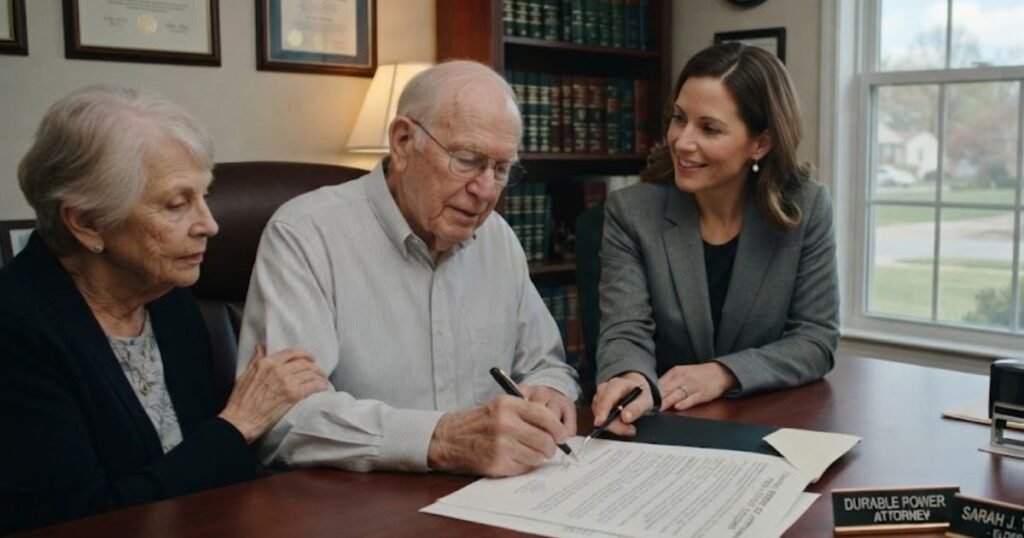
A durable power of attorney for health care (sometimes called a health care proxy, medical power of attorney, or durable medical power of attorney) is a legal document. It lets you appoint someone you trust your health care agent to make medical decisions for you if you’re unable to make them yourself.
It is one type of advance directive. Advance directives are legal tools that let you plan ahead for future medical care.
Simple Definition
Think of it this way: you’re choosing a stand-in decision-maker for medical situations, not writing down every possible medical wish yourself. Your agent steps in only when you can’t speak for yourself.
Legal Purpose
The purpose is to protect your voice. Even when illness or injury takes away your ability to communicate, your chosen agent can talk to your doctors, review your medical situation, and make choices based on what they know about your values and wishes.
When It Becomes Effective
This document only takes effect after a doctor determines that you lack the capacity to make your own health care decisions. Until that point, you keep full control over your own medical choices. The “durable” part of the name means the document stays in effect even after you become incapacitated it doesn’t expire just because you can no longer manage your own affairs.
Difference From Financial Power of Attorney
A durable power of attorney for health care only covers medical decisions. It does not give your agent authority over your finances, property, or bank accounts. That authority comes from a separate document called a financial power of attorney. Many people set up both, but they are not the same thing and often name different agents.
Relationship to Advance Directives
In many states, the durable power of attorney for health care is combined with a living will into a single form, often called an advance directive or advance health care directive. In other states, they remain two separate documents. Either way, both work together to protect your medical wishes.
READ MORE: How Much Does a Medicaid Asset Protection Trust Cost?
How Does It Work?
Choosing a Health Care Agent
You select one primary agent and, ideally, one or more backup (alternate) agents. This person doesn’t need to be a lawyer or a medical professional just someone who knows you well and can be trusted to follow your wishes.
Agent Authority
Once active, your agent can typically:
- Talk with your doctors and review your medical records
- Consent to or refuse specific treatments
- Choose hospitals, specialists, or care facilities
- Make decisions about long-term care or hospice
When Doctors Rely on the Agent
Physicians turn to your named agent only when you cannot communicate your own wishes, whether that’s temporary (such as being under anesthesia) or longer-term (such as a coma or advanced dementia).
Incapacity Determination
A doctor sometimes two, depending on state law and the situation must formally determine that you’re unable to understand your medical situation or communicate a decision. This isn’t something a family member can decide alone.
Communication With Physicians
Your agent becomes the main point of contact for your care team. Good agents ask questions, request second opinions when appropriate, and keep other family members informed, which helps prevent conflict during stressful moments.
Durable Power of Attorney vs. Living Will
These two documents are often confused, but they serve different purposes. Many people benefit from having both.
| Feature | Durable Power of Attorney | Living Will |
| Purpose | Names a person to make medical decisions for you | Records your specific treatment wishes in advance |
| Decision Maker | A chosen human agent | The document itself; no person is named |
| Flexibility | Can adapt to unexpected or changing situations | Limited to the scenarios it describes |
| Medical Situations | Covers any medical decision, foreseen or not | Usually focused on end-of-life care |
| Legal Role | Grants decision-making authority | States preferences, doesn’t grant authority |
| Best Uses | Ongoing or unpredictable medical situations | Specific end-of-life choices (e.g., life support) |
Why You Need Both
Think of these two documents as a cohesive team. A living will provides the map, and your healthcare agent acts as the driver.
If you only have a living will, doctors may struggle to apply your general written wishes to a highly specific, complex medical scenario. If you only have a medical power of attorney, your agent might feel overwhelmed by the immense emotional burden of guessing what you want during a crisis. Combining a living will and a durable power of attorney into a comprehensive advance directive gives your agent both the legal authority to act and the clear instructions they need to do so confidently.
READ MORE: Non Grantor Irrevocable Trust Guide
Who Should Have a Durable Power of Attorney for Health Care?
This isn’t only for people who are elderly or seriously ill. Consider these groups:
- Seniors and retirees — planning ahead reduces stress on the whole family
- All adults over 18 — accidents and sudden illness don’t check your age first
- Veterans — VA health benefits and care coordination often go more smoothly with a named agent
- People with chronic illness — conditions can change quickly and unpredictably
- Anyone undergoing surgery — even routine procedures carry some risk
- People with a family history of dementia — planning early, while capacity is intact, is essential
- Married couples — a spouse is often assumed to be the decision-maker, but this isn’t guaranteed everywhere without documentation
- Single adults — without a document, decision-making authority may default to family members you wouldn’t have chosen, or require a court process
What Decisions Can a Health Care Agent Make?
Depending on how the document is written and your state’s laws, your agent may be authorized to make decisions about:
- Approving or declining surgery
- Choosing or adjusting medications
- Selecting hospitals or specialists
- Nursing home or long-term care placement
- Rehabilitation and therapy decisions
- Hospice and palliative care
- Life support and resuscitation (CPR)
- Ventilator use
- Feeding tubes and artificial nutrition
- Organ and tissue donation, where permitted by the document and state law
Your agent is expected to follow your known wishes whenever possible. If your wishes on a specific issue aren’t clear, they’re expected to act in your best interest, guided by your values.
Expert Tip: Talk with your chosen agent about your values, not just a checklist of procedures. Values-based conversations (“I want comfort over aggressive treatment if there’s little chance of recovery”) often guide decisions better than trying to list every possible medical scenario.
When Does It Become Effective?
A durable power of attorney for health care becomes effective only under specific conditions:
- Medical incapacity — you’re unable to understand or communicate a health care decision
- Physician determination — a doctor must formally confirm this incapacity, usually in writing
- Temporary incapacity — for example, during and after surgery; authority may pause once you recover
- Permanent incapacity — such as advanced dementia; the agent’s authority continues as needed
- Recovery scenarios — if you regain capacity, you resume making your own decisions immediately
This built-in trigger is what makes the document safe to sign early. It gives your agent no power over your day-to-day choices while you’re able to make them yourself.
READ MORE: Best Estate Planning & Trust Attorneys Near Me
How to Choose the Right Health Care Agent
This may be the most important decision in the entire process. Look for someone who has:
- Trustworthiness — someone who will honor your wishes, not their own preferences
- Strong communication skills — comfortable asking doctors questions and pushing back when needed
- Composure under pressure — able to make hard calls during emotional, high-stress moments
- Availability — realistically reachable and willing to show up when needed
- Understanding of your values — knows how you feel about quality of life, independence, and end-of-life care
- Willingness to serve — has actually agreed to the role, not just been assumed to accept it
- Geographic proximity — helpful, though not always required, especially with phone and video access to care teams
Real-Life Scenario: Margaret, age 78, initially planned to name her oldest son as her agent simply because he was the oldest. After a family conversation, she realized her daughter, who lived nearby and had asked thoughtful questions about her mother’s wishes, was a better fit. Margaret named her daughter as primary agent and her son as the backup. This kind of honest conversation choosing based on fit, not tradition often leads to better outcomes.
Who Should NOT Be Your Health Care Agent?
Be cautious about naming someone who is:
- Unreliable or difficult to reach in emergencies
- In active conflict with other family members
- Financially motivated in ways that could create a conflict of interest
- Unwilling or hesitant to take on the responsibility
- Known to disregard your stated wishes in favor of their own opinions
If you’re unsure, it’s better to name a levelheaded friend or a more distant relative than to default to whoever is “supposed to” take the role.
Step-by-Step Guide to Creating a Durable Power of Attorney for Health Care
- Understand your state’s requirements. Forms, witness rules, and notary rules vary.
- Choose your primary agent. Pick someone who meets the criteria above.
- Select one or two alternate agents. This covers you if your first choice is unavailable.
- Complete the correct state form. Many states offer free official forms online.
- Sign the document properly. Follow your state’s exact signing rules.
- Arrange witnesses or notarization, as required in your state.
- Share copies with your agent, alternate agents, primary doctor, and close family members.
- Discuss your wishes openly with your agent so they understand your values, not just the paperwork.
- Store the original safely, and keep a note of where it is with a trusted family member.
- Review it regularly, especially after major life or health changes.
Printable Preparation Checklist
- [ ] Research my state’s official health care power of attorney form
- [ ] Choose a primary agent and confirm they’re willing to serve
- [ ] Choose one or two alternate agents
- [ ] Complete and sign the form according to state rules
- [ ] Arrange witnesses and/or notarization
- [ ] Give copies to my agent, doctor, and family
- [ ] Have a values conversation with my agent
- [ ] Store the original in a safe, known location
- [ ] Set a yearly reminder to review the document
READ MORE: Revocable Living Trust vs Irrevocable Trust: Complete USA Guide
State Laws: Why They Matter
Every state has its own rules for health care powers of attorney, so it’s important not to assume a form from one state automatically works the same way in another.
- Different forms — states use different official documents and language
- Witness requirements — some states require one or two witnesses; others don’t
- Notary requirements — some states require notarization, others don’t, and some accept either witnesses or a notary
- Recognition across states — many states will honor an out-of-state document, but not all, so this matters if you split time between states
- Updating after moving — it’s wise to review and, if needed, redo your document after a permanent move to a new state
Because these rules shift, this guide intentionally avoids state-specific legal advice. An elder law or estate planning attorney in your state can confirm exactly what’s required where you live.
Can You Change or Revoke It?
Yes. As long as you have the mental capacity to do so, you can change your mind at any time.
- Revocation — you can cancel the document entirely, usually in writing
- Updates — you can revise it to reflect new wishes or a new agent
- New forms — creating a new, properly signed document generally replaces the old one
- Divorce considerations — many states automatically revoke a spouse’s authority as agent after divorce, but not all, so update your documents promptly
- Agent replacement — if your agent becomes unwilling, unable, or untrustworthy, you can name someone new
- Life changes — marriage, the death of an agent, a new diagnosis, or a move to a new state are all good reasons to review your document
READ MORE: Free Wills for Seniors Near Me | Legal Help & Estate Planning
Common Mistakes to Avoid
- Waiting too long. You must have decision-making capacity to sign; waiting until after a diagnosis worsens can be too late.
- Choosing the wrong person out of obligation rather than fit.
- Not discussing your wishes with your agent in detail.
- Forgetting to name alternate agents.
- Never updating documents after major life changes.
- Failing to share copies with doctors and family, leaving the document undiscovered when it’s needed most.
Myth vs. Fact
| Myth | Fact |
| “Only elderly or sick people need this document.” | Any adult can face sudden incapacity from an accident or illness. |
| “My spouse automatically has full authority to decide for me.” | Rules vary by state and situation; a spouse’s authority isn’t guaranteed without documentation. |
| “A living will is enough on its own.” | A living will can’t cover every scenario; an agent can respond to situations the document didn’t anticipate. |
| “Once signed, it can’t be changed.” | You can update or revoke it any time you have capacity to do so. |
| “It gives my agent control over my finances too.” | Health care and financial powers of attorney are separate documents. |
Benefits for Seniors
- Peace of mind — knowing your wishes will be respected
- Reduced family conflict — one clear decision-maker instead of competing opinions
- Faster medical decisions — care teams know exactly who to contact
- Better respect for personal values — decisions reflect what matters to you, not guesswork
- Reduced court involvement — without this document, families sometimes need a court-appointed guardian, which is slower and more stressful
- Extra support during emergencies — your agent can advocate for you when you’re not able to advocate for yourself
READ MORE: Salvation Army Free Car Program (Eligibility & How to Apply)
How Families Can Prepare Together
Planning works best as a shared family effort, not a solo project.
- Hold a family meeting to talk openly about health care wishes and who is best suited to be the agent
- Have honest health care conversations about quality-of-life preferences, not just legal paperwork
- Build an emergency plan that includes contact information, medication lists, and document locations
- Share documents with everyone who might need them — doctors, agents, and close family
- Coordinate with physicians ahead of time so your primary care provider has a copy on file
Caregiver Tip: If you’re helping a parent or loved one through this process, focus the conversation on their values first, then move to paperwork. Questions like “What does a good quality of life look like to you?” often open up more honest conversations than starting with legal forms.
Veterans Considerations: Veterans receiving care through the VA health system can typically use a VA-specific advance directive form, and can also name a health care agent to help coordinate care between VA and non-VA providers. If you or a loved one is a veteran, ask your VA social worker or patient advocate about the specific forms your VA facility uses.
Frequently Asked Questions
What is a durable power of attorney for health care decisions?
It’s a legal document that lets you name a trusted person, called a health care agent, to make medical decisions on your behalf if you become unable to make them yourself.
What is the difference between a medical power of attorney and a living will?
A medical power of attorney names a person to make decisions for you. A living will records your specific treatment preferences in writing. Many people use both together for complete coverage.
Can a health care power of attorney override family members?
Generally, yes. Once the document is in effect, the named agent has legal authority to make medical decisions, even if other family members disagree, because that authority was granted directly by the person who signed the document.
Does a durable power of attorney for health care expire?
In most states, it does not expire on its own. It stays valid indefinitely once signed, even if your incapacity turns out to be temporary. Even so, it’s wise to review and update it periodically, especially after any major life change.
When does a medical power of attorney become effective?
It becomes effective when a physician determines that you’re unable to understand your medical situation or communicate your own health care decisions. Until that point, you retain full control over your own care.
Final Thoughts
Planning for a moment when you might not be able to speak for yourself isn’t easy to think about. But it’s one of the most caring, practical steps you can take for yourself and for the people who love you.
A few reminders as you move forward:
- Plan early, while you have full decision-making capacity
- Choose your health care agent thoughtfully, based on fit rather than obligation
- Keep your documents updated after major life or health changes
- Talk openly with your family so no one is caught off guard
- Review your documents after events like a move, a divorce, or a new diagnosis
This guide offers general information, not legal advice, since requirements vary from state to state. The best next step is to review your wishes with your loved ones and consult a qualified estate planning or elder law attorney in your state to make sure your documents are complete, valid, and truly reflect what you want.


Pingback: How to Qualify for Medicaid Long-Term Care? (2026 Guide) - Free Senior Grants