If you or a loved one struggles to sit down or stand up safely from a standard low toilet commode, a raised toilet seat with handles is an affordable, highly stable solution that prevents dangerous bathroom falls.
According to data collected by the Centers for Disease Control and Prevention (CDC), over 235,000 individuals visit emergency departments annually due to injuries sustained in the bathroom, with the highest concentration of incidents occurring during sit-to-stand transfers near the toilet or bathtub. This is exactly where a high-quality raised toilet seat with handles steps in.
This guide covers what to look for, five specific products worth comparing, and the mistakes that lead people to buy the wrong one. Lets deep dive into “Best 5 Raised Toilet Seat with Handles (2026): Reviews, Comparison & Cost”
Key Takeaways
- Bathroom falls are common and serious for older adults, and toilet transfers are a frequent trigger.
- “Raised toilet seat” and “toilet safety rail” are not the same product one adds seat height, the other adds handles around the existing seat. Some buyers need both.
- Weight capacity should comfortably exceed the user’s actual weight, not just meet it.
- Toilet shape (round vs. elongated) and bolt accessibility determine whether a product will even fit.
- Medicare typically does not cover these as “convenience items,” though Medicare Advantage OTC allowances or FSA/HSA funds sometimes do.

READ MORE: Best Health Tracking Smartwatch for Seniors — Top 8 Picks Compared
Why Seniors Need Raised Toilet Seats
Several overlapping conditions make a standard 15–17-inch toilet seat genuinely difficult and risky to use:
- Arthritis in the knees, hips, or hands makes bending and pushing up painful.
- Hip or knee replacement recovery often comes with strict bend-angle restrictions from the surgeon a low seat can violate those limits.
- Parkinson’s disease affects balance and the ability to control a slow, steady descent onto the seat.
- Stroke recovery can leave one side of the body weaker, making a stable handle (or two) essential.
- General balance problems and muscle weakness, which naturally increase with age, make the “point of no return” moment of sitting or standing more dangerous.
- Caregiver assistance is easier and safer for both parties when there’s a stable structure to guide a transfer, rather than the caregiver bearing all the weight.
A properly fitted raised seat or safety rail reduces the physical strain of that sit-to-stand transfer. That said, these products are aids, not guarantees correct installation, an appropriately rated weight capacity, and (for anyone with complex mobility needs) input from a physical therapist or physician all matter for getting real safety benefit.
How We Selected These Products
Each product was evaluated on:
- Stability — does it rely on a secure bolt/clamp system, or a looser suction/friction fit?
- Safety features — weight rating, non-slip feet, locking mechanisms
- Durability — frame material (steel, aluminum, reinforced plastic)
- Comfort — padding, handle spacing, seat design
- Ease of installation — tools required, estimated setup time
- Customer feedback — patterns across publicly available reviews
- Value — feature set relative to price tier
- Adjustability — height and width ranges
- Ease of cleaning — removable parts, quick-release hinges
- Toilet compatibility — round vs. elongated, bolt accessibility, skirted/hidden-bolt toilets
READ MORE: Best Medical Alert Systems for Seniors | Top Picks & Reviews
Best 5 Raised Toilet Seat with Handles Reviews
1. KMINA Toilet Safety Rails for Seniors
Overview: KMINA’s product is a freestanding safety frame rather than a seat riser; it straddles the existing toilet and gives the user two stable armrests without necessarily changing seat height.
Key Features: The stainless-steel frame relies on side suction pads and a rubber centering piece to stay put during use, and it adjusts in three dimensions: width (27″–30″), height (25″–29″), and depth (about 18.5″). Setup requires no tools the armrests slot into the frame and the suction pads tighten by hand. KMINA also sells a separate raised-seat attachment for buyers who want added height in addition to the frame.
Pros:
- No drilling or permanent modification
- Adjustable in three dimensions for a genuinely custom fit
- Doesn’t require removing the existing toilet seat
Cons:
- Suction-cup stability depends on clean, smooth flooring
- Bulkier footprint than a bolt-on seat
Best For: Someone who just needs sturdy handles and doesn’t necessarily need extra seat height, or who wants a non-permanent solution for a shared or rented bathroom.
Performance, Installation & Build Quality: Buyer feedback on this line frequently mentions that the armrests hold up well even for larger users pushing off with their full weight, and that assembly is quick without any specialized tools.
Final Verdict: A solid, adjustable, no-tools option if handles not height are the main need.

2. Lunderg Solva Raised Toilet Seat with Handles
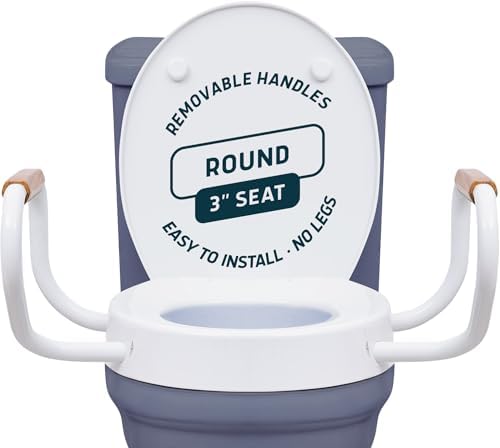
Overview: Solva is designed to look and function like a normal toilet seat while adding real height and support a common request from people who don’t want their bathroom to feel clinical.
Features: It adds 3 inches of seat height and skips the floor-standing legs found on most risers, which removes a tripping hazard and simplifies cleaning around the toilet. The 21-inch handles are removable, so the unit can be converted to a plain, discreet-looking seat when guests are over. It also includes a quick-release hinge for deep cleaning, plus a soft-close lid and anti-slam seat.
Pros:
- Bolts directly to the toilet rather than relying on a clamp, which several buyers specifically called more stable when leaning to one side
- Handles are removable for a normal look when not needed
- Opens and closes like a standard seat, so daily use feels familiar
Cons:
- Requires roughly 8 inches of clearance on each side for the handles
Best For: Someone who wants a raised seat that feels indistinguishable from a regular toilet seat day-to-day.
Installation: Setup involves removing the existing seat and bolting the new one on in its place. Most buyers report finishing in around 10 minutes without special tools.
Comfort & Durability: The 21-inch sitting space between handles is rated to support up to 300 lbs, and reviewers frequently point to the metal-bolt attachment as sturdier than clip-on risers, particularly under side pressure.
Final Verdict: One of the more “invisible” options for someone who doesn’t want their bathroom to look like a care facility, provided their toilet has accessible bolts.
3. HolyHeal Toilet Safety Rails for Seniors
Overview: A foldable safety frame aimed at buyers who want strong support plus portability useful for travel, multiple bathrooms, or apartments where a permanent fixture isn’t practical.
Features & Build Quality: The aluminum frame uses a dual-locking structure along with four large suction-cup pads for grip on tile, plus soft foam handles designed to stay comfortable even with damp hands. Width adjusts from 21 to 27 inches and height from 25 to 31 inches.
Safety: Rated to 350 lbs in its standard configuration (a higher-capacity 500-lb version is sold under the same brand for those who need it).
Advantages:
- Folds flat for storage or travel
- No tools needed, fast setup
- Fits tighter bathrooms thanks to the adjustable width range
Drawbacks:
- Doesn’t raise seat height
- Foldability adds moving parts that need periodic tightness checks
Ease of Assembly & Value: Assembly is tool-free and quick, and the foldable design adds flexibility that fixed-frame competitors don’t offer at a similar price point.

4. Brosive Toilet Seat Riser with Handles
Overview: Brosive’s riser targets buyers who specifically need a higher weight rating without sacrificing adjustability.
Design & Stability: The riser uses a trapezoidal frame design in a high-strength aluminum alloy, built to support up to 500 pounds. The padded, waterproof 16.5-inch seat is intended to stay comfortable during extended sitting.
Height: Seat height adjusts from 19″ to 25″, handle height from about 25.8″ to 32″, and internal width from 25″ to 30″ a wider adjustment range than most competitors offer.
Installation & Cleaning: Tool-free assembly is designed to take roughly five minutes, with all hardware included. The padded seat surface is waterproof and wipes clean easily.
Best Uses: Larger-bodied users, or households with more than one person who needs different height settings.
Pros:
- Highest weight capacity of the group
- Wide adjustment range accommodates different users and toilet sizes
- Padded seat is more comfortable for longer sitting than bare plastic risers
Cons:
- Higher weight capacity means a larger footprint, which may crowd small bathrooms
Overall Recommendation: A strong pick specifically when weight capacity and adjustability matter more than a compact, discreet look.

5. PELEGON Toilet Safety Rails (Raised Toilet Seat with Handles)
Overview: PELEGON’s riser emphasizes precise, customizable fit across a range of body types and bathroom layouts.
Features & Ergonomics: Height adjusts from 16″ to 22″ and handle width from 20.5″ to 24.5″ across six preset positions, with an overall base width of 21″ to 26″. Handles are thickly padded and water-resistant, and the base uses anti-slip rubber feet for grip in wet conditions.
Durability: The frame combines heavy-duty plastic with rust-resistant aluminum. The manufacturer states its products go through lab testing for structural integrity, and the unit is rated to a 400-lb weight capacity.
Performance & Installation: Assembly is tool-free, using a locking mechanism that secures the riser directly to the toilet bowl within a few minutes, and it’s built to fit both standard (round) and elongated bowls without needing a separate version for each.
Best Users: Households where more than one person will use the same toilet, since the six-position width adjustment makes it easy to reconfigure between users.
Pros:
- Very granular height and width adjustability
- Handles detach for tighter spaces or wheelchair transfers
- Works across both round and elongated toilets without buying a separate version
Cons:
- More adjustment points can mean more parts to keep tightened over time
Verdict: A flexible, well-built option for shared bathrooms or anyone who wants to fine-tune the fit rather than pick from fixed sizes.

Raised Toilet Seat with Handles Comparison Table
| Product | Height | Weight Capacity | Material | Adjustable | Handle Style | Foldable | Easy Installation | Best For |
| KMINA Toilet Safety Rails | 25″–29″ | 330 lbs | Steel/plastic | Yes (H/W/D) | Padded armrest | No | Yes, tool-free | Non-permanent, handles-only need |
| Lunderg Solva | +3″ fixed | 300 lbs | Plastic/wood-finish | Handle removal only | Removable wood-finish | No | Bolts on, ~10 min | Discreet, everyday-normal look |
| HolyHeal Toilet Safety Rails | 25″–31″ | 350 lbs | Aluminum | Yes (H/W) | Foam-padded | Yes | Yes, tool-free | Portability, tight bathrooms |
| Brosive Seat Riser | 19″–25″ | 500 lbs | Aluminum alloy | Yes (H/W) | Padded armrest | No | Yes, ~5 min | Higher weight capacity |
| PELEGON Safety Rails | 16″–22″ | 400 lbs | Aluminum/plastic | Yes (H/W, 6 positions) | Padded, detachable | No | Yes, tool-free | Multiple users, custom fit |
Price varies by retailer and changes frequently — check current listings rather than relying on a fixed price range.
READ MORE: Best Smart Pill Dispensers for Medication for Seniors
Raised Toilet Seat with Handles Buying Guide
- Choose the Correct Height: Most raised seats add 2–5 inches. A good rule of thumb: when seated, hips should be level with or slightly higher than the knees. Too much height can make it harder to fully sit down safely.
- Weight Capacity: Select a product whose rated capacity comfortably exceeds the user’s weight rather than one that just meets it stability under real-world, side-loaded pressure matters more than a marginal weight rating.
- Round vs. Elongated Toilets: Measure the bowl before buying. Round bowls measure roughly 16–17 inches front-to-back from the seat bolts; elongated bowls run 18–19 inches. Seat-style risers (like Solva) come in shape-specific versions, while most safety frames are shape-agnostic.
- Locking Mechanism: A secure clamp, bolt, or locking system generally holds up better under side pressure than a loose friction or suction-only fit, especially for someone leaning heavily to one side during a transfer.
- Handle Comfort: Padded, contoured handles reduce strain on arthritic hands. Removable handles offer flexibility for guests or tighter spaces.
- Installation: Tool-free frames take minutes; bolt-on seats take slightly longer but tend to feel more integrated and stable long-term.
- Cleaning: Quick-release hinges and removable seats/handles make a real difference for hygiene, especially for daily caregiver cleaning routines.
- Bathroom Space: Measure clearance on both sides of the toilet handle-style products often need 8+ inches per side.
- Portability: Foldable frames suit travel or multiple households; bolt-on seats are effectively permanent.
- Warranty: Look for at least a 1-year warranty; some brands offer multi-year coverage.
READ MORE: Best Video Doorbell for Seniors: Wireless, Without Subscription, Easy & Safe
Benefits of Raised Toilet Seats with Handles
- Safer, more controlled transfers on and off the toilet
- Reduced fall risk during a high-risk daily activity
- Easier standing with less strain on knees and hips
- Greater independence, which can reduce reliance on a caregiver for routine bathroom visits
- More convenient assistance for caregivers when help is still needed
- Improved comfort for anyone dealing with joint pain
- Less strain on healing joints after hip or knee surgery
- More confidence and less anxiety around daily bathroom use
Who Should Buy One?
- Seniors managing general mobility decline
- People with arthritis
- Larger-bodied users who need a higher weight rating
- Adults with physical disabilities
- Post-surgery patients, including those recovering from hip or knee replacement
- People with Parkinson’s disease
- Stroke survivors rebuilding strength and balance
- People with multiple sclerosis
- Anyone managing chronic pain that makes low seating difficult
Common Mistakes to Avoid
- Ignoring toilet shape (round vs. elongated) before buying a shape-specific seat
- Buying based on height alone without checking weight capacity
- Exceeding the rated weight limit “just a little”
- Skipping proper installation steps, especially tightening bolts or suction pads fully
- Not measuring bathroom clearance before ordering a wide-handle model
- Choosing solely on price without checking stability features
- Failing to periodically check for looseness or wear over months of use
READ MORE: Best Smart TV for Seniors: Easy to Use & Large Screen Picks
Maintenance Tips
- Clean weekly with a standard disinfectant, focusing on padded handle surfaces
- Check bolts and clamps monthly for any looseness
- Inspect handles and padding for cracking or wear
- Replace worn rubber feet or suction pads once grip weakens
- Store foldable frames flat and dry when not in use to protect the locking mechanism
Frequently Asked Questions
What is the best raised toilet seat with handles for seniors?
There’s no single “best” it depends on the need. For a natural, everyday feel, Lunderg’s Solva is a strong pick because it bolts on and functions like a normal seat. For maximum weight capacity, Brosive’s 500-lb riser stands out. KMINA or HolyHeal are better fits.
Are raised toilet seats with handles safe?
Yes, when properly fitted and installed. Look for a rated weight capacity that comfortably exceeds the user’s weight, a secure locking or bolting mechanism rather than loose suction alone, and correct measurement of the toilet before purchase.
Do raised toilet seats fit all toilets?
No. Toilets come in round and elongated bowl shapes, and some raised seats are shape-specific. Bolt-on models also require accessible seat bolts — they generally won’t work with skirted toilets, wall-hung toilets, or toilets with hidden or covered bolts.
What height raised toilet seat is best after hip replacement?
Surgeons commonly recommend added height to avoid excessive hip flexion during recovery, but the exact amount varies by procedure and individual precautions. Many post-surgery patients use a seat that adds 3–5 inches, paired with stable handles for support.
Can Medicare cover raised toilet seats with handles?
Generally, no. Original Medicare (Parts A and B) classifies raised toilet seats as convenience items rather than medically necessary durable medical equipment, so they’re typically not covered.
Conclusion
All five products here solve a real, common problem, just in different ways. If you want a seat that adds height and still feels like a normal toilet seat, Lunderg’s Solva is the closest to invisible. If maximum weight capacity is the priority, Brosive’s 500-lb riser leads the group. If you’d rather not modify the existing seat at all and just need something sturdy to hold onto, KMINA and HolyHeal’s safety frames do that well, with HolyHeal adding the option to fold for storage or travel. And if you need a highly adjustable fit for more than one household member, PELEGON’s six-position frame offers the most flexibility.
Whichever you choose, prioritize a weight rating with real margin, a secure (not just friction-based) attachment method, and a fit that matches your specific toilet shape. A little extra care at the buying stage is what turns a good-looking product into one that actually holds up under daily, real-world use — and that’s what keeps a bathroom safer for the long run.