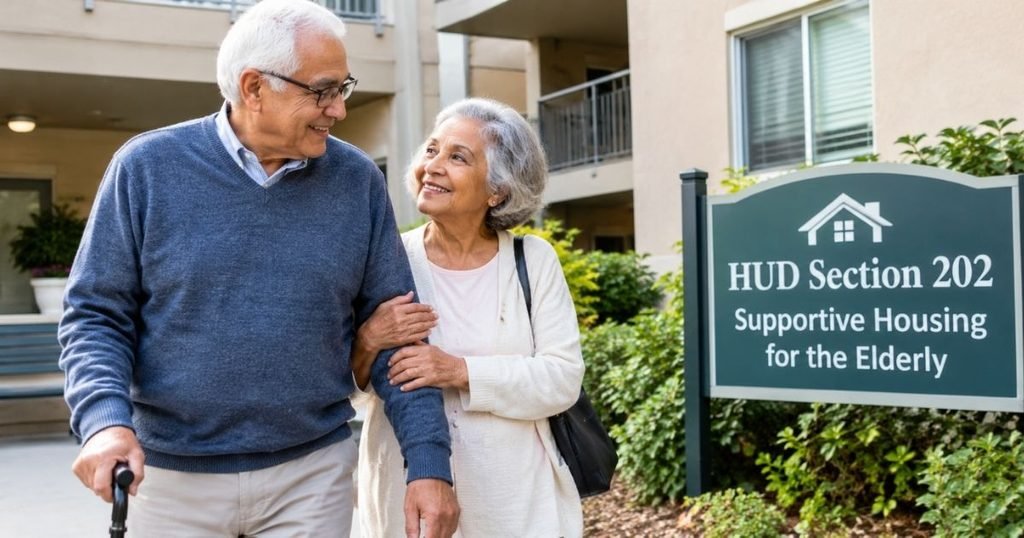
If you are an older adult living on a fixed income or if you are a caregiver, adult child, or spouse trying to help a loved one find a secure place to live you may have heard of HUD Section 202 Supportive Housing for the Elderly.
This valuable federal program helps eligible older adults find affordable rental housing with access to supportive services. However, navigating federal housing programs can feel overwhelming. It is important to know upfront that Section 202 properties are in high demand, many have waiting lists, and the program does not offer “free” or guaranteed housing. Instead, it provides a stable, highly subsidized rental option for those who qualify.
This comprehensive guide will explain exactly what the Section 202 program is, who qualifies, how income limits and rent are calculated, what supportive services are typically available, and, most importantly, how to find and apply for a property near you. Lets deep dive into “HUD Section 202 Supportive Housing for the Elderly: Eligibility & How to Apply”
What Is HUD Section 202 Supportive Housing for the Elderly?
To understand the Section 202 program, it helps to look at why it was created. The program is designed to expand the supply of affordable housing with supportive services for very-low-income older adults.
Ordinary market-rate senior apartments can be incredibly expensive, and standard affordable housing does not always cater to the unique physical or social needs of older adults. The Section 202 program bridges this gap. It helps nonprofits and organizations build and operate properties specifically designed for seniors.
Through Project Rental Assistance Contracts (PRAC), the federal government helps cover the operating costs of the building. This allows the property to charge residents significantly reduced rent while still maintaining the building and offering community-based supportive services.
It is vital to understand what Section 202 is not. Section 202 housing is not an assisted living facility, a nursing home, or a medical care center. Residents live in their own private apartments and must be capable of independent living (either on their own or with the help of community services or a caregiver). The goal of the program is to allow older adults to maintain their independence and “age in place” safely for as long as possible.
READ MORE: Does HUD Offer Grants For Senior Citizens?
Who Qualifies for Section 202 Senior Housing?
Because the program is heavily subsidized, HUD sets strict eligibility guidelines, which are then enforced by the individual property managers. While eligibility depends on HUD rules and the specific property, Section 202 is generally intended for very-low-income older adults.
While specific rules can vary slightly depending on how and when a property was funded, you generally need to meet the following criteria:
- Age Requirement: Generally, at least one adult member of the household must be 62 years of age or older.
- Household Income: The household must qualify as “very-low income” based on HUD’s guidelines for the local area.
- Area Median Income (AMI): Income thresholds are generally set at or below 50% of the Area Median Income for the property’s location.
- Household Composition: The size of the apartment you qualify for will depend on how many eligible people live in your household.
- Citizenship/Eligible Immigration Status: Depending on the property, residents may need to provide proof of U.S. citizenship or eligible immigration status.
- Screening Requirements: Properties will typically conduct background checks, review rental history, and assess whether the applicant can meet the obligations of the lease.
Keep in mind that these requirements are starting points. Meeting the age and income guidelines does not automatically guarantee you a spot in a building. Your eligibility for a particular property will always depend on that specific property’s rules, their screening process, and the availability of units.
What Is the Section 202 Income Limit?
Many seniors wonder, “Exactly how much money am I allowed to make?” There is no single, national dollar amount that applies everywhere. This is because the cost of living in San Francisco, California, is vastly different from the cost of living in rural Ohio.
Instead, HUD uses a metric called Area Median Income (AMI). Generally, to qualify for Section 202 housing, your household income must be at or below 50% of the AMI for the specific county or metropolitan area where the property is located.
When looking at income, property managers consider several factors:
- Gross Income: This includes all the money coming into the household before taxes or deductions. This includes Social Security, Supplemental Security Income (SSI), pensions, retirement account withdrawals, and wages.
- Adjusted Income: HUD allows certain deductions to be subtracted from your gross income to determine your adjusted income. These deductions might include out-of-pocket medical expenses for elderly households, which can help lower your qualifying income.
- Year of the Schedule: Income limits are updated by HUD annually.
An Illustration of Income Limits:
(Please note: This is strictly a hypothetical example to show how limits work, not a universal threshold).
If the Area Median Income for a specific city is $50,000, the 50% AMI limit (very-low income) for a 1-person household might be set at roughly $25,000. If a senior applicant in that city has a gross annual income of $20,000, they would likely meet the income requirement for a Section 202 property in that area.
Because these limits vary so widely by state, county, household size, and year, older adults and their caregivers should always check the current income limits directly with the specific property they wish to apply to.
READ MORE: Emergency Housing Assistance for Seniors: USA Guide
How Much Does Section 202 Housing Cost?
One of the greatest benefits of the Section 202 program is that rent is made affordable for seniors living on fixed incomes.
Rent at a Section 202 property is generally income-based. Typically, a resident’s rent payment is calculated at 30% of the household’s monthly adjusted income.
How is the rest of the rent paid? Section 202 properties typically receive a Project Rental Assistance Contract (PRAC) from HUD. The PRAC covers the difference between what the tenant pays (the 30%) and the actual cost of operating the property.
A Simple Rent Calculation Example:
(This is purely an illustration and not a guaranteed Section 202 rent amount).
- Let’s say a senior’s gross income from Social Security is $1,600 a month.
- After eligible HUD-approved medical deductions, their adjusted monthly income is determined to be $1,500.
- 30% of their adjusted income ($1,500) would be $450.
- In this example, the senior’s monthly rent contribution would be roughly $450.
Rent calculations can differ between properties, and there may be other factors involved, such as whether utilities are included or if a utility allowance applies. Seniors should always ask the property manager for a written estimate or explanation of the actual tenant payment calculation before signing a lease.
READ MORE: Help for Seniors Facing Eviction
What Supportive Services Are Available?
The word “supportive” in Section 202 Supportive Housing for the Elderly is a key feature of the program, but it is often misunderstood. It does not mean the building is a medical facility, nor does it guarantee that nurses or doctors are on staff.
Instead, supportive services are generally intended to help eligible residents live independently, maintain their health, and age in place safely in their community. Depending on the property and local community partnerships, available services may include:
- Transportation assistance (such as shuttles to grocery stores or medical appointments)
- Housekeeping-related support or light chore assistance
- Meal or nutrition resources (such as Meals on Wheels coordination or on-site congregate meals)
- Social services and benefits assistance
- Community programs and social activities to prevent isolation
- Health-related community services (such as visiting wellness clinics or fall-prevention classes)
Availability varies heavily by property. Do not assume that every Section 202 building provides every service. Often, these services are coordinated by a dedicated staff member known as a service coordinator.
What Is a Section 202 Service Coordinator?
Many Section 202 properties utilize a Service Coordinator. The primary goal of a service coordinator is to link elderly residents to supportive services in the general community to help prevent premature and unnecessary institutionalization.
A service coordinator is an advocate and a resource guide. They assess individual resident needs, determine eligibility for public programs, and link residents to appropriate local services. For example, if a senior is struggling to afford groceries, the service coordinator might help them apply for SNAP benefits or connect them with a local food pantry. If a resident has a fall and needs temporary in-home help, the coordinator can help the family arrange for local home-health aides.
It is important to make clear that a service coordinator is generally not a doctor, nurse, or caregiver. They may not provide supportive services directly or serve as the property’s recreational director. Their job is purely coordination acting as a bridge between the senior and the resources they need to maintain housing stability and age in place.
READ MORE: Can Seniors on Social Security Benefits Get Free Affordable Housing?
How to Find HUD Section 202 Housing Near You
Because the Section 202 program involves many independently owned and managed properties, there is no single national application form. Finding a property requires a bit of research. Here is a practical step-by-step process:
Step 1: Use HUD’s Housing Resources
Start by going online to the official HUD Resource Locator tool (resources.hud.gov). This interactive map allows you to search for affordable elderly housing by city, state, or ZIP code.
Step 2: Search for Section 202 Properties
Look specifically for properties designated for seniors or the elderly. Keep in mind that properties can be operated by different nonprofit owners or management companies, meaning availability, waitlists, and exact requirements will vary from building to building.
Step 3: Contact the Property Directly
Since most searches start with the property itself, you or your family member must contact the management office of the buildings you are interested in.
Step 4: Apply as Soon as Possible
Waiting lists can be long. When you find a suitable property with an open waiting list, request an application immediately and follow the property’s submission instructions carefully.
What to Ask the Property Manager
When you call a Section 202 property, it is highly useful to have a checklist of questions ready:
- Is the waiting list currently open or closed?
- What is the current very-low-income limit for a household of my size?
- How is the tenant rent payment calculated here?
- What utilities are included in the rent, if any?
- Does the property have a dedicated service coordinator?
- What specific supportive services or community programs are available?
- Are accessible units (e.g., roll-in showers, grab bars) available?
- What specific documents are required to apply?
- Roughly how long is the current waiting time?
- Can I apply online, by mail, or do I need to apply in person?
- Are there any application or background check fees?
- What happens if my income changes while I am on the waitlist?
READ MORE: Low-Income Senior Housing With No Waiting List | Immediate Move-In
How to Apply for Section 202 Housing
Applying for federal housing assistance requires patience and organization. Each property may ask for different documents, so families can often reduce delays by preparing a basic folder of paperwork before calling or applying.
Potential Application Documents:
- Government-issued identification (State ID, Driver’s License, or Passport)
- Social Security card or official benefit documentation
- Proof of age (Birth certificate)
- Proof of income (Social Security award letters, pension statements, wages)
- Bank or asset information (Recent bank statements)
- Tax documents, when requested
- Disability/accessibility documentation, if requesting a reasonable accommodation
- Contact information for emergency contacts or caregivers
The General Application Process:
- Find a property: Locate a Section 202 property in your desired area.
- Contact management: Call or visit the property manager and ask whether the waiting list is open.
- Request an application: Obtain the application packet directly from the property.
- Submit documentation: Fill out the forms completely and attach the required proof of income, age, and identity.
- Respond to requests: Property management may reach out to verify your information. Respond promptly so your application is not discarded.
- Wait for availability: Once approved for the waitlist, you must wait for your name to reach the top and for an appropriate unit to become vacant.
- Complete the lease: When selected and your final eligibility is reviewed, you will complete the leasing process and move in.
How Long Is the Section 202 Waiting List?
One of the hardest truths about affordable senior housing is the waiting time. Waitlists are common for Section 202 housing.
There is no standard, national average waiting time. Waiting times vary significantly based on:
- Local demand for affordable senior housing
- The total number of units in the building
- The natural turnover rate of current residents
- The specific type of unit you need (e.g., a one-bedroom versus an accessible studio)
- The size of the local senior population
In some rural areas, a waitlist might be a few months. In high-demand metropolitan areas, waiting lists can be several years long or the property might close the list entirely because it has reached capacity. Because of this, seniors are frequently encouraged to apply to multiple suitable properties where permitted to increase their chances of securing housing.
READ MORE: Homeless Shelter for Seniors | Free Housing & Support Programs
Section 202 vs. Section 8 vs. Public Housing
Navigating government acronyms can be confusing. Here is a clear comparison of how Section 202 differs from other common low-income housing programs.
| Feature | Section 202 | Section 8 (Housing Choice Vouchers) | Public Housing |
| Primary population | Older adults | Eligible low-income households | Eligible low-income households |
| Age focus | Generally 62+ | Not necessarily age-specific | Not necessarily age-specific |
| Housing type | Senior-focused affordable housing | Varies (private market rentals) | Public housing developments |
| Rent assistance | Property-based assistance may apply | Depends on program type (Voucher travels with tenant) | Housing authority-based |
| Supportive services | May be available | Depends on property/program | Depends on property |
| Application | Usually property-specific | Depends on program (Usually Local Housing Authority) | Usually housing authority |
| Waiting list | Can apply (Property manages list) | Often applies (Authority manages list) | Often applies (Authority manages list) |
It is important to note that one program is not universally “better” than another. Section 202 is specifically built for seniors needing a supportive environment, whereas Section 8 gives renters the flexibility to find housing in the private market, subject to program rules.
Section 202 vs. Other Senior Housing Options
Beyond HUD programs, seniors have other housing options. Here is a brief look at how Section 202 compares to them:
- Low-Income Housing Tax Credit (LIHTC) Apartments: These are also affordable senior apartments, but rents are typically set at a flat rate below market value rather than being strictly 30% of your personal income.
- Assisted Living: Assisted living facilities provide hands-on medical care, medication management, and daily dressing/bathing assistance. Section 202 is independent living and does not automatically provide these medical services.
- Nursing Homes: Nursing homes provide 24/7 skilled medical care. Section 202 properties do not.
- Medicaid-Supported Long-Term Care: Medicaid may help pay for nursing homes or assisted living for eligible low-income seniors. Section 202 is a HUD housing program, completely separate from Medicaid long-term care programs.
Can Seniors With Disabilities Live in Section 202 Housing?
Yes. The Section 202 program supports older adults, many of whom may have mobility issues or age-related disabilities. Section 202 properties are designed with the elderly in mind, often featuring accessible common areas, elevators, and physical features that make aging in place easier.
Seniors with disabilities can request reasonable accommodations from the property management. This might include requesting a fully accessible apartment (such as one with a roll-in shower or lowered countertops), requesting permission to have a service animal or assistance animal where applicable, or asking for communication accommodations regarding lease documents. Management is generally required to accommodate reasonable requests that allow a resident to fully use and enjoy the housing, though specific capabilities depend on the building’s architecture and federal guidelines.
Can a Married Couple Qualify for Section 202 Housing?
Household composition directly affects eligibility, but married couples certainly can qualify. Generally, at least one adult member of the household must be 62 years of age or older. For example, if a married couple applies and one spouse is 62 while the other is 58, they may meet the age requirement for the household.
However, simply having one spouse who is 62+ does not guarantee eligibility. The property manager will look at the combined household income to ensure it falls below the very-low-income limit for a two-person household in that area. Furthermore, the couple must comply with the property’s occupancy rules regarding unit size.
Can Seniors With Social Security or SSI Qualify?
Absolutely. In fact, Social Security retirement benefits, Supplemental Security Income (SSI), Social Security Disability Insurance (SSDI), and small pensions are the most common forms of income for Section 202 residents.
Receiving these benefits does not automatically disqualify someone. Instead, these benefit amounts are counted as gross income when the property manager determines your eligibility and calculates your rent. For a senior living exclusively on a fixed SSI or Social Security income, the Section 202 program is highly beneficial because rent is capped at a percentage of that fixed income, shielding them from sudden market rent spikes.
Does Section 202 Housing Include Utilities?
Utility arrangements differ heavily by property. In some Section 202 properties, major utilities (like water, trash, and sometimes electricity) are included in the monthly rent payment. In other properties, residents are responsible for paying their own utility bills directly to the local utility companies.
If tenants are required to pay their own utilities, HUD properties typically factor in a “utility allowance.” This allowance is a pre-calculated amount deducted from your expected rent contribution to help ensure that your combined rent and utility burdens remain affordable. Always ask the property manager for a written explanation of exactly what your monthly payment covers and what additional bills you should expect.
What If the Section 202 Property Has a Closed Waiting List?
Because demand is so high, it is not uncommon to find that a Section 202 property has completely closed its waiting list to new applicants. If this happens, you should explore practical alternatives:
- Check other Section 202 properties in neighboring towns or counties.
- Contact your local Public Housing Authority (PHA) to ask about the Housing Choice Voucher (Section 8) waiting list or public housing specifically designated for seniors.
- Look into state housing programs or LIHTC senior properties.
- Reach out to local nonprofit senior housing organizations.
- Contact your local Area Agency on Aging (AAA), which can often provide referrals to community assistance organizations that help with housing navigation.
While these alternatives are not guaranteed to have immediate availability either, casting a wide net is the best strategy for securing affordable housing.
Common Mistakes to Avoid When Applying
Navigating affordable housing is complex. Avoid these common pitfalls:
- Assuming Section 202 means free housing: Rent is heavily subsidized, but tenants still pay a portion of their income.
- Using outdated income limits: HUD updates limits annually; always ask for the current year’s numbers.
- Applying only to one property: Put your name on multiple open waiting lists if permitted.
- Ignoring waiting-list instructions: Properties will occasionally mail letters asking if you want to remain on the list. If you do not reply, you will be removed.
- Failing to report changes: Always update the property if your contact information, household size, or income changes dramatically while you are waiting.
- Not keeping copies: Make copies of your application and any correspondence.
- Missing deadlines: Respond to property management requests immediately.
- Assuming every property offers the same services: Service coordinators and programs vary.
- Paying someone who claims they can guarantee HUD housing: This is a major red flag for fraud.
- Giving sensitive personal information to an unverified housing website: Always verify you are dealing with official HUD resources or the actual property management company.
How to Avoid Section 202 Housing Scams
Unfortunately, scammers frequently target older adults searching for affordable housing. Seniors and caregivers should be highly cautious of websites, companies, or individuals making unrealistic promises.
Avoid anyone offering “guaranteed approval,” “immediate housing,” or “guaranteed placement” for a fee. There is no such thing as a “secret” HUD apartment that you can access by paying a broker. Applications for Section 202 waitlists are processed by the properties themselves, and paying an upfront fee to a third party will not bypass the waitlist or guarantee a spot.
Always verify properties through the official HUD Resource Locator (hud.gov) and contact the property management directly to submit an application.
Frequently Asked Questions (FAQs)
What is HUD Section 202 supportive housing for the elderly?
HUD Section 202 is a federal program that expands affordable rental housing integrated with supportive services for very-low-income seniors. It provides funding to nonprofits to develop senior apartments and offers project-based rental assistance to keep rents affordable. The program is designed to help older adults age in place safely while living independently, rather than acting as a medical facility or nursing home.
What are the income limits for Section 202 housing?
Income limits are not a single national dollar amount. Instead, they depend on the Area Median Income (AMI) of the specific county or city where the property is located. Generally, a household must be categorized as “very-low income,” meaning their income is at or below 50% of the local AMI.
How do I apply for Section 202 housing for seniors?
There is no universal, national application form. Most searches start with the specific property. You must find a participating Section 202 property in your area, contact the management office, and ask if their waitlist is open. If it is, you will request their specific application packet, complete it, and submit it along with necessary documentation like proof of age, identity, and income.
How much rent do seniors pay in Section 202 housing?
Rent is generally income-based to remain affordable for seniors on fixed incomes. Typically, a resident in a Section 202 property pays approximately 30% of their household’s monthly adjusted income toward rent. A HUD Project Rental Assistance Contract (PRAC) helps cover the remaining operating costs of the unit.
How do I find Section 202 housing near me?
The safest and most reliable way to find Section 202 properties is to use the official HUD Resource Locator available on the U.S. Department of Housing and Urban Development website. This interactive map allows you to search for affordable elderly housing by your city or ZIP code. Once you find a list of local properties, you can call them directly to inquire about unit availability, age requirements, and waiting lists.
Sources
- U.S. Department of Housing and Urban Development (HUD)
- HUD Section 202 Supportive Housing for the Elderly Program Guidelines
- HUD Multifamily Housing Division
- HUD Resource Locator
- Official Federal Regulations for Multifamily Housing Service Coordinators
Disclaimer: This article is for informational purposes only and does not constitute financial, legal, or official housing authority advice. Housing program guidelines, income limits, and rent calculations are subject to change. Always consult directly with the U.S. Department of Housing and Urban Development (HUD) or local property management for the most accurate and current application requirements.