The landscape of long-term care in New York has undergone a fundamental transformation as of 2026, driven by an aging population that increasingly prefers to remain in the home rather than transition to institutional settings. For many families, this preference creates a significant economic and physical burden, as adult children, siblings, and friends find themselves performing essential activities of daily living for their loved ones without initial compensation. A frequent question — “How to Get Paid as a Family Caregiver in New York: CDPAP, VA & How to Apply” — points directly to available solutions: the state’s commitment to consumer-directed care has solidified through the Consumer Directed Personal Assistance Program (CDPAP) and various federal veterans’ initiatives, allowing these informal supports to become formal, paid personal assistants.
This guide explains the main ways New Yorkers get paid for family caregiving, who qualifies, how much people typically make, and the exact next steps.

What Paid Family Caregiving is in New York: CDPAP New York, VA and MLTC
Paid family caregiving in New York means the care recipient (the person who needs help) gets benefits that allow them to hire and pay a caregiver — often a family member. The most widely used state route is the Consumer Directed Personal Assistance Program (CDPAP). Under CDPAP, an eligible Medicaid member can recruit and direct their own personal assistant (PA). A fiscal intermediary handles payroll, taxes, and benefits; until recently New York moved to a single statewide fiscal intermediary. For program basics, see the New York State Department of Health’s CDPAP page.
Public Partnerships LLC (PPL) has been named the statewide fiscal intermediary to manage CDPAP payroll and administration — meaning many caregivers now enroll through PPL and the Medicaid plan or local department of social services (LDSS) coordinates authorization. Fiscal intermediaries do not decide eligibility; they process payroll and benefits once services are authorized. For an FI overview see PPL’s New York CDPAP FAQ pages.
For veterans, the U.S. Department of Veterans Affairs administers a separate caregiver benefit (PCAFC) with its own eligibility rules and stipend framework; that program is separate from Medicaid/CDPAP and is managed by VA caregiver services.
Quick snapshot
| Program / Route | Who can be paid (family allowed?) | Typical eligibility for the care recipient | Typical pay range (varies by county/plan) | How to apply / who to contact | Pros / Cons |
| CDPAP (New York Medicaid) | Most family members & friends; exclusions apply (spouses/parents-of-minor). | Must be Medicaid-eligible with assessed need for personal assistance. | $18.10–$23.81/hr in 2026 (varies by region). | Apply through Medicaid plan or county LDSS; enroll with PPL. | Pros: Flexible, family-centered. Cons: Paperwork, regional rate differences. |
| VA PCAFC (Veterans) | Family caregivers for qualifying veterans (primary/secondary). | Veteran must meet program service-connection & care needs. | Monthly stipends based on GS-4 Step 1 locality rates. | Apply via VA caregiver support services. | Pros: Stipend + health insurance; Cons: Stringent eligibility. |
| MLTC Consumer-Directed | Depends on plan. | MLTC-enrolled members with long-term needs. | Pay depends on plan and authorization. | Contact MLTC plan care manager. | Pros: Coordinated services; Cons: May be plan limits. |
| Private-pay / Home care agency | Agencies hire aides (family rarely paid directly). | N/A (Self-funded) | Market rates vary | Contact local home care agencies. | Pros: Consistent payroll/taxes; Cons: Higher personal cost. |
READ MORE: Free Dental Clinics for Seniors in New York City
How to Get Paid as a Family Caregiver in New York: Eligibility rules and common exclusions
Basic eligibility focuses on two sides: the care recipient and the caregiver.
1. Care recipient (person who needs care)
Because CDPAP is a Medicaid program, the care recipient must first qualify for New York State Medicaid. This requires meeting specific income and asset thresholds, which are adjusted annually. For seniors (ages 65+) and those with disabilities, the 2026 limits are particularly relevant.
Medicaid Financial Thresholds
The income and asset limits for New York Medicaid long-term care in 2026 are structured to allow individuals with modest means to access services while requiring those with significant resources to “spend down” or engage in Medicaid planning.
| Category (65+ or Disabled) | Monthly Income Limit | Resource (Asset) Limit |
| Single Individual | $1,836 | $33,038 |
| Married Couple (Both applying) | $2,489 | $44,796 |
| Married (One spouse applying) | $1,836 (Applicant) | $33,038 (Applicant) / $162,660 (Non-applicant spouse) |
New York’s “Spousal Impoverishment” rules provide significant protection for the community spouse, the partner who does not require care. In 2026, the community spouse can retain up to $162,660 in assets, ensuring they are not forced into poverty to pay for their partner’s home care. Additionally, the primary home is generally exempt if the applicant’s equity is below $1,130,000, or if a spouse or minor child resides there.
The September 2025 Minimum Needs Pivot
Beyond financial qualifications, a care recipient must demonstrate a clinical need for assistance. A physician must first sign a physician’s order—a standard medical form confirming that the patient is in a stable medical condition but requires help with personal care or nursing tasks.
A major shift in 2026 involves the “Minimum Needs Requirements” implemented on September 1, 2025. These rules set a higher bar for new applicants to ensure that home care resources are directed toward those with the most significant needs. To qualify for CDPAP in 2026, new applicants must be assessed through the New York Independent Assessor (NYIA) system and meet the following functional thresholds:
- General Requirement: Individuals must be assessed as needing at least limited assistance with physical maneuvering for more than two Activities of Daily Living (ADLs).
- Dementia/Alzheimer’s Diagnosis: Recognizing the unique challenges of cognitive decline, the state allows a lower threshold for those with a documented diagnosis. These individuals must be assessed as needing at least supervision with more than one ADL.
- Legacy Status: Individuals who were already authorized or receiving services prior to September 1, 2025, are granted “Legacy Status” and continue to be reassessed using the older criteria.
For those with cognitive impairments, the Alzheimer’s Disease or Dementia Form (DOH-5821) must be completed by a physician to qualify under the specialized threshold.
2. Caregiver (the person who wants to be paid)
CDPAP is designed to allow the consumer to hire many family members and friends as paid PAs. Most relatives, adult children, siblings, in-laws, nieces/nephews, and friends can be hired. However, some relatives are excluded under particular rules or local policies: examples commonly cited include paying a spouse or parents of minors under certain circumstances. These exclusions vary by the policy or county/plan, so check your local LDSS or the fiscal intermediary’s FAQ. PPL and other CDPAP resources list typical exclusions and paperwork requirements.
3. Practical notes
Many people must be enrolled in a managed care plan (often an MLTC plan) or otherwise connected to Medicaid to access CDPAP — the plan or LDSS opens the intake and care assessment. In some counties the LDSS performs intake directly. Always confirm which office handles intake in your county or for your plan.
READ MORE: Salvation Army Free Car Program (Eligibility & How to Apply)
Step-by-step: How to apply for CDPAP in New York
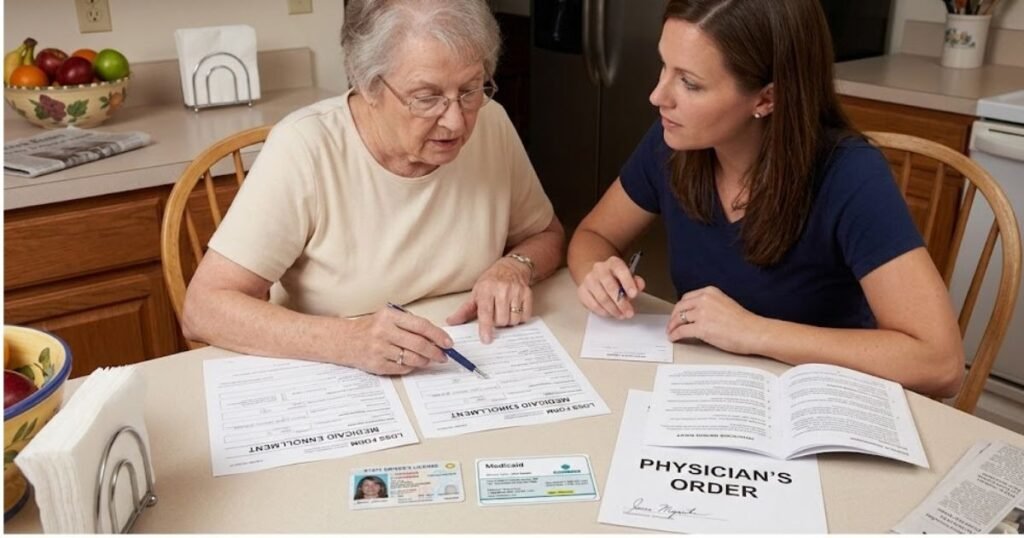
Below is a practical, step-by-step pathway that reflects how most New Yorkers move from interest to paid work. Exact forms and contacts vary by county and plan.
1. Check Medicaid eligibility and plan status.
Confirm the care recipient has active Medicaid (or is enrolling) and whether they’re in a Managed Long-Term Care (MLTC) or other Medicaid managed plan. If they’re unsure, call their Medicaid plan’s member services or the county LDSS.
2. Request an assessment / clinical intake.
Ask the plan care manager or LDSS for a home care/needs assessment. The assessor documents ADLs/IADLs and whether CDPAP or consumer-directed services are appropriate. The clinician’s recommendation leads to service authorization.
3. Service authorization.
If the clinical team authorizes consumer-directed personal assistance hours, the plan or LDSS issues an authorization that lists approved hours and services. Keep a copy it’s essential for payroll and appeals.
4. Choose a fiscal intermediary / payroll vendor.
New York has transitioned to a single statewide FI for CDPAP payroll in many situations; confirm whether your county or plan requires enrollment with the statewide FI (Public Partnerships LLC) or a different vendor. The fiscal intermediary handles background checks, payroll, tax withholding, and benefits for the caregiver.
5. Enroll the caregiver.
The caregiver provides ID, proof of eligibility to work, direct deposit info, W-4 and state tax forms, Social Security number, and other paperwork the FI requests. The consumer (or authorized representative) must sign employer-of-record documents that name the caregiver. Expect identity verification and sometimes a background check per the FI’s rules.
6. Start recordkeeping and timekeeping.
Use the FI’s time-keeping tools (paper timesheets or an app, depending on the vendor). Accurately record start/stop times, tasks performed, and any travel or mileage claims allowed by your FI or plan. In recent system transitions, some caregivers experienced time-entry problems if hours look wrong, contact the FI and your plan care manager immediately. (A CDPAP caregiver named Jamie Moore told a local TV station: “It’s saying total time worked is 33 hours well no, that’s not true. I didn’t work 33 hours and I’m only approved to work 15.”)
7. Payroll and benefits.
Once the FI processes timesheets, the caregiver receives pay according to the authorized hours and pay rate. The FI should withhold payroll taxes and provide wage statements. Ask your FI about direct deposit timing, payroll cycles, overtime rules, holiday pay, and benefits.
8. If things go wrong: appeals and advocacy.
If an authorization is denied or hours are changed, ask for a written notice and the appeal instructions. Contact your plan care manager and county LDSS for help. If you suspect fraud or payment problems, the New York Office of the Medicaid Inspector General (OMIG) and your plan’s member services are the channels to report concerns.
Practical paperwork checklist for caregivers (bring to first meeting)
- Photo ID (driver’s license or state ID)
- Social Security number or ITIN
- Direct deposit info (bank routing/account)
- W-4 and any state tax withholding forms
- Your Medicaid card (for the care recipient) and physician order or assessment (if available)
- Completed employer-of-record forms from your FI (PPL or other)
READ MORE: Habitat For Safe Seniors Free Ramp Program (Eligibility & How to Apply)
Family Caregiver Pay Rates in New York
Compensation for family caregivers is not uniform across New York. Rates are dictated by regional minimum wage laws for home care aides and the reimbursement schedules set by the Department of Health.
Typical Pay and Overtime Rules
In 2026, pay rates vary significantly based on the locality of the work performed. CDPAP caregivers typically earn 15-25% more than traditional home health aide agency workers due to the flexibility of the program.
| Region | 2026 Standard Hourly Rate | Overtime Rate (1.5x) |
| New York City (5 Boroughs) | $23.81 | $35.72 |
| Long Island (Nassau & Suffolk) | $23.81 | $35.72 |
| Westchester County | $23.81 | $35.72 |
| Hudson Valley (Rockland, Orange) | $19.10 | $28.65 |
| Western NY (Buffalo, Rochester) | $18.10 | $27.15 |
| Capital Region (Albany) | $18.10 | $27.15 |
Overtime pay is triggered after a caregiver works more than 40 hours in a single workweek. It is important to note that all overtime must be authorized within the consumer’s approved care plan. Caregivers are W-2 employees of the fiscal intermediary, meaning taxes are withheld automatically.
For live-in caregivers providing 24-hour care, the 2026 rates in New York City are approximately $354.63 per day, typically reflecting payment for 13 hours of work with 11 hours set aside for sleep and meals.
READ MORE: Can Seniors Get Free Window Replacement Grants
VA Caregiver Stipend New York (PCAFC and Aid & Attendance)
For families of veterans, the federal government offers a separate set of benefits that do not require Medicaid eligibility. These programs are managed by the U.S. Department of Veterans Affairs (VA) and are specifically for caregivers of veterans with service-connected conditions.
Program of Comprehensive Assistance for Family Caregivers (PCAFC)
The PCAFC provides a monthly tax-free stipend, health insurance (through CHAMPVA), mental health counseling, and at least 30 days of respite care per year. To be eligible, the veteran must have a combined service-connected disability rating of 70% or more and need personal care services for a minimum of six continuous months.
The stipend amount is calculated based on the Office of Personnel Management (OPM) General Schedule (GS) Annual Rate for grade 4, step 1, in the veteran’s locality.
- Level 1 (Lower Need): The stipend is 62.5% of the monthly GS-4 Step 1 rate.
- Level 2 (Higher Need): The stipend is 100% of the monthly GS-4 Step 1 rate for veterans unable to self-sustain in the community.
In the New York City locality area, the 2026 GS-4 Step 1 annual rate is $42,907, meaning a Level 1 caregiver receives approximately $2,234.74 per month.
VA Aid & Attendance Pension
The Aid & Attendance benefit is an “add-on” to the basic veterans’ pension for wartime veterans who require help with daily activities or are housebound. In 2026, this benefit can provide up to $2,874 per month tax-free for a married veteran to help cover care costs, including hiring family members. Unlike PCAFC, Aid & Attendance is a needs-based pension program and does not require a service-connected injury.
Paid Family Caregiver NY: Systemic Integrity and Fraud Prevention
The expansion of CDPAP has been met with increased oversight from the state. New York’s transition to a single statewide fiscal intermediary (PPL) in 2025 was aimed at rooting out fraud and abuse, including schemes that have cost the state tens of millions of dollars.
As PPL President Maria Perrin stated during the transition: “We are seeing incredible turnout… and are focused on delivering a stronger CDPAP that serves their needs for years to come”.
READ MORE: Overnight Care for Elderly | In-Home & Assisted Care Options
Consumer Directed Personal Assistance Program NY: Risks and Red Flags
Families should be aware of several risks and program changes:
- Fraud Oversight: The state has issued cease and desist letters to agencies providing false information about the PPL transition or charging illegal fees to workers for training.
- Administrative Middlemen: The move to a single FI (PPL) is intended to save $1 billion annually by reducing wasteful spending on administrative middlemen.
- Compliance Deadlines: All caregivers must complete registration and required training through the Nevvon portal by mandated deadlines (e.g., March 31, 2026) to remain compliant and ensure payment.
- Electronic Visit Verification (EVV): Caregivers must use the Time4Care app or a telephony system to log hours in real-time. Paper timesheets are increasingly restricted.
How to Get Paid to Care for Parent NY: Checklist
Navigating the bureaucracy of New York home care requires persistent communication with local agencies.
Real-Life Checklist
- [ ] Confirm active Medicaid status for the care recipient.
- [ ] Obtain a signed Physician’s Order (DOH-4359) from the primary doctor.
- [ ] Call the New York Independent Assessor (1-855-222-8350) for a CHA evaluation.
- [ ] Choose an MLTC plan and request CDPAP authorization.
- [ ] Register both consumer and caregiver at pplfirst.com/cdpap.
- [ ] Complete the caregiver medical screening and Nevvon portal training.
Frequently Asked Questions
Can I get paid to care for my parent in New York?
Yes — many New Yorkers are paid through CDPAP or similar consumer-directed Medicaid options if the care recipient is Medicaid-eligible and has a documented medical need. Check local exclusions and enrollment steps with your county LDSS or plan.
What is CDPAP and how does it work in New York?
CDPAP lets a Medicaid recipient hire and direct their own personal assistant (including many family members). The state authorizes services; a fiscal intermediary processes payroll and benefits once services are authorized.
How much will I get paid as a CDPAP caregiver in NY?
Pay varies by county, plan, and shift; recent 2026 reporting shows many areas paying in the roughly $18–$24/hr range for regular hours, with higher overtime rates in some counties. Verify current rates with your fiscal intermediary or plan.
Can a spouse or parent be paid under CDPAP?
There are restrictions — many programs limit paying spouses or parents of minors in certain situations. Rules vary by county and plan; confirm with PPL/plan FAQ or your LDSS.
Are there federal options for caregivers of veterans in New York?
Yes — the VA’s Program of Comprehensive Assistance for Family Caregivers (PCAFC) may provide a monthly stipend, training, and services for qualifying veterans’ caregivers; it is separate from Medicaid programs. Contact VA caregiver support for details.
Final Verdict
If family care is already part of your life, it’s worth checking whether CDPAP or VA caregiver benefits apply the paperwork can pay off. Start by calling the care recipient’s Medicaid plan or county LDSS and keep copies of every authorization and timesheet. If you want, I can turn the checklist above into a printable one-page PDF you can use at calls and meetings.
Sources consulted
New York State Department of Health — Consumer Directed Personal Assistance Program (CDPAP) (NYS DOH).
- NYS DOH — CDPAP rates and fiscal intermediary info.
- Public Partnerships LLC — New York CDPAP FAQ and program page.
- U.S. Department of Veterans Affairs — Program of Comprehensive Assistance for Family Caregivers (PCAFC) and caregiver support pages.
- Recent reporting on CDPAP rates and regional variation (example reporting 2026).
- Local news coverage of CDPAP transition and caregiver payment problems (example caregiver quote).
- New York Office of the Medicaid Inspector General (OMIG) — fraud reporting and 2026 work plan.
- Oversight and news reports about program reform and transition issues (for red-flag context).