The HISA (Home Improvements and Structural Alterations) benefit is a VA medical program that helps eligible veterans pay for medically-necessary home modifications (ramps, widened doorways, roll-in showers, electrical for life-support equipment). Lifetime benefits are either $6,800 or $2,000 depending on service connection and date rules. You must have a VA prescription/medical justification and submit VA Form 10-0103 to your local Prosthetic & Sensory Aids Service (PSAS). VA may provide a 50% advance payment after approval. Read below for step-by-step guidance, timelines, pitfalls, and a printable checklist. Lets deep dive into “HISA Grant for Veterans: How It Works & How to Apply”
What is the HISA Grant?
If you are a veteran or a caregiver for a senior veteran, you know that “aging in place” is often the preferred choice. However, a home that was perfect 30 years ago can become a series of obstacles as mobility changes. This is where the HISA grant comes in.
HISA stands for Home Improvements and Structural Alterations. It is not a traditional housing grant like the Specially Adapted Housing (SAH) grant; instead, it is a medical benefit managed by the VA’s Prosthetic and Sensory Aids Service (PSAS).
The core purpose of HISA is to ensure that a veteran can enter and leave their home safely and access essential sanitary facilities (like the bathroom). Whether it is widening a front door to accommodate a walker or lowering a sink for wheelchair access, HISA provides the financial “bridge” to make these medically necessary changes possible. Because it is a medical benefit, the primary requirement is that the modification must be necessary for the continuation of your treatment or for disability access.
READ MORE: Habitat For Safe Seniors Free Ramp Program (Eligibility & How to Apply)
Who is Eligible?
One of the most common misconceptions about VA benefits is that you must have a 100% disability rating to qualify for help. With the HISA grant, that is simply not true.
The VA divides eligibility into two distinct “tiers” based on your service history and disability status.
The Two Tiers of Funding
- Service-Connected Veterans ($6,800 Lifetime Limit): * Veterans who have a condition rated as service-connected.
- Veterans with a non-service-connected condition who are rated at 50% or more for their combined service-connected disabilities.
- Veterans seeking modifications for a condition related to treatment under 38 U.S.C. 1151 (disabilities resulting from VA hospitalization or treatment).
- Non-Service-Connected Veterans ($2,000 Lifetime Limit): * Veterans who are enrolled in the VA health care system but whose need for home modification is not related to a service-connected disability.
Special Considerations
- Renters: You do not have to own your home to use a HISA grant. If you rent, you can still apply, but you must provide a written statement from your landlord giving permission for the specific structural changes.
- Property Type: The grant can be used for your primary residence. It generally cannot be used for vacation homes or temporary housing.
- Lifetime Benefit: It is important to remember that these dollar amounts are lifetime limits. If you use $3,000 for a ramp this year, you would have $3,800 remaining for future needs (if you are in the service-connected tier).
Example scenarios
- Mary, a veteran with a 70% service-connected mobility disability, needs a roll-in shower. She may qualify for up to $6,800 for medically-necessary work.
- Joe, a veteran with no service-connected disability but who uses oxygen for a non-service condition and is registered with VA care, may be eligible for $2,000 if the modification is medically necessary.
READ MORE: Free Bathroom Remodel for Seniors
How Much Can You Get?
- Lifetime benefit amounts: $6,800 for higher-tier cases (service-connected conditions, 50%+ rules, some 1151 cases). $2,000 for other eligible veterans who applied on/after May 5, 2010. These are lifetime maximums — one total pool per beneficiary. VA will confirm your available lifetime balance when you apply. (Bold: $6,800 and $2,000.)
- What that typically covers: The HISA payment can be used for labor, materials, permits, and inspections to accomplish medically justified modifications. It does not pay for decorative or purely cosmetic work. Typical costs that HISA helps cover include ramps, accessible bathrooms, widened doorways, stair lifts (sometimes), and electrical upgrades to power life-support equipment.
- If the project costs less than your approved amount, the unused balance remains in your lifetime benefit and may be used later (subject to program rules). If you receive an advance payment and the final cost is less than the advance, you must repay the difference.
Pro Tip: HISA funds can be used in conjunction with other VA grants. If you are eligible for the larger SAH (Specially Adapted Housing) grant, you can often use HISA for smaller, immediate needs while the larger project is being planned.
What Modifications are Covered (and What’s Not)?
The VA is very specific about what they will pay for. The keyword is “medically necessary.” The modification must solve a specific physical barrier mentioned in your doctor’s prescription.
Common Covered Modifications:
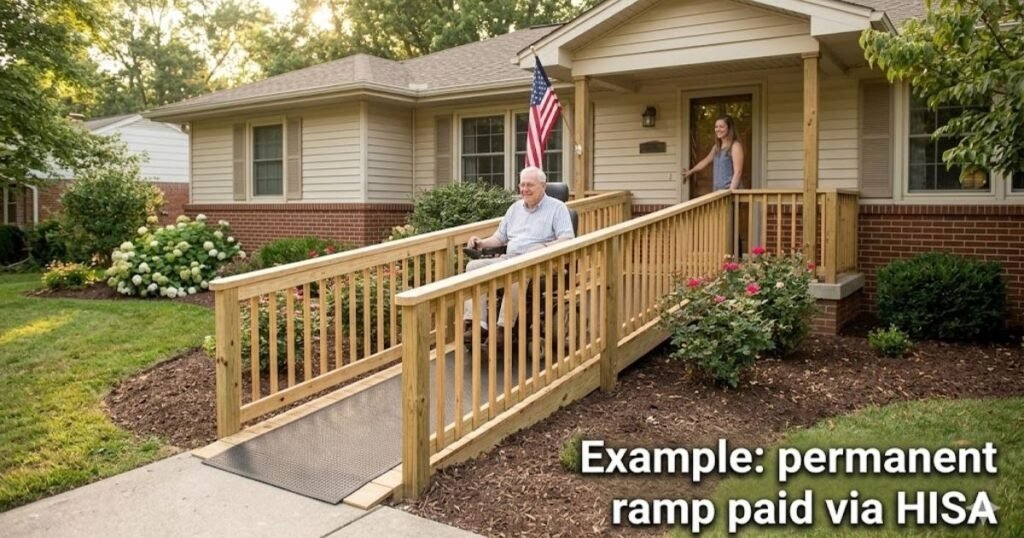
- Ramps: Permanent or semi-permanent ramps to allow entrance to and exit from the home.
- Bathroom Modifications: Roll-in showers, walk-in tubs (if medically justified), lowering of sinks, and installation of grab bars.
- Doorways: Widening interior or exterior doors to allow for wheelchair or walker passage.
- Kitchen Accessibility: Lowering counters or specialized plumbing for veterans who are primary cooks but have mobility limitations.
- Flooring: Replacing thick carpeting with hard surfacing to allow for easier wheelchair movement.
- Electrical: Improving lighting for veterans with visual impairments or adding outlets for specialized medical equipment (like a home dialysis machine or oxygen concentrator).
What is NOT Covered:
HISA will not pay for “lifestyle” improvements or general maintenance.
- Decks and Patios: Unless it is part of a necessary ramp landing.
- Hot Tubs and Spas: These are considered luxury items, even if they provide therapeutic relief.
- New Construction: HISA does not pay to build a new room or a whole new house.
- Cosmetic Changes: Painting, fancy tiling, or upgraded cabinetry that doesn’t serve a medical purpose.
- Exterior Paths: Sidewalks to a garden or a gazebo are generally excluded.
READ MORE: How Many Times Can I Use the SAH Grant?
HISA Grant for Veterans: Step-by-Step How to Apply
The application process for HISA can feel bureaucratic, but if you follow these steps in order, you can avoid the “denial loop.”
1. Get a Prescription
You cannot apply for HISA without a formal medical justification. You must see your VA primary care physician or a specialist (like an Occupational Therapist).
- What it must say: The prescription needs to state your medical diagnosis and specifically explain why the modification is necessary (e.g., “Patient is at high risk of falls and requires a roll-in shower for safe hygiene”).
2. Complete VA Form 10-0103
This is the “Veterans Application for Assistance in Acquiring Home Improvements and Structural Alterations.” It’s a relatively short form, but accuracy is key.
- Ensure your contact information matches what the VA has on file.
- Clearly state whether you own the home or rent.
3. Get a Contractor’s Estimate
You will need a detailed, itemized bid from a contractor.
- The bid must show the cost of labor and materials separately.
- It must specify the exact dimensions and materials for the project (e.g., “5ft x 10ft aluminum ramp”).
- Note: The contractor must be licensed and insured according to your local state laws.
4. Provide Proof of Ownership (or Landlord Permission)
If you own the home, provide a copy of a tax bill or deed. If you rent, provide a signed, notarized letter from the owner stating they approve of the “permanent structural changes.”
5. Submit the Package
Send the Prescription, Form 10-0103, the Estimate, and Ownership proof to your local VA Prosthetic and Sensory Aids Service (PSAS) office.
| Document Checklist | Status |
| VA Form 10-0103 | [ ] |
| Physician Prescription | [ ] |
| Itemized Contractor Estimate | [ ] |
| Color Photo of the “Before” area | [ ] |
| Proof of Home Ownership / Rental Agreement | [ ] |
READ MORE: Weatherization Assistance Program Income Limits for Seniors 2026
Typical Timeline & What to Expect
Once you submit your application, the clock starts. Generally, the VA aims to review HISA applications within 30 to 60 days.
- Medical Review: A VA clinician reviews the request to ensure the modification matches the medical need.
- Administrative Review: The PSAS office checks the contractor’s bid and verifies your eligibility tier ($6,800 vs $2,000).
- Approval Letter: If approved, you will receive a formal letter in the mail. Only after receiving this letter should the contractor begin work.
- Inspection: For larger projects, a VA inspector may visit the home after completion to ensure the work meets the prescribed needs and local building codes.
- Payment: Payment is usually issued after the work is finished and inspected.
Costs, Billing & Advanced Payments
A common question is: “Do I have to pay the contractor out of my own pocket first?”
Ideally, the VA pays the contractor directly upon completion of the work. However, some contractors require a “down payment” for materials.
- Advanced Payments: The VA can authorize an advance payment of up to 50% of the total grant amount to the veteran so they can pay the contractor for materials. You must request this specifically if needed.
- Cost Overruns: If the project ends up costing $8,000 and your grant is for $6,800, you are responsible for the remaining $1,200. Always ensure your contract clearly states who is responsible for costs exceeding the grant amount.
Common Mistakes & How to Avoid Them
- Starting Work Too Soon: This is the #1 reason grants are denied. If the hammer hits the nail before the VA signs the approval letter, they will not reimburse you.
- Vague Prescriptions: A note that says “Veteran needs home help” isn’t enough. It must specify the structural need (e.g., “Needs 36-inch wide doorways”).
- Using Unlicensed Contractors: The VA requires contractors to follow local building codes and carry proper insurance.
- Missing Signatures: Ensure the veteran (or legal representative) and the contractor have signed all relevant parts of the bid.
- Ignoring Permits: If your city requires a permit for a ramp or plumbing change, the HISA grant expects that permit to be pulled.
- Inaccurate Estimates: If the contractor’s bid is just a single total (e.g., “$5,000 for bathroom”), the VA will send it back. It must be broken down by labor and materials.
READ MORE: Government Grants for Seniors: The Complete, Up-to-Date U.S. Guide
Real-World Examples
Case Study 1: The Roll-In Shower
The Veteran: Robert, a 72-year-old Vietnam Veteran with a 60% service-connected rating for knee and back injuries.
The Need: Robert was struggling to step over the 14-inch wall of his standard bathtub, leading to two falls in six months.
The Outcome: Robert’s VA doctor wrote a prescription for a “level-entry roll-in shower.” Robert got a bid for $6,500. The VA approved the full amount under his $6,800 lifetime benefit. He now has a safe, accessible bathroom that allows him to remain independent.
Case Study 2: The Front Porch Ramp
The Veteran: Mary, a 65-year-old veteran with non-service-connected COPD.
The Need: Mary uses supplemental oxygen and a walker. The three steps leading to her front door made it nearly impossible for her to leave the house for medical appointments.
The Outcome: Because her condition was non-service-connected, she was eligible for the $2,000 tier. She found a contractor who could install a high-quality modular aluminum ramp for $2,800. The HISA grant covered $2,000, and Mary used a local senior non-profit to help cover the remaining $800.
Resources & Next Steps
- VA Form 10-0103: Download it here from the official VA website.
- Local PSAS Office: Contact your nearest VA Medical Center and ask for the “Prosthetics Department.”
- VSO Assistance: Reach out to the VFW, American Legion, or DAV. They often have service officers who can help you fill out the paperwork for free.
- Legal Reference: HISA is governed by 38 U.S.C. 1717 and 38 CFR 17.31.
FAQ
What is the HISA grant for veterans?
The HISA grant is a VA medical benefit that provides funding for medically necessary home improvements and structural alterations. Its goal is to help veterans with disabilities enter and leave their homes safely and access essential areas like the bathroom or kitchen.
Who is eligible for the VA HISA benefit and how much does it pay?
Veterans with a service-connected disability or a combined rating of 50% or more are eligible for a lifetime benefit of $6,800. Veterans with non-service-connected disabilities who are enrolled in the VA healthcare system are eligible for a lifetime benefit of $2,000.
How do I apply for a HISA grant (step-by-step)?
First, get a medical prescription from a VA physician. Second, obtain a detailed, itemized bid from a licensed contractor. Third, complete VA Form 10-0103. Finally, submit these documents along with proof of home ownership to your local VA Prosthetics Service (PSAS) office.
What home modifications does HISA cover and what is excluded?
Covered items include wheelchair ramps, roll-in showers, widened doorways, and specialized flooring or lighting for medical needs. Excluded items include cosmetic upgrades, new room construction, hot tubs, decks, and general home maintenance or repairs.
How long does HISA approval take and can I get advanced payment?
Approval typically takes 30 to 60 days. You can request an advanced payment of up to 50% of the grant amount to help cover the contractor’s initial material costs, but this must be approved before work begins.
Final Verdict
Do not wait until a fall happens to make your home safe. 1. Call your VA primary care doctor today and ask for a referral to Occupational Therapy for a “Home Accessibility Evaluation.”
2. Tell them you are interested in a HISA grant for your specific mobility needs.
3. Download VA Form 10-0103 and keep it in your records so you’re ready when the doctor provides the prescription.
Sample Script for calling the VA:
“Hi, I’m [Your Name], a veteran enrolled in care here. I am having trouble with [e.g., getting into my bathtub/climbing my front stairs] due to my medical condition. I would like to speak with my doctor about a prescription for a HISA grant to make my home safer. Who can help me schedule that appointment?”
Important Note: This article is for informational purposes. Always consult with your local VA representative or a qualified Veteran Service Officer (VSO) before making financial decisions regarding home modifications.