Stretching a limited budget to cover housing, medical care, and daily expenses can be challenging for older adults. If you or a senior family member are looking for reliable food assistance, the Commodity Supplemental Food Program (CSFP) is an excellent resource to explore.
The CSFP is a government nutrition assistance program administered by the United States Department of Agriculture (USDA). It is specifically designed to supplement the diets of eligible low-income adults who are at least 60 years old. Through this program, participating state and local agencies provide a free monthly package of nutritious USDA Foods.
While the CSFP is a supplemental food program meaning it is not intended to provide a person’s entire diet it offers a dependable monthly source of healthy pantry staples that can make a real difference in a senior’s grocery budget and overall nutritional health. Lets deep dive into “Commodity Supplemental Food Program (CSFP): Eligibility & Application Guide”
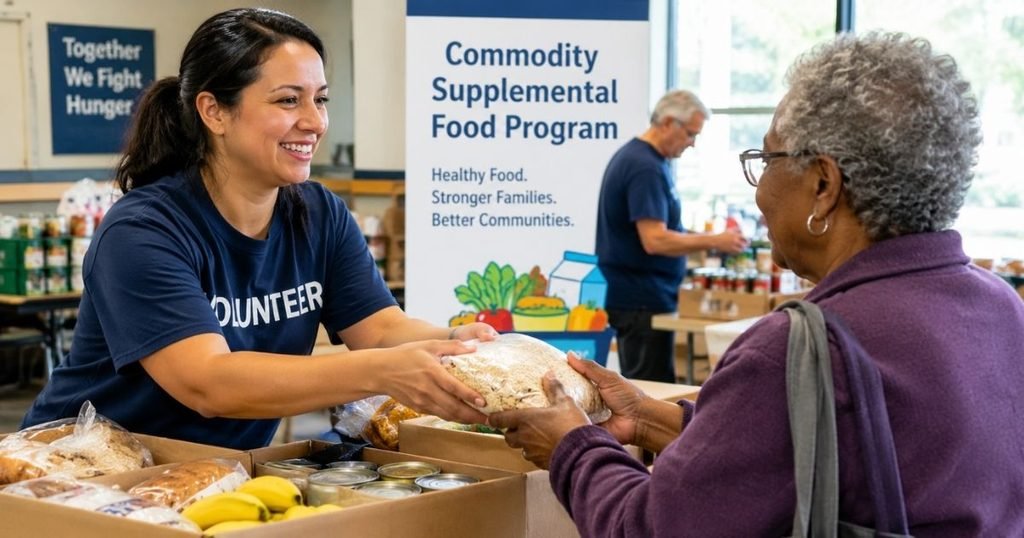
What Is the Commodity Supplemental Food Program?
Navigating government assistance can sometimes feel complicated, but the Commodity Supplemental Food Program operates on a very simple premise: getting healthy food directly into the hands of older adults who need it.
CSFP stands for the Commodity Supplemental Food Program. At the federal level, the program is funded and regulated by the USDA’s Food and Nutrition Service (FNS). However, the USDA does not hand out the food directly. Instead, federal, state, and local agencies work together to manage the program:
- The USDA purchases healthy, high-quality agricultural products (known as USDA Foods) and ships them to participating states.
- State agencies (such as a state’s Department of Health, Department of Agriculture, or Department of Aging) manage the program across their state.
- Local agencies (such as regional food banks, community action programs, and local health clinics) store the food, determine applicant eligibility, and distribute the monthly packages to seniors in their neighborhoods.
The program exists to combat food insecurity among older adults. As people age, adequate nutrition becomes vital for managing chronic health conditions, preserving bone density, and maintaining a strong immune system. CSFP helps eligible seniors supplement their diets with nutritious USDA Foods formulated to provide the vitamins and minerals frequently missing from older adult diets.
It is important to note that CSFP availability is not necessarily identical in every community. Because the program operates based on federal funding and local caseload capacities, you should always check with your state or local distributing agency to see how the program works in your specific area.
READ MORE: How to Apply for SNAP Benefits as a Low-Income Older Adult
Who Is Eligible for CSFP?
Unlike some government assistance programs with complex and highly variable rules, the primary CSFP requirements are relatively straightforward. To qualify for the Commodity Supplemental Food Program, seniors must generally meet a specific set of criteria.
- Minimum age requirement: You must be at least 60 years old.
- Income requirements: Your gross household income must fall at or below the income limits established for the program.
- Residency requirements: You must reside in the state where you are applying. Some local agencies also require you to live within a specific county or designated local service area.
- Nutritional-risk requirements: In the past, federal rules sometimes required a medical professional to certify that an applicant was at “nutritional risk.” Today, federal regulations generally consider the combination of being 60 or older and having a low income as sufficient evidence of nutritional risk.
Eligibility rules can differ somewhat by state. While federal rules generally require senior participants to be at least 60 years old, federal law also allows state agencies to establish exact income limits within specified federal boundaries. For this reason, do not assume that every person over 60 automatically qualifies; you must apply and have your eligibility confirmed by a local agency.
CSFP Income Limits in 2026
To qualify for CSFP, an applicant’s gross income (income before taxes and deductions) must meet specific federal and state guidelines.
Federal rules allow state agencies to establish maximum income limits up to 150% of the Federal Poverty Guidelines (historically, this limit was often set at 130%). Because the Federal Poverty Guidelines are updated annually by the Department of Health and Human Services, CSFP income limits also change every year.
Household size directly affects income eligibility. If you live alone, your income limit will be lower than if you live with a spouse or other family members.
Below are the maximum 2026 CSFP income guidelines based on 150% of the Federal Poverty Guidelines for the 48 contiguous states and Washington, D.C.
| Household Size | Maximum Monthly Income | Maximum Annual Income |
| 1 | $1,995 | $23,940 |
| 2 | $2,705 | $32,460 |
| 3 | $3,415 | $40,980 |
| 4 | $4,125 | $49,500 |
| 5 | $4,835 | $58,020 |
| 6 | $5,545 | $66,540 |
| 7 | $6,255 | $75,060 |
| 8 | $6,965 | $83,580 |
| Each additional member, add: | +$710 | +$8,520 |
Note: These figures represent the maximum federal limits for the 48 contiguous states in 2026. Alaska and Hawaii have higher income limits.
You should always verify the current income limit with your state’s CSFP agency. Because federal rules allow state agencies to establish limits within specified boundaries, your state may elect to use a slightly lower threshold.
READ MORE: Older Americans Act Nutrition Program: Meals & Eligibility
What Does CSFP Provide?
Seniors enrolled in the program receive a physical package of USDA Foods each month. These foods are selected specifically to provide nutrients that older adults need to stay healthy, such as calcium, protein, iron, and vitamins A and C.
While the exact contents of a food package can vary depending on program availability, USDA food offerings, and local distribution, you will generally receive items from the following categories:
- Fruits and Vegetables: Canned fruits (often packed in light syrup or juice) and canned vegetables with reduced sodium.
- Juice: 100% fruit juice, such as apple, grape, or orange juice.
- Milk and Cheese: Shelf-stable ultra-high temperature (UHT) fluid milk, nonfat dry milk, and blocks of real American cheese.
- Grains and Cereals: Whole grain cereals, rolled oats, and farina.
- Pasta or other grain products: Whole wheat pasta, macaroni, or rice.
- Protein foods: Canned meat, poultry, or fish (like canned salmon, tuna, or beef).
- Plant-based protein options: Peanut butter, dry beans, or canned beans.
It is important to make clear that the food package is intended to supplement a senior’s diet rather than replace all grocery shopping. The box provides reliable basics, allowing seniors to spend their limited grocery funds on highly perishable items like fresh produce and fresh meats.
How Does the CSFP Food Package Work?
Getting started with CSFP is a straightforward process, though the exact logistics depend on where you live. Here is how the program generally works in simple steps:
- Apply through the appropriate state or local agency: You must initiate the process by reaching out to your local distributing agency, such as a local food bank or senior center.
- Provide information needed to determine eligibility: You will fill out an application and provide necessary details about your age, household size, and income.
- Receive an eligibility determination: The local agency will review your application to ensure you meet all federal and state requirements.
- Receive CSFP food: If approved and space is available, you will receive CSFP food through the designated distribution system. (Note: Because local agencies have “caseload limits” determined by funding, you may be placed on a waiting list if the program is currently full in your area).
- Follow local rules for pickup or delivery: Distribution methods can differ significantly by location. Some agencies require you to pick up the box at a drive-through pantry, while others may offer home delivery for homebound seniors.
- Complete required recertification: To keep receiving your monthly package, you will need to periodically confirm your continued eligibility (usually every one to three years, depending on your state).
READ MORE: TEFAP: Eligibility, Benefits & How to Apply
How to Apply for the Commodity Supplemental Food Program
If you believe you or a loved one meets the requirements, follow this practical step-by-step application guide.
Step 1: Find Your State’s CSFP Agency
Because the USDA does not accept applications directly, you must find the agency managing the program in your state. You can find this information by searching the official USDA Food and Nutrition Service website for state CSFP contacts, or by calling your state’s Department of Health and Human Services.
Step 2: Contact the Local Agency
State agencies usually delegate the actual application process to local agencies, such as regional food banks or community action networks. Call your local food bank or Area Agency on Aging and ask which organization handles the CSFP senior food boxes in your county.
Step 3: Ask About Eligibility
Before traveling to an office, call the local agency and ask exactly what applicants may need to provide. You will likely need to discuss information regarding your:
- Age
- Household size
- Gross income
- Residency
- Other eligibility information required by the local agency
Step 4: Submit the Application
Application methods can vary by state and local agency. Some locations allow you to apply over the phone or online, while others require a paper application to be mailed or filled out in person at a local senior center or food pantry.
Step 5: Complete Recertification if Required
Once approved, you are not enrolled permanently without check-ins. Participants may need to periodically confirm continued eligibility by submitting updated income or household information.
Please note: Do not expect immediate approval or a specific processing time, because procedures and waitlists vary greatly by location.
What Documents Do You Need to Apply for CSFP?
When applying, you will likely be asked to provide proof of your identity, age, and financial situation. While documentation requirements can vary by state and local agency, applicants may commonly be asked for:
- Proof of age: A driver’s license, state ID, birth certificate, or passport.
- Proof of address/residency: A recent utility bill, lease agreement, or official piece of mail showing your name and current address.
- Income information: Social Security award letters, pension statements, recent bank statements, or pay stubs.
- Household information: Details about how many people live with you and share income and expenses.
- Identification: A government-issued photo ID, if required by the local agency.
Do not worry if you do not have all of these documents immediately available. Clearly state your situation to the local agency caseworker; they will tell you exactly what is required and may accept alternative forms of proof. Avoid assuming that every applicant must provide every document listed above.
READ MORE: Best Medical Alert Systems for Seniors | Top Picks & Reviews
Is CSFP Free?
Yes. The Commodity Supplemental Food Program is a government nutrition assistance program, and eligible participants generally receive the food package without purchasing it.
You will never be asked for credit card information, bank account numbers for billing, or copayments to receive your monthly CSFP box. It is entirely separate from commercial, for-profit meal-delivery services, and it is not a Medicare benefit.
Can Seniors Get CSFP and SNAP at the Same Time?
Yes, seniors can potentially receive both CSFP and the Supplemental Nutrition Assistance Program (SNAP) simultaneously, provided they meet the distinct eligibility requirements for each program.
SNAP (formerly known as food stamps) is a much larger federal program that provides monthly financial benefits on an Electronic Benefits Transfer (EBT) card, which seniors can use to purchase their own groceries at authorized retailers. CSFP, conversely, provides a physical box of specific foods.
Because the programs have different rules, receiving SNAP does not automatically mean a senior qualifies for CSFP. CSFP eligibility must still be determined under applicable CSFP rules, which may have different income thresholds and different age requirements than SNAP. However, seniors should definitely consider checking eligibility for both programs when appropriate, as combining a SNAP EBT card with a monthly CSFP food box provides excellent nutritional support. Use current USDA guidance and contact your local offices, but do not assume eligibility for one guarantees eligibility for the other.
CSFP vs. SNAP: What’s the Difference?
To better understand how these two vital programs compare, here is a simple factual comparison:
| Feature | CSFP | SNAP |
| Main purpose | To supplement diets with a set monthly package of nutritious foods. | To provide financial benefits to purchase groceries of your choice. |
| Typical senior eligibility | Age 60 and older, with low income. | Available to eligible low-income individuals of all ages. |
| Type of assistance | Physical packages of USDA Foods. | Funds loaded onto an EBT card. |
| How benefits are provided | Picked up at or delivered by a local community agency [cite: 2.1.9; 2.1.10]. | Automatically reloaded onto an EBT card monthly. |
| Where food can be obtained | Through local distributing agencies (like food banks) [cite: 2.1.10]. | Most grocery stores, supermarkets, and participating farmers’ markets. |
| Application process | Handled through local/state CSFP distributing agencies. | Handled through state social services or welfare departments. |
| Can seniors potentially receive both? | Yes, if eligible for both. | Yes, if eligible for both. |
READ MORE: 5 Best Dementia Clocks for Seniors: Day & Date Guide
CSFP vs. Senior Farmers’ Market Nutrition Program
Another popular initiative is the Senior Farmers’ Market Nutrition Program (SFMNP). It is helpful to understand the difference between the two.
- Monthly USDA food packages vs. Local Produce: CSFP provides a monthly box of shelf-stable pantry items year-round. The SFMNP provides seasonal benefits (usually a booklet of checks, coupons, or an electronic card) specifically used for eligible locally grown fresh fruits, vegetables, herbs, and honey at farmers’ markets and roadside stands.
- Eligibility requirements: Both are aimed at low-income seniors aged 60 and older. However, their exact income limits can occasionally differ depending on how your state administers them.
- Availability: SFMNP is typically seasonal (summer and fall), whereas CSFP is a year-round monthly program.
Seniors can check their eligibility for both programs. Using CSFP for pantry staples and SFMNP for fresh, local produce is a great way to maximize your grocery budget.
Where Can Seniors Get CSFP Food?
Because the USDA relies on local partners, food distribution can be handled by participating:
- State agencies
- Local government agencies
- Nonprofit organizations (like regional food banks)
- Community organizations (like senior centers or churches)
- Other authorized local distribution agencies
Not every location has the same distribution method. In some areas, seniors drive up to a local food pantry once a month to have a box loaded into their trunk. Other areas may allow you to designate a “proxy”—a trusted caregiver or family member who can pick up the box on your behalf. In some communities, agencies offer delivery options to bring the box directly to the homes of seniors with limited mobility.
Is CSFP Available in Every State?
While CSFP operates in many participating areas across the United States, it may not be available in every community. Furthermore, the program operates on a fixed budget. This means local agencies are granted a specific “caseload” limit the maximum number of seniors they can serve at one time.
You should verify:
- Whether your state currently participates in CSFP.
- Whether your county or local service area participates.
- Whether there is an open enrollment/caseload in your area.
- Where food is distributed locally.
- Whether a waiting list exists.
If the program has reached its funding limit for the year, eligible seniors may be placed on a waiting list until a spot opens up. Do not imply that every senior in the United States can automatically enroll and receive food immediately; capacity varies wildly by region.
READ MORE: Best 5 Raised Toilet Seat with Handles: Reviews, Comparison & Cost
How Much Food Does CSFP Provide Each Month?
CSFP provides a monthly supplemental food package, but the exact package can vary from month to month.
The contents depend heavily on what the USDA purchases for the program and local distribution differences. You will receive items across core food categories fruits, vegetables, protein, dairy, and grains but you might receive canned peaches one month and canned pears the next.
Because the USDA purchases these goods in massive bulk directly from agricultural producers, placing a standard retail “dollar value” on the box is difficult and inaccurate. Readers should check the current food list with their local agency to understand exactly what to expect in their monthly package.
Benefits of the Commodity Supplemental Food Program
Participating in CSFP offers several practical benefits for older adults, including:
- Helps stretch a limited grocery budget: By covering the cost of pantry staples like cereal, milk, pasta, and peanut butter, seniors can use their cash for other necessities.
- Provides nutritious foods: The foods are specifically chosen to offer nutrients commonly missing in older adult diets [cite: 2.1.10].
- Can support healthier eating: Having access to low-sodium canned vegetables and healthy proteins encourages balanced meals.
- Provides recurring food assistance: It is not a one-time emergency handout; it provides a reliable, ongoing monthly package.
- May reduce some grocery expenses: Every dollar saved on groceries is a dollar that can go toward utilities or medical bills.
- Connects seniors with nutrition education: Many local agencies provide recipe cards, nutrition facts, and connections to other assistance resources alongside the food boxes.
(Note: While good nutrition supports overall health, CSFP is a dietary supplement program. Avoid claiming that CSFP prevents or treats specific diseases.)
Common Reasons Seniors May Have Trouble Getting CSFP
While the program is highly beneficial, applicants sometimes encounter hurdles. Common reasons seniors may have trouble getting CSFP include:
- Program not available in the local service area: Your county may not have a participating local agency.
- Income above the applicable limit: Even if you struggle to pay bills, you will be denied if your gross income exceeds your state’s maximum CSFP threshold.
- Age requirement not met: You must be 60 or older. A 59-year-old facing food insecurity will not qualify.
- Enrollment/caseload capacity: The local agency may be full, resulting in a waiting list.
- Missing documentation: Failing to provide proof of identity, age, or income can stall an application.
- Local service-area restrictions: You might live outside the precise zip codes the local agency is funded to serve.
- Application or recertification issues: Forgetting to submit annual paperwork can cause benefits to lapse.
Being denied or unable to enroll in CSFP does not necessarily mean you cannot qualify for other food assistance programs.
What If You Do Not Qualify for CSFP?
If you do not meet the CSFP requirements or the program is full in your area, do not give up. There are alternative resources to investigate, including:
- SNAP (Supplemental Nutrition Assistance Program): Provides funds for groceries.
- Senior Farmers’ Market Nutrition Program: Provides funds for fresh, local produce.
- Local food banks and pantries: Often provide emergency food boxes without strict government age or income requirements.
- Area Agencies on Aging: Can connect you to various local senior services.
- Meals on Wheels or other local meal programs: Delivers hot, prepared meals directly to homebound seniors.
- TEFAP (The Emergency Food Assistance Program): Another USDA program providing emergency food and nutrition assistance at no cost.
- Other state or local senior nutrition programs: Including congregate meals at senior centers.
Eligibility differs widely among these programs. Encourage readers to check official government or nonprofit resources rather than assuming they are ineligible for all assistance.
CSFP and Medicare — Are They the Same?
No, they are entirely completely separate. This is a common point of confusion among older adults.
Medicare is federal health insurance for people 65 and older (and certain younger people with disabilities). The Commodity Supplemental Food Program (CSFP) is a USDA food assistance program.
CSFP is not a Medicare benefit. Medicare eligibility does not automatically mean someone qualifies for CSFP, nor does a Medicare card function as a food benefit card. Seniors may qualify for multiple assistance programs depending on their circumstances, but you must apply for CSFP independently of your health insurance.
Frequently Asked Questions
What is the Commodity Supplemental Food Program for seniors?
The Commodity Supplemental Food Program (CSFP) is a federal USDA nutrition assistance program. It works by providing eligible low-income seniors, aged 60 and older, with a free monthly package of healthy USDA Foods. These packages are designed to supplement a senior’s diet with essential nutrients, helping them stretch their grocery budgets and maintain better health.
What are the income limits for CSFP?
Federal rules allow state agencies to set CSFP gross income limits up to 150% of the Federal Poverty Guidelines. In the 48 contiguous states and Washington, D.C., this maximum limit is $23,940 annually (or $1,995 monthly) for a one-person household. Limits are higher for larger households, and higher in Alaska and Hawaii.
How do I apply for the Commodity Supplemental Food Program?
You apply for CSFP by contacting the local distributing agency in your area, which is often a regional food bank, senior center, or community action agency. You cannot apply directly through the USDA. You will need to fill out an application and provide documentation proving your age (60+), your gross household income, and your residency.
What foods do you get from CSFP?
CSFP provides a monthly supplemental package of healthy, shelf-stable USDA Foods. While exact items vary based on agricultural availability, a typical box includes canned fruits and vegetables, 100% fruit juice, shelf-stable or dry milk, real cheese, whole grain cereals, oats, pasta or rice, peanut butter or beans, and canned meats like poultry, salmon, or tuna.
Can I get CSFP and SNAP at the same time?
Yes, eligible seniors can receive both CSFP and SNAP at the same time. SNAP provides monthly financial benefits on an EBT card to purchase your own groceries, while CSFP provides a physical box of specific USDA Foods. Because the two programs have different eligibility requirements and applications, qualifying for one does not automatically qualify you for the other. You must apply for and be approved for both programs individually.
Sources:
- USDA Food and Nutrition Service (FNS): Commodity Supplemental Food Program
- USA.gov: Food Assistance Programs
- Code of Federal Regulations (CFR): 7 CFR Part 247 – Commodity Supplemental Food Program
Disclaimer: Government program eligibility rules, income limits, availability, and application procedures can change. The information provided in this article reflects 2026 maximum federal guidelines. Readers should always verify current requirements and availability with their state or local CSFP agency.