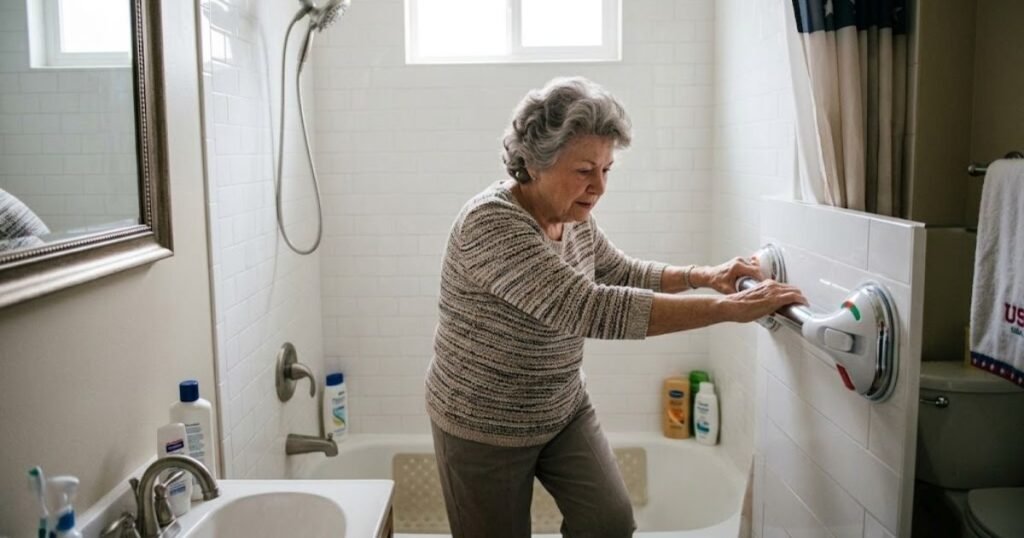
Wet tile, a slick tub floor, and a body that doesn’t balance the way it used to that combination sends more older adults to the emergency room than almost any other spot in the house. It’s no surprise families start searching for a fast fix the moment a parent or spouse has a close call in the shower.
A no-drill grab bar is often the first thing people look into. Most models install in minutes, need no tools, and leave tile and fiberglass untouched which matters if you rent, live somewhere with strict rules, or don’t want to drill holes in a bathroom you just renovated. They’re also easy to reposition as needs change.
But here’s the part a lot of product listings gloss over: not every no-drill grab bar is built to catch a falling person or hold someone’s full body weight. Many are designed for light balance assistance only. A high weight rating on a box doesn’t mean the product meets the structural standards that apply to permanently anchored bars. This guide covers how these products actually work, which ones are worth considering, and when a professionally installed bar is the better call. Lets deep dive into “Best No-Drill Grab Bar for Seniors: Reviews & Safety Guide”
READ MORE: Best Affordable Smart Ring Under $200 for Seniors | Top Picks, Cost & Comparison
What Is a No-Drill Grab Bar?
A no-drill grab bar attaches without screws, anchors, or wall damage — through suction, adhesive, or a mechanical clamp instead. That makes it appealing for anyone who wants hand support without a remodeling project.
Suction Grab Bars
Large rubber or PVC suction cups, often paired with a locking lever, create an airtight seal against a smooth wall. Press the bar in place, flip the latch, and the cup pulls tight. Most include a red/green indicator showing whether the seal is solid.
Adhesive-Mounted Grab Bars
These rely on an industrial-strength adhesive pad rather than suction. They bond more permanently and work on a few more surfaces, but they’re harder to reposition and can leave residue when removed.
Clamp-On Tub Grab Bars
These clamp directly onto a bathtub’s edge and tighten with a screw knob with no wall contact at all, which suits anyone who mainly needs help getting in and out of a tub.
Temporary vs. Permanent Grab Bars
No-drill products are removable by design. A permanently mounted bar is screwed into wall studs or blocking behind the tile, letting it handle real load-bearing force a trade-off temporary bars make in exchange for convenience.
READ MORE: Bed Assist Rail for Seniors: Best Picks, Safety Tips & Buying Guide
Are No-Drill Grab Bars Safe for Seniors?
This is the question that matters most, and the honest answer is: it depends on the surface, the installation, and how the bar is used.
Used correctly, a suction or adhesive bar can genuinely help someone steady themselves stepping over a tub wall or standing from a shower seat. But reliability hinges on a few things:
- The wall must be smooth, clean, and non-porous glass, glazed tile, or untextured fiberglass.
- Water, soap film, dust, or grout lines all weaken the seal.
- A suction cup that looked secure yesterday can loosen without obvious warning.
- These products aren’t automatically equivalent to a bar anchored into a stud.
The U.S. Access Board, which sets federal accessibility guidelines, requires structural grab bars along with their fasteners, mounting hardware, and the wall structure behind them to withstand 250 pounds of force applied at any point. That standard covers the entire mounting system, not just the bar. A suction cup on tile isn’t engineered to that same standard, whatever number appears on its packaging.
READ MORE: Best 5 Raised Toilet Seat with Handles: Reviews, Comparison & Cost
Best No-Drill Grab Bars for Seniors
The five products below are commonly sold as no-drill, suction-style shower handles. Exact weight ratings, pricing, and certifications change often, so confirm those details on the current manufacturer or retailer listing before buying.
1. TAILI Grab Bars for Shower, Suction Shower Handles Rails, 2 Pack, 16.8″
The TAILI 2-Pack system features an overall length of 16.8 inches, offering a generous middle gripping area. It utilizes a vacuum-tech mechanism designed for quick press-and-lock attachment against suitable bathroom surfaces.
Key Characteristics
- Length: 16.8 inches per bar.
- Quantity: 2-pack configuration.
- Locking Mechanism: Press-to-lock suction pad system.
- Grip Area: Smooth plastic contoured body.
Practical Performance & Considerations
This set works best for users who want to establish two distinct balance points in a large shower enclosure for example, one near the entrance threshold and another beside the shower controls. Its 16.8-inch frame requires smooth, large-format ceramic or porcelain tiles (at least 5×5 inches wide) so that both suction ends sit flat without overlapping grout lines.
Like most suction handles, this unit is built strictly for steadying yourself while standing or washing. It is not engineered for full load-bearing leverage or pulling yourself up from a shower chair.
- Pros: Includes two complete bars for multi-point positioning; clean aesthetic; quick lever locking action.
- Cons: Requires large continuous tile space; smooth grip surface can become slippery when covered in soap.
- Who Should Consider It: Seniors looking for basic steadying support at two separate locations in a smooth-tiled shower.

2. Reyiu Grab Bars for Shower, Updated 16.5″ Shower Handle
The Reyiu 16.5-inch shower handle features a contoured midsection designed to improve finger placement for older adults dealing with hand stiffness or mild arthritis.
Key Characteristics
- Length: 16.5 inches.
- Design Focus: Contoured grip channel.
- Mechanism: Dual flip-locking vacuum suction levers.
Practical Performance & Considerations
The slightly shorter 16.5-inch profile makes this bar somewhat easier to fit on standard tiled walls compared to longer models, though accurate measuring remains essential. The main draw is its middle handle region, which incorporates subtle indentations to help guide finger placement.
The latching levers flip down to create a strong atmospheric seal against clean, smooth fiberglass, acrylic, or glazed tile walls. It acts as an effective steadying handle while stepping into a tub. However, users must avoid applying sudden downward jerks or using it to pull their full body weight upward.
- Pros: Ergonomic finger placement design; manageable 16.5-inch footprint; straightforward lever lock system.
- Cons: Unsuitable for textured fiberglass units or small mosaic tiles.
- Who Should Consider It: Renters or seniors with mild hand weakness who need a simple balance aid near the shower entry.
3. Foxrino 18.3″ Suction Grab Bars for Shower
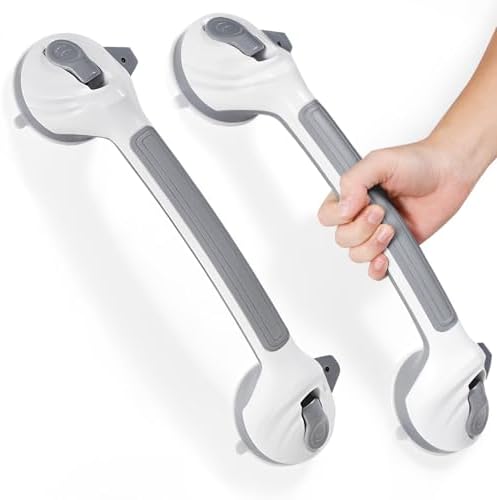
Measuring 18.3 inches long, the Foxrino suction bar is one of the larger single-span options in the no-drill category, offering an extended gripping section.
Key Characteristics
- Length: 18.3 inches.
- Feature: Extended midsection gripping space.
- Mechanism: Dual-end latching suction pads.
Practical Performance & Considerations
The primary advantage of an 18.3-inch bar is the expanded area available for holding on with both hands sequentially while shifting weight. This extra length can be helpful for taller seniors or those who prefer a wider stance when balancing.
However, the longer length means the two end suction pads are spaced further apart. On tiled shower walls, this increased distance makes it more likely that one of the pads will land on a grout line unless your tiles are large format (at least 6×6 inches or larger). Always measure your tile dimensions before choosing an extended-length bar.
- Pros: Generous two-handed gripping area; sturdy feel on large smooth surfaces.
- Cons: Harder to position without crossing grout lines on standard 4×4 tile walls.
- Who Should Consider It: Individuals with smooth acrylic tub surrounds or large-format tile walls who prefer a wider gripping bar for steadying.
4. LEVERLOC Grab Bars for Shower, 16.8″
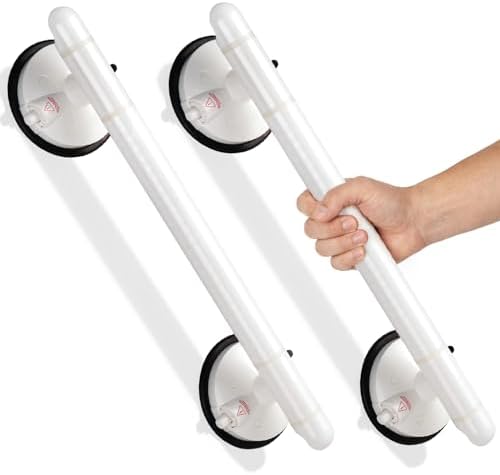
LEVERLOC focuses on a streamlined press-and-lock suction system designed to simplify installation while maintaining a firm seal on compatible non-porous walls.
Key Characteristics
- Length: 16.8 inches.
- Locking System: Direct press-and-lock suction structure.
- Body Build: High-grade ABS plastic construction.
Practical Performance & Considerations
The LEVERLOC handle uses a internal spring/vacuum cup setup that engages when firmly pressed against the wall, reducing the manual force needed to flip traditional levers. This can be helpful for seniors with limited hand strength or arthritis in their fingers.
It performs reliably on clean glass shower doors, smooth acrylic shells, and flat ceramic tile. As with all suction-based devices, it provides light balance assistance only and must be inspected and re-seated periodically.
- Pros: Easy-push installation system reduces finger straining; clean, modern aesthetic.
- Cons: Must be removed and thoroughly cleaned if soap residue penetrates around the edge of the seal.
- Who Should Consider It: Seniors who struggle to flip stiff mechanical locking levers but still want a removable balance handle for a smooth shower wall.

5. YUGUOHOME Upgraded 2-Pack Grab Bars for Shower
The YUGUOHOME Upgraded 2-Pack offers two complete suction handles in a single package, giving caregivers flexible placement options across different parts of the bathroom.
Key Characteristics
- Quantity: 2 complete grab bar handles.
- Design: Dual-lever locking vacuum suction.
- Surface Target: Glazed tile, smooth glass, polished metal, or acrylic.
Practical Performance & Considerations
Having two matching bars allows for customized placement layouts such as positioning one vertically near the tub door to assist with stepping in, and mounting the second horizontally inside the shower stall for steadying while washing.
Installing two bars increases coverage across movement zones, but it does not double the weight capacity of either individual bar. Each handle functions independently as a balance aid and must be checked separately for seal integrity.
- Pros: Cost-effective two-bar package; versatile placement choices; simple flip-lever attachment.
- Cons: Requires double the surface checks to ensure both bars maintain vacuum pressure over time.
- Who Should Consider It: Caregivers and seniors who want multi-zone balance support across both the shower entryway and internal bathing area.

READ MORE: 5 Best Dementia Clocks for Seniors: Day & Date Guide
Comparison Table: 5 Best No-Drill Grab Bars for Seniors
| Product | Size | Quantity | Installation | Suction/Locking System | Best For | Main Advantage | Main Limitation |
| TAILI Grab Bars | 16.8″ | 2 Pack | Tool-free, press-and-lock | Suction cup with locking latch | General balance assistance | Versatile mid-size length | Check current listing for weight rating |
| Reyiu Grab Bars | 16.5″ | Check current listing | Tool-free, press-and-lock | Suction cup, locking mechanism | Single steadying point | Compact, easy to reposition | Check current listing for materials |
| Foxrino Grab Bars | 18.3″ | Check current listing | Tool-free, press-and-lock | Suction cup, locking mechanism | Continuous hand movement | Longer gripping surface | Check current listing for weight rating |
| LEVERLOC Grab Bars | 16.8″ | Check current listing | Tool-free, lever-lock | Suction with lever-style lock | Tactile lock confirmation | Lever locking action | Check current listing for surface specs |
| YUGUOHOME Upgraded | Check current listing | 2 Pack | Tool-free, press-and-lock | Suction cup with locking latch | Covering two support points | Two-bar placement flexibility | Each bar’s seal must be checked individually |
How to Choose the Best No-Drill Grab Bar for a Senior
1. Surface Compatibility
Suction models work best on smooth, flat, non-porous surfaces, and underperform on textured or small mosaic tile, porous stone, grout lines, rough fiberglass, or damaged surfaces. Check the manufacturer’s minimum tile size before buying.
2. Grip Size and Shape
Diameter and how the bar sits in the hand matters. A textured, non-slip grip counts more than it seems, since soapy or wet hands lose friction fast ergonomic curves help anyone with arthritis or limited grip strength.
3. Length
Shorter bars (12–16 inches) suit a single steadying point. Longer bars, like the 18.3-inch option above, give more room to slide a hand along while moving.
4. Locking Mechanism
A clear locking indicator or lever gives a more confident signal than suction alone; red/green indicators and mechanical levers are easier to trust at a glance.
5. Weight Capacity
Read the manufacturer’s fine print carefully, and never treat a printed weight number as a guarantee that a suction bar can safely arrest a fall. A rating reflects lab-tested static pull, not how the bar performs against the sudden force of a real fall.
6. Repositionability
Being able to move a bar helps renters, multi-generational households, or anyone still figuring out where support is needed.
7. Cleaning and Maintenance
Soap scum and hard-water buildup on the wall or the suction cup itself are common reasons a “reliable” bar suddenly isn’t. Wipe both down regularly, not just at install time.
READ MORE: Power Lift Recliner Chair for Elderly: Top Picks, Review & Comparison
No-Drill Grab Bar vs. Permanently Installed Grab Bar
| Feature | No-Drill/Suction Grab Bar | Permanently Mounted Grab Bar |
| Installation | Usually quick | Requires drilling/anchoring |
| Tools | Often not required | Usually required |
| Removable | Yes | Usually no |
| Good for renters | Often | Depends on landlord |
| Surface requirements | Very important | More flexible |
| Structural support | Limited depending on product | Much stronger when properly installed |
| Best use | Balance assistance | Load-bearing support |
| Installation difficulty | Easy | Moderate/professional |
| Long-term reliability | Depends on seal/product | Generally higher |
| Senior fall-risk applications | Use caution | Preferred when properly installed |
A no-drill bar is a smart, low-commitment way to add a hand-hold in a rental or a bathroom you’re not ready to remodel; it just shouldn’t stand in for a properly anchored bar when someone needs real load-bearing support.
How to Install a No-Drill Suction Grab Bar
- Choose the Correct Surface. Pick a flat, smooth, non-porous wall section that meets the minimum size requirement.
- Clean the Surface. Remove soap residue, hard-water spots, and grime.
- Dry the Area Completely. A thin film of moisture can prevent a full seal.
- Position the Grab Bar. Hold it where it will actually be used, matching how the person moves.
- Engage the Suction/Locking Mechanism. Press the cups flat and flip the latches or levers.
- Check the Indicator or Lock. Confirm a secure seal before trusting the bar with any weight.
- Perform a Careful Pre-Use Check. Pull gently from a few angles before relying on it.
- Recheck Regularly. Suction seals weaken gradually — test the bar periodically, not just on day one.
Every product differs slightly, so read the manufacturer’s instructions first.
How Often Should You Check a Suction Grab Bar?
A suction grab bar safety check should be part of every shower routine. Atmospheric changes, humidity, steam, and subtle micro-shifting cause all suction seals to lose pressure over time.┘
- Before Every Use: Perform a quick physical tug test. Give the handle a firm shake before trusting it with your weight.
- Weekly Inspection: Look closely at the locking levers and visual indicators to confirm that no air has leaked into the vacuum chamber.
- Every 2 to 4 Weeks: Unlatch the bar completely. Wash both the rubber suction cups and the wall surface with warm water and alcohol to remove fine soap residue, then reinstall from scratch.
Where Should You Place a No-Drill Grab Bar?
Proper placement targets key transition zones where balance shifts occur during bathing.
1. Shower Enclosure Entryway
Place a vertical handle near the outer edge of the shower door or tub wall frame. This offers a steadying grip while stepping over the threshold onto wet tile flooring.
2. Inside the Shower Washing Zone
Mount a horizontal or angled bar along the side wall at chest height (roughly 33 to 36 inches from the shower floor). This provides a steadying point while closing your eyes to wash your hair or turning under the water stream.
3. Next to a Shower Seat or Bench
If the senior uses a shower chair, install a handle alongside it to offer steady balance assistance when shifting from a seated position to standing.
Note: For permanent accessibility guidelines, reference official standards provided by the U.S. Access Board, which detail precise mounting heights, wall clearances, and structural structural requirements for accessibility compliance.
Where Should You NOT Use a Suction Grab Bar?
Knowing where not to place a suction handle is vital for preventing accidents.
Never attach a suction grab bar in the following conditions:
- Over Grout Seams: Even a tiny overlap causes immediate vacuum loss.
- Textured or Matte Finishes: Unsealed slate, embossed tile patterns, or tumbled stone allow air leaks.
- Drywall, Plaster, or Wallpaper: Suction pads can tear paper and paint off the wall rather than holding firm.
- Cracked, Chipped, or Damaged Surfaces: Fractures interrupt the smooth seal surface.
- Under Heavy Pulling Force: If the senior needs to pull their entire body weight up from a deep tub, suction products are unsafe. A hardware-mounted bar anchored to wall studs is required.
Can a Suction Grab Bar Prevent a Fall?
Not reliably, and it shouldn’t be marketed that way. A suction bar can offer real value for steadying yourself or light balance support during a normal shower routine. That’s different from pulling your full body weight upward, supporting sustained heavy weight, or catching you mid-fall.
That distinction matters for senior safety. Someone stable enough to shower independently, with just a little extra reassurance, is a reasonable candidate for a no-drill bar. Someone whose balance has become unreliable enough that a fall is an ongoing concern needs a structural solution instead.
Are No-Drill Grab Bars ADA Compliant?
Generally, no none of the five products above should be assumed ADA compliant unless the manufacturer provides specific, verifiable documentation.
ADA and related accessibility standards cover more than the bar itself: dimensions, mounting height, wall clearance, and a structural strength requirement of 250 pounds of force applied at any point on the bar, its fasteners, and the wall behind it. A suction cup pressed against tile isn’t evaluated against that engineered standard, regardless of the weight figure in the listing.
“No-drill” does not automatically mean “ADA compliant.” If compliance genuinely matters — a rental covered by fair housing requirements, for instance — a permanently mounted, code-compliant bar installed by a professional is the appropriate choice.
Pros and Cons of No-Drill Grab Bars
Pros
- No drilling into tile or walls
- Easy, tool-free installation
- Fully removable
- Convenient for renters
- Usually inexpensive compared with a remodel
- Repositionable as needs change
- Useful for temporary or light balance assistance
Cons
- Performance is highly surface-dependent
- Suction can gradually release without warning
- Not necessarily load-bearing or fall-rated
- Requires regular inspection
- Not suitable for every senior’s level of need
- Doesn’t match the security of a properly anchored bar
Which No-Drill Grab Bar Is Best?
There’s no single “best” pick for every bathroom — it depends on wall surface, layout, and how much support someone needs.
- Best for a two-bar setup: TAILI or YUGUOHOME, both sold in pairs.
- Best for a longer gripping surface: Foxrino, at 18.3 inches.
- Best compact option: Reyiu, at 16.5 inches, for one well-placed steadying point.
- Best for a tactile lock confirmation: LEVERLOC, thanks to its lever mechanism.
Whichever option you consider, confirm current specifications, weight ratings, and price directly on the manufacturer’s listing before buying.
Frequently Asked Questions
Are no-drill grab bars safe for seniors?
They can be, when installed correctly on a suitable surface and used for light balance support rather than full body weight. Safety depends on wall type, seal maintenance, and how much support the individual needs. Seniors with a meaningful fall risk should lean toward a permanently mounted, structurally anchored bar instead of relying on suction alone.
Do suction grab bars really work?
Yes, but only under the right conditions. Suction cups need a smooth, clean, non-porous, properly sized surface glazed tile, glass, or smooth fiberglass. Textured walls, grout lines, or dirty surfaces weaken or prevent a proper seal, which is why checking the wall type matters as much as the product itself.
What is the best no-drill grab bar for seniors?
There isn’t one universal answer; it depends on the wall surface, shower layout, and level of support needed. A compact bar suits a single steadying point, while a longer bar helps with continuous hand movement. Always verify current specs on the manufacturer’s listing before deciding.
Can suction grab bars hold your body weight?
Some are rated for a fairly high static load under controlled testing, but that’s different from catching a person mid-fall or reliably supporting full body weight during everyday movement. Manufacturer ratings describe lab conditions, not real-world fall protection, an important distinction for anyone with a genuine fall risk.
Can you install a shower grab bar without drilling?
Yes — suction cups, strong adhesive mounts, and clamp-on tub bars are all no-drill options. Suction bars are the most repositionable but most surface-dependent, adhesive mounts bond more firmly but are harder to move, and clamp-on bars work only on a tub’s edge rather than a wall.
Final Verdict
No-drill grab bars solve a real problem: they add a hand-hold in the shower without the cost, mess, or commitment of a full remodel. That’s especially appealing to renters, people who don’t want to drill into tile they just installed, and anyone testing where support is needed before making a bigger investment.
But their performance rises and falls with the surface they’re mounted on, and a suction seal that looks fine today can weaken without much warning. These products are best understood as balance-assistance tools, not permanent, structural safety equipment, a distinction that genuinely matters for anyone with a real fall risk.