Many older adults search online for a $3000 senior assistance program application because they are looking for real help with bills, groceries, rent, medicine, or everyday living costs. That search is understandable. Rising prices can make life stressful, especially for retirees and fixed-income households.
At the same time, seniors should be careful. The phrase $3000 senior assistance program application is often used as a general search term, not always as the name of one official national program. Some websites use big promises to get attention, collect personal information, or push paid services that are not necessary.
The good news is that there are real and legitimate sources of help for seniors. Depending on your income, age, location, and needs, you may qualify for government assistance, local aging services, utility support, food help, housing aid, or healthcare savings programs. The key is knowing where to look and how to apply safely.
This guide explains what the search term usually means, who may qualify, what documents to gather, and how to apply step by step without falling for scams. Lets deep dive into “$3000 Senior Assistance Program Application”
READ MORE: How to Apply for SNAP Benefits as a Low-Income Older Adult
What Is the $3000 Senior Assistance Program?
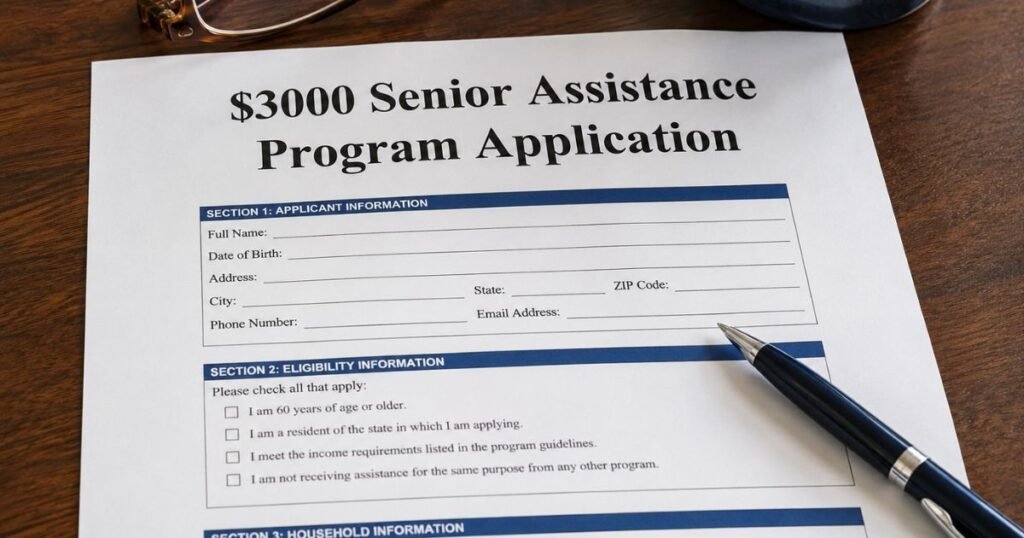
When you see headlines or search results for a $3000 senior assistance program application, it is helpful to understand what is actually behind that number. In most cases, there is no single, official federal program called the “$3000 Senior Assistance Program.” Instead, this phrase is frequently used as a general term or an advertising headline representing the total amount of money an older adult might save or receive across multiple real senior benefits programs over the course of a year.
For instance, if a low-income senior qualifies for help with their heating bills, receives monthly food support, and gets assistance paying for their medications, the combined value of that help can easily add up to $3000 or more annually.
Rather than looking for one single application form that dispenses a lump sum of $3000, it is much more effective to look at the individual, legitimate programs set up by federal, state, and local governments. These programs are designed to provide ongoing, targeted senior financial help for the specific areas where you need it most.
⚠️ Important Safety Tip
Official government assistance programs will never charge you a fee to apply, and they will never ask for your credit card number or bank information just to view an application. If a website claims you must pay a fee to access your “guaranteed $3000 grant,” leave the website immediately. Always stick to official government websites ending in .gov or trusted non-profit organizations ending in .org.
Who May Qualify for Senior Financial Help?
Every official senior benefits application has its own specific set of rules, but most programs look at a few common factors to determine who qualifies for help. Understanding these guidelines can help you decide which programs are worth your time to explore.
1. Age Requirements
Many programs specifically target older adults. Depending on the agency, the minimum age might be 60, 62, or 65. Some programs also offer support to individuals with disabilities, regardless of their age.
2. Income and Financial Assets
Because these programs are designed to provide low-income senior help, your monthly or yearly income is a major deciding factor. Programs will look at your Social Security benefits, pensions, or any part-time wages. Some programs also evaluate your “countable assets,” which include money in savings accounts or stocks, though your primary home and car are usually excluded.
3. Residency and Citizenship
To qualify for U.S. senior aid, you generally must be a U.S. citizen or a lawful permanent resident. Additionally, because many programs are administered at the state or county level, you must live in the specific state or locality where you are applying.
4. Household Size
Eligibility income limits often adjust based on how many people live in your home. A married couple living together will have a slightly higher income limit than a senior living completely alone.
5. Specific Living or Medical Needs
Some forms of assistance are based entirely on your circumstances. For example, if you have high medical bills that consume most of your income, or if your home requires energy-efficiency repairs to keep you safe, you may qualify for specialized aid even if your income is slightly above the standard limit.
READ MORE: Low Income Home Energy Assistance Program: LIHEAP Benefits and How to Apply
What Types of Help May Be Available?
When looking for a $3000 senior assistance program application, your actual goal is likely finding help for seniors with bills. Legitimate assistance is usually divided into specific categories. By applying for the individual programs below, you can build a safety net that provides significant financial relief.
Help with Food and Groceries
The Supplemental Nutrition Assistance Program (SNAP), formerly known as food stamps, provides a monthly balance on an electronic card that you can use just like a debit card at grocery stores and supermarkets. Many states have simplified SNAP application rules specifically for seniors to make the process easier. Additionally, programs like the Commodity Supplemental Food Program (CSFP) provide monthly boxes of nutritious, senior-friendly foods completely free of charge.
Help with Utility Bills
No one should have to choose between buying medicine or keeping their home warm in the winter and cool in the summer. The Low-Income Home Energy Assistance Program (LIHEAP) is a federally funded program that helps eligible households pay their heating and cooling bills. It can also provide emergency help if you are facing a utility shut-off notice.
Help with Rent and Housing
If keeping up with housing costs is a struggle, several programs can assist:
- Housing Choice Vouchers (Section 8): Helps low-income seniors rent safe, privately owned apartments by paying a portion of the rent directly to the landlord.
- Section 202 Supportive Housing for the Elderly: A program that provides affordable, independent living communities specifically designed for seniors.
- Weatherization Assistance Program (WAP): Assists homeowners in making their homes more energy-efficient (such as adding insulation or fixing windows) free of charge, which permanently lowers monthly utility bills.
Help with Medicine and Healthcare Costs
Healthcare is often the largest expense for retirees. If you have Medicare, you can look into the Medicare Savings Programs (MSPs), which help pay for your Medicare Part B premiums, deductibles, and co-payments. You can also apply for Extra Help, a program specifically designed to lower the costs of your Medicare Part D prescription drug plan.
Help Through Local Aging Services
Every community has an organization dedicated to supporting local older adults. These are often called Area Agencies on Aging (AAAs). They can connect you to localized help, such as free home-delivered meals (Meals on Wheels), free or low-cost senior transportation for doctor visits, and local property tax relief programs.
READ MORE: 6000 Dollar Senior Tax Deduction for Over 65 Rules
The $3000 Senior Assistance Program Application: How to Apply Step by Step
Navigating a senior assistance application can feel overwhelming if you try to do everything at once. Breaking the process down into manageable steps can help keep you calm and organized.
[Gather Documents] ➔ [Check Eligibility] ➔ [Use Trusted Resources] ➔ [Complete & Submit] ➔ [Track & Follow Up]
Step 1: Gather Your Initial Documents
Before you open an application online or sit down with a paper form, gather your personal paperwork. Having everything in one neat folder saves you from searching for missing items mid-application. (A full list of common documents is detailed in the section below).
Step 2: Check Your Eligibility Locally
Because programs vary wildly by state, visit an official directory or call your local agency to see what the exact income limits are for your specific area. This prevents you from wasting time on programs you might not qualify for.
Step 3: Use Trusted Government or Local Resources
Always begin your application journey on a verified platform. You can use official tools like Benefits.gov or the National Council on Aging’s BenefitsCheckUp.org. Alternatively, you can visit your local department of social services or senior center to get physical application forms.
Step 4: Complete the Application Carefully
Take your time filling out the forms. Read every question twice. If an online application gives you an option to save your progress, do so frequently. If you are filling out a paper form, print clearly using black or blue ink.
Step 5: Submit Your Required Proof
An application cannot be processed without supporting documentation. If you are applying online, you will need to upload clear photos or scanned copies of your documents. If you are mailing a paper application, never send your original documents—always send clear photocopies.
Step 6: Track and Follow Up
Keep a written note of the date you submitted your application, the name of the agency, and any confirmation numbers provided. If you haven’t heard back within the specified timeframe (usually 30 to 45 days), call the agency to politely check on your application status. If they request additional proof, send it right away to avoid delays.
READ MORE: Kohl’s Senior Citizens Discount: Eligibility, Savings, and How It Works
Documents Seniors May Need
To ensure your senior benefits application is approved quickly without delays, you will generally need to provide proof of your identity, living situation, and financial status.
Here is a handy checklist of items to gather before you begin:
- Government-Issued Photo ID: A current driver’s license, state identification card, or U.S. passport to verify your age and legal name.
- Social Security Information: Your Social Security card or your annual Social Security Benefit Verification Letter showing your current monthly benefit amount.
- Proof of Monthly Income: Recent pay stubs (if you work part-time), pension statements, or documentation of any veteran’s benefits.
- Proof of Address: A recent utility bill, a copy of your lease, or a mortgage statement that proves you live at your current address.
- Bank Statements: Most recent statements for your checking and savings accounts (usually the last 1 to 3 months).
- Health Insurance Cards: Your Medicare card, Medicaid card, or any private supplemental insurance cards.
- Current Expense Bills: Your latest electric, gas, water, or phone bills, as well as proof of what you pay for prescription medications out of pocket.
Common Mistakes to Avoid
When looking for financial support, making a small mistake can lead to long delays, application denials, or worse falling victim to an online scam. Keep these common pitfalls in mind so you can avoid them:
- Paying for “Fast Tracing” or Application Fees: Legitimate government assistance for seniors is entirely free. If a website asks for money to submit your form or promises to “speed up” your approval for a fee, it is an outright scam.
- Sharing Information with Random Callers: Be incredibly cautious of unsolicited phone calls from people claiming to be from “the senior benefit office.” Legitimate agencies will almost always write to you by mail first before calling. Never give your Social Security number or bank details to an unexpected caller.
- Leaving Sections Blank: If a question on an application does not apply to you, write “N/A” (Not Applicable) or “0” instead of leaving it completely blank. A blank space can make an agency think your application is incomplete, which pauses the approval process.
- Missing Deadline Dates: Many programs require annual renewals or have strict deadlines for seasonal help (like winter heating assistance). Mark these dates clearly on your calendar.
- Assuming One Denial Means No Help Is Available: If you don’t qualify for one specific program, do not lose heart. The rules for food help (SNAP) are completely different from the rules for utility help (LIHEAP). You might be denied for one but fully accepted for another.
READ MORE: Medicare Supplement Plan G vs N: Coverage, Costs and Key Differences
How to Tell If a Program Is Legitimate
Protecting your personal data is just as important as finding financial help. Since phrases like $3000 senior assistance program application are common online search terms, scam artists occasionally use them to create fake websites designed to steal identity information.
Use this quick comparison table to help tell the difference between a real assistance opportunity and a dangerous trap:
| Look for Legitimate Programs (Safe) | Avoid Red Flags (Scams) |
| The website address ends in .gov (government) or .org (trusted non-profits). | The website address ends in strange letters, or mimics a government site with typos. |
| The application is completely free to access, fill out, and submit. | You are asked to pay a registration fee, a processing fee, or buy a gift card. |
| The program is clearly run by a known entity, like your state’s Department of Health or Aging. | The entity has a vague name like “National Senior Relief Center” with no physical address. |
| You are asked for standard documents to verify your income and residency. | You are told you have “guaranteed approval” without needing to verify your actual income. |
| Support is provided through a direct payment to your utility company, a food card, or an official award letter. | You are promised a large, lump-sum check sent directly to your house within 24 hours. |
READ MORE: Salvation Army Free Car Program (Eligibility & How to Apply)
Helpful Alternatives to the “$3000” Search
If you are struggling to find a clear path forward using general internet searches, step away from the search engines and use these concrete, highly respected alternative paths to find real aid.
1. BenefitsCheckUp® by NCOA
Run by the National Council on Aging, BenefitsCheckUp.org is a completely free, confidential tool. You simply enter your zip code and answer a few basic questions about your income and needs. The tool instantly searches thousands of local, state, and federal programs to give you a personalized list of benefits you might qualify for.
2. The Eldercare Locator
This is a public service of the U.S. Administration on Community Living. By visiting eldercare.acl.gov or calling toll-free at 1-800-677-1116, you can connect directly with trusted local support services and social workers right in your home county.
3. Your Local Area Agency on Aging (AAA)
These local offices are goldmines for senior aid. They are staffed by real people who live in your area and understand your state’s unique programs. They can sit down with you, provide physical copies of applications, and help you fill them out line by line.
4. 211.org (or Calling 2-1-1)
Sponsored by the United Way, dialing 2-1-1 from your phone (or visiting 211.org online) connects you to a local community specialist who can point you toward emergency food pantries, rental assistance funds, and local utility relief programs operating right in your neighborhood.
Who Can Help You Apply?
You do not have to tackle this paperwork all by yourself. If navigating websites or filling out detailed forms feels stressful, reach out to trusted people in your life who can help guide you through the process:
- Family Members or Caregivers: An adult child, grandchild, or trusted friend can help look up official websites, organize your physical documents, and make sure online forms are submitted correctly.
- Social Workers or Case Managers: If you visit a local clinic, hospital, or community center, ask to speak with a social worker. They are experts at navigating public benefit systems.
- Senior Center Staff: Local senior centers often have designated staff members or volunteers trained specifically to help older adults review insurance options and fill out utility or food assistance forms.
READ MORE: Best Smart TV for Seniors in 2026: Easy to Use & Large Screen Picks
Summary Checklist for Seniors Seeking Assistance
Before you jump into an application, print or save this simple checklist to keep yourself on the right path:
- [ ] I am using a trusted website ending in .gov or .org, or I am working directly with a local senior agency.
- [ ] I have gathered my ID, Social Security information, and proof of income.
- [ ] I have confirmed that the program does not charge any application or processing fees.
- [ ] I am filling out the application completely, ensuring no required sections are left blank.
- [ ] I have made photocopies of my documents to submit, keeping the original copies safely at home.
- [ ] I have written down the date of my submission and the agency’s contact number for a follow-up.
Conclusion
Searching for a $3000 senior assistance program application is a great first step toward taking control of your financial well-being. While you may not find a single federal check for that exact amount, you can find a network of higlhly effective, legitimate programs that can collectively save you thousands of dollars a year on food, medical care, housing, and utilities.
The key to finding senior financial help safely is patience and verification. Avoid the flashy online advertisements that make grand, immediate promises, and anchor your efforts in trusted local resources like your Area Agency on Aging or official government benefits finders. There is real, compassionate help out there designed to protect your independence and provide peace of mind you just have to reach out to the right, official places to claim it.
Frequently Asked Questions (FAQ)
What is the $3000 senior assistance program application?
The term “$3000 senior assistance program application” is a common search phrase rather than a single, official federal program. It typically refers to the combined annual savings an older adult can receive by applying for multiple legitimate benefits, such as SNAP for food, LIHEAP for utility bills, and Medicare savings programs.
How do seniors apply for financial assistance online?
Seniors can safely apply for financial assistance online by using official government websites like Benefits.gov or verified non-profit tools like BenefitsCheckUp.org. These portals guide you to specific state and federal applications based on your location and financial need.
What documents are needed for senior assistance programs?
While specific requirements vary, most programs require proof of age (such as a driver’s license or birth certificate), proof of income (like a Social Security benefit letter or pension statement), proof of residency (a utility bill or lease agreement), and recent bank statements.
How can seniors tell if an assistance program is legitimate?
A program is legitimate if it is completely free to apply for, does not guarantee immediate cash without checking your income, and is run by an official government agency or a recognized non-profit organization. Look for website addresses that end strictly in .gov or .org.
Where can older adults find help with bills, food, or rent?
Older adults can find direct help by calling the Eldercare Locator at 1-800-677-1116, dialing 2-1-1 for local community resources, or visiting their local Area Agency on Aging. These resources connect seniors directly to food programs (SNAP), utility assistance (LIHEAP), and affordable housing support.