If you or an elderly loved one are struggling to keep up with rising food prices, this guide is for you. Florida provides a public assistance safety net called the Food Assistance Program, which is the state’s version of the federal Supplemental Nutrition Assistance Program (SNAP). Formerly known as food stamps, this program is designed to ensure that no older adult has to choose between paying for life-saving medication or buying nutritious food.
Applying for public assistance does not have to be confusing. This step-by-step guide breaks down exactly how to claim your benefits in 2026, whether you want to apply online through Florida’s MyACCESS portal, submit a paper application, or have an adult child or caregiver help you along the way. Lets deep dive into “How to Claim Supplemental Nutrition Assistance Program Florida”
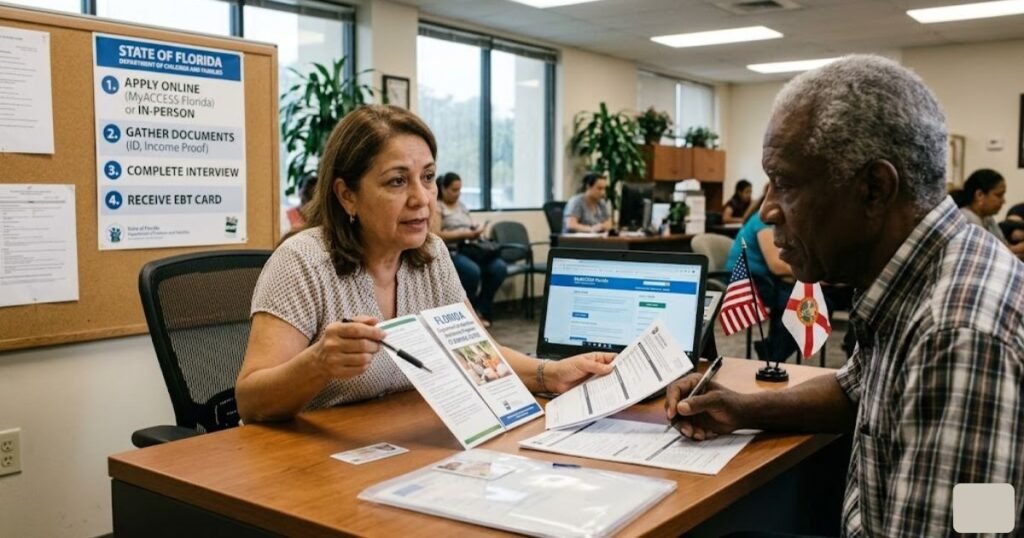
What is the Supplemental Nutrition Assistance Program in Florida?
The Supplemental Nutrition Assistance Program (SNAP) is a federal program that helps low-income individuals and families buy the food they need for good health. While funded by the federal government, each state manages its own application and distribution process. In the Sunshine State, the Florida Department of Children and Families (DCF) oversees these services under the official name Food Assistance Program.
When you are approved for food assistance in Florida, you do not receive paper coupons or stamps. Instead, your monthly benefit is loaded electronically onto a plastic card that looks and functions exactly like a standard debit card. This is called an Electronic Benefits Transfer (EBT) card, or an ACCESS card. You can use this card at major grocery stores, supermarkets, convenience stores, and even many local farmers’ markets across Florida to buy bread, cereal, fruits, vegetables, meat, fish, poultry, and dairy products.
For seniors, this program provides a vital boost to monthly budgets. Many older Floridians live on a fixed income from Social Security, a small pension, or Supplemental Security Income (SSI). When the cost of utilities, rent, and medical care rises, the grocery budget is usually the first thing to get cut. Claiming your food assistance benefits helps close this gap, protecting your physical health and providing peace of mind.
Who Can Claim SNAP Benefits in Florida?
Understanding the eligibility criteria is the first step toward successfully claiming your food assistance. Florida has specific guidelines to ensure that benefits go to those who need them most. However, the state also features special, more relaxed rules for households that include someone who is elderly (age 60 or older) or living with a recognized disability.
Here are the main eligibility foundations you need to know:
1. Identity and Residency
To receive benefits, your identity must be verified. You must also be a legal resident of the state of Florida. U.S. citizens and certain qualified non-citizens (such as legal permanent residents who meet specific criteria) are eligible to apply.
2. General Income Limits
Most households must meet specific income tests to qualify. However, Florida applies a higher gross income limit for households containing an elderly or disabled member. For most standard households, the gross income limit is 130% of the Federal Poverty Level (FPL). But if your household includes an older adult over 60 or a disabled individual, the gross income limit increases to 200% of the Federal Poverty Level, provided no household member has been disqualified due to an intentional program violation.
For perspective in 2026, the gross monthly income limits (before taxes and deductions) for households with a senior or disabled member generally align with these figures:
- Household Size of 1: Up to $2,610 per month
- Household Size of 2: Up to $3,526 per month
- Household Size of 3: Up to $4,442 per month
3. Lenient Asset Rules for Seniors
In past years, having a modest savings account or owning a car could disqualify you from receiving food assistance. Fortunately, Florida has largely eliminated the asset test for the majority of applicants. If your household includes a senior or disabled member, you do not have to worry about an asset limit unless a member of your household has been disqualified for a violation. This means your home, your primary vehicle, and standard retirement savings typically will not count against your eligibility.
4. Work Rules
Florida enforces specific work requirements for certain individuals between the ages of 16 and 64 to encourage employment. However, seniors aged 60 and older are completely exempt from all SNAP work rules. If you live in a multigenerational household such as an elderly parent living with an adult child who is 45 the younger family member may need to meet Florida’s work rules, but the senior member will not.
Pre-Application Eligibility Checklist
Before starting your application, take a brief moment to run through this checklist to see if you meet the baseline criteria:
- [ ] At least one member of the household is a Florida resident.
- [ ] The applicant can provide a Social Security Number or proof of application for one.
- [ ] Total monthly household income before taxes falls below the 200% Federal Poverty Level for your household size (for senior/disabled households).
- [ ] No household members are currently receiving overlapping food assistance benefits from another state.
READ MORE: Difference Between Medicare and Medicaid Coverage: 2026 Guide
How to Claim Supplemental Nutrition Assistance Program Florida
Florida offers multiple paths to apply for food assistance to accommodate different comfort levels with technology. The fastest and most efficient way to submit an application is online through the state’s modern public assistance portal, but traditional paper-based methods are fully supported for those who prefer them.
Step 1: Gather Your Information
Before opening the portal or picking up a pen, collect basic information for everyone living in your household. This includes full names, dates of birth, Social Security Numbers, and details about your current income (such as your latest Social Security award letter or pension statements).
Step 2: Choose Your Application Method
Option A: Online via MyACCESS (Recommended)
The MyACCESS Florida portal is an all-in-one website managed by the Florida Department of Children and Families. It allows you to submit forms, upload digital documents, and track your case status from home.
- Go to the official website: myaccess.myflfamilies.com.
- Click on “Create Account” if you are a new user, or sign in if you already have an account. Caregivers can create an account on behalf of the elderly parent they are assisting.
- Once logged in, select “Apply for Benefits” and choose Food Assistance (SNAP).
- Follow the simple on-screen prompts to fill out your household profile, income details, and monthly expenses.
Option B: Paper Application via Mail or Fax
If you do not have a computer, find the internet confusing, or lack a reliable web connection, you can use a physical paper application.
- Download and print the official application form directly from the Florida DCF website, or ask a local community partner to print it for you.
- Carefully fill out the fields using blue or black ink.
- Mail your completed paper application to the centralized processing office:
Office of Economic Self-Sufficiency Mail Center
P.O. Box 1770
Ocala, FL 34478-1770 - Alternatively, you can fax the document to the state’s toll-free number: 1-866-886-4342.
Option C: In-Person with a Community Partner
Florida DCF collaborates with a vast network of community partners including local senior centers, food banks, ministries, and libraries that are specially trained to help seniors file for benefits. You can search for a partner close to your home using the “Community Partner Search” tool on the DCF homepage, or visit a physical DCF Family Resource Center to submit your paperwork via an on-site computer terminal.
The Application Step Summary
No matter which route you choose, your application will follow these structural phases:
- Account Creation: Setting up your digital ID or filling out your primary paper contact details.
- Program Selection: Explicitly checking the box for “Food Assistance (SNAP).”
- Household Review: Listing everyone who lives with you and purchases or prepares food with you.
- Income Reporting: Entering exact amounts for Social Security, retirement pensions, or wages.
- Expense Documentation: Listing your rent or mortgage, utility bills, and out-of-pocket medical bills.
- Final E-Signature: Submitting the data securely to initiate the state’s review.
READ MORE: Best Robot Lawn Mowers for Seniors Review: Comparison & Buying Guide
Documents You May Need for Food Assistance Program in Florida
To approve your food assistance, the state of Florida must verify the statements made on your application. Providing these documents quickly prevents processing delays. You can upload clear pictures or scans of these papers directly through your MyACCESS account, or mail photocopies along with your paper application.
Florida’s verification guidelines recommend pulling together the following records:
- Proof of Identity: A valid Florida driver’s license, state-issued identification card, U.S. passport, or health insurance card.
- Social Security Verification: Social Security numbers for all applicants, or a document showing you have applied for a number.
- Proof of Income: A copy of your annual Social Security award letter, recent pension statements, veterans’ benefits letters, or the last four consecutive weeks of pay stubs if you work part-time.
- Housing Expenses: A copy of your current lease, mortgage statement, or property tax bill to verify your shelter costs.
- Utility Statements: Recent bills for electricity, gas, water, or telephone service.
- Out-of-Pocket Medical Expenses: Detailed receipts, pharmacy printouts, or bills for medical costs that are not covered by Medicare or private insurance (highly important for seniors).
- Bank Account Information: Recent statements for checking or savings accounts (only required if your household includes a member who has been disqualified).
- Citizenship or Immigration Documents: A birth certificate, naturalization certificate, or green card if you were born outside the United States.
READ MORE: How to Maximize Social Security Survivor Benefits for a Spouse
What Seniors and Caregivers Should Know Before Applying
Applying for public assistance programs can occasionally feel intimidating, but seniors enjoy several distinct statutory advantages in the SNAP program that make qualifying much easier.
Fixed Incomes are Expected and Welcomed
Living on a fixed income like Social Security is never a barrier to receiving help. In fact, because your income is steady and predictable, the state can verify it quickly through automated data exchanges with the Social Security Administration. This often speeds up the time it takes to get your application approved.
The SUNCAP Option for SSI Recipients
If you are a senior who receives Supplemental Security Income (SSI), your path to food assistance might be completely automatic through a specialized program called SUNCAP.
SUNCAP is a joint effort between the Social Security Administration and Florida DCF. If you meet the criteria such as being at least 18, receiving SSI, not working, and purchasing and preparing your food alone your SSI interview serves as your food assistance interview.
You may not need to fill out a separate MyACCESS application, file extra paperwork, or complete a second interview. If you already receive regular food assistance and later become eligible for SSI, the state will automatically transition your case to the SUNCAP program if it benefits you.
Deducting Medical Expenses Can Boost Your Monthly Benefit
When Florida calculates how much food assistance you will receive each month, they do not just look at your income they also look at your expenses. For seniors aged 60 and older, any unreimbursed medical expenses over $35 a month can be deducted from your income.
A lower countable income means you receive a higher monthly food assistance allotment. Make sure to claim expenses like prescription copays, dental treatments, vision care, hearing aid batteries, health insurance premiums, and even transportation costs to and from your doctor’s office.
How Family Caregivers and Adult Children Can Help
If an elderly parent is frail, lacks internet access, or finds the process stressful, an adult child or family caregiver can step in legally. On the application, you can designate yourself as an Authorized Representative. This designation gives you permission to speak with DCF caseworkers, fill out the forms on their behalf, upload documentation, and even hold onto their EBT card to do the grocery shopping for them.
READ MORE: Best Smart TV for Seniors in 2026: Easy to Use & Large Screen Picks
What Happens After You Apply?
Once your application is submitted via MyACCESS or received at the Ocala mail center, your case enters the review phase.
Processing Timeline
By federal and state law, Florida has up to 30 days to process your standard food assistance application. If your household has extremely low income and very little cash on hand, you may qualify for Expedited Food Assistance, which delivers your benefits within 7 days of submission.
The Phone Interview
A SNAP interview may be required for your Food Assistance case. Once your application is reviewed, Florida DCF will determine if an interview is necessary. If it is, they will send a notice detailing the scheduled date and time.
These interviews are almost always conducted over the telephone. A caseworker will call you to verify your identity, ask clarifying questions about who lives in your home, and confirm your monthly income and shelter costs.
Important Note: State agency phone calls may show up on your mobile phone as “Unknown,” “Restricted,” or “Private Number.” During your application window, be sure to answer these calls so you do not miss your scheduled interview window.
Notice of Eligibility and Receiving Your Card
You will receive an official Notice of Decision through your online MyACCESS portal account or via postal mail. If your application is approved, your notice will detail exactly how much money you will receive on your card each month and how long your certification period will last before you need to renew.
If you are a first-time applicant, your new Electronic Benefits Transfer (EBT) card will arrive in your mailbox via the U.S. Postal Service within a few days of approval. The card arrives in a plain white envelope for safety, accompanied by an instructional brochure explaining how to choose a secure 4-digit Personal Identification Number (PIN) and use the card at grocery checkout lines.
READ MORE: Best Wireless Earbuds for Senior Runners: 2026 Top Picks
Common Mistakes to Avoid
To guarantee your application flows smoothly without getting stuck in bureaucratic delays, be mindful of these frequent missteps:
- Omitting Out-of-Pocket Medical Bills: Many seniors forget to report their medical expenses because they assume only rent and utilities matter. Skipping medical deductions could cause you to receive far fewer monthly food benefits than you deserve.
- Leaving Out People Who Live with You: You must list everyone who sleeps under your roof. However, if you live with roommates or family members but buy and cook your food entirely separate from them, make sure to indicate that clearly on the application so their income isn’t mistakenly blended with yours.
- Missing the Scheduled Interview Call: If DCF schedules a phone interview and you miss the call, your application can be denied for non-cooperation. If you miss a call, use the contact numbers provided immediately to reschedule.
- Ignoring the MyACCESS Message Center: If you opt into electronic notifications, check your online account regularly. The state will post formal requests for missing documents there, and you usually have a strict 10-to-12-day window to respond.
- Submitting Unreadable Document Photos: When taking photos of your ID or utility bills with a smartphone, ensure the text is perfectly sharp, well-lit, and that no corners of the document are cut off. Blurred or cut-off images will be rejected by caseworkers.
- Assuming Social Security Disqualifies You: Never assume that because you receive Social Security or a modest retirement pension, you are automatically ineligible. The higher 200% gross income limit for seniors allows many retirees to qualify easily.
How to Get Help with Your Florida SNAP Application
If you run into technical issues online, don’t understand a specific question on the form, or need help tracking down a delayed application, several state resources are standing by to guide you.
The primary point of contact is the Florida Department of Children and Families Customer Call Center. You can call the automated system or wait to speak with a customer service representative directly:
| Contact Method | Information | Best Used For |
| DCF Customer Call Center | 1-850-300-4323 | Checking case status, updating phone numbers, or asking application questions. |
| Florida Relay System | 711 or 1-800-955-8771 (TTY) | Support for deaf, hard of hearing, or speech-disabled individuals. |
| Online Help Center | myaccess.myflfamilies.com | Instructional video tutorials, password resets, and direct document uploads. |
If calling the state phone lines involves a long wait time, remember that you can always drop by a local community partner office such as a neighborhood senior center or food bank for free, friendly, face-to-face assistance from staff members who understand the system.
READ MORE: Salvation Army Free Car Program (Eligibility & How to Apply)
Final Takeaway
Claiming your Supplemental Nutrition Assistance Program benefits in Florida is a practical, effective way to safeguard your budget and your long-term health. The application process is entirely manageable when you break it down step by step, organize your documents early, and lean on the automated tools inside the MyACCESS portal.
Remember that these public programs exist because you contributed to the safety net throughout your working life. Do not let complex forms or old stigmas keep you from getting the food assistance you are legally qualified to receive. Gather your documents, log onto MyACCESS or fill out a paper form, and take that simple first step toward a healthier, stress-free retirement today.
How do I claim Supplemental Nutrition Assistance Program Florida online?
You can claim Food Assistance in Florida by using the MyACCESS portal. Florida says this is the quickest way to apply, submit forms, and check your case status.
Can seniors get SNAP benefits in Florida?
Yes, seniors can qualify if they meet Florida’s Food Assistance rules. Florida requires identity verification and income review, and older adults may benefit from special deductions and special household rules.
What documents do I need for Florida SNAP application?
Common documents include proof of identity, income, housing costs, utility bills, bank information if requested, and any disability or immigration paperwork that applies. Florida’s verification page lists examples such as bank accounts, citizenship, disability, income, and immigration documents.
Do I need an interview for SNAP in Florida?
Maybe. Florida says Food Assistance cases may require an interview, and applicants are told after submitting the application whether one is needed. Some interviews may be completed by phone.
Can I get Florida food assistance if I receive SSI?
Possibly yes, and the SUNCAP option is important here. Florida says some SSI recipients may receive Food Assistance through SUNCAP without a separate application, paperwork, or interview.


Pingback: Older Americans Act Nutrition Program: Meals & Eligibility - Free Senior Grants