When searching for government-assisted housing, older adults are often met with discouraging news: multi-year waitlists. Finding low-income senior housing with no waiting list feels almost impossible when major metropolitan Housing Choice Voucher (Section 8) lists remain closed for years.
The reality is nuanced. While high-demand housing programs do have waiting lists, immediate or short-wait availability does exist across the United States. By targeting specific federal, state, and private affordable housing programs and knowing exactly where and how to look seniors, caregivers, and family members can secure safe, comfortable, and affordable apartments much faster.
This comprehensive guide covers everything you need to know: how federal housing subsidies work, hidden strategies to bypass multi-year delays, step-by-step application advice, and actionable resources to help you or your loved one find a home without waiting indefinitely. Lets deep dive into “Low-Income Senior Housing With No Waiting List (2026) | Immediate Move-In”
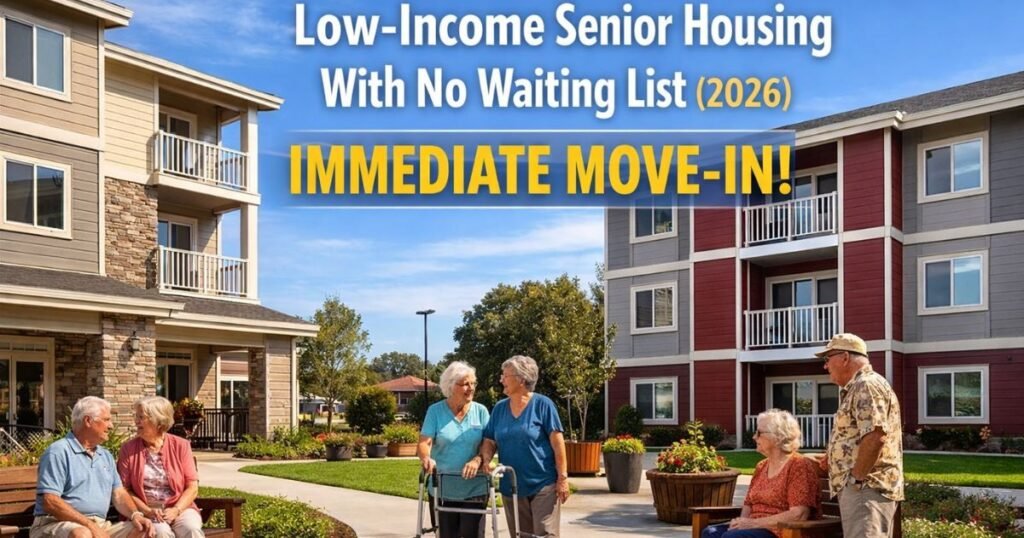
What Is Low-Income Senior Housing?
Low-income senior housing refers to residential communities specifically designed, regulated, or subsidized for older adults whose household income falls below a percentage of the local median income. These properties provide safe, accessible, and dignified living spaces tailored to the physical and financial needs of aging adults.
Key Elements of Low-Income Housing
- Income-Based Rent: Most federally subsidized properties calculate rent based on 30% of your adjusted gross income. If your income changes, your rent adjusts accordingly.
- Age Qualifications: Properties fall into two primary age categories under federal law: 55+ (Housing for Older Persons), where 80% of units must have at least one occupant 55 or older, and 62+ properties, which are strictly designated for elderly residents.
- Senior-Friendly Design: Physical layouts typically exclude stairs, feature lever-style door handles, incorporate emergency response systems, and offer communal activity spaces.
READ MORE: Can Seniors on Social Security Benefits Get Free Affordable Housing?
Can Seniors Really Find Housing With No Waiting List?
To set clear, honest expectations: there is no nationwide single program where every senior automatically gets immediate housing without a wait. Anyone promising instant, universal placement in any city is not being truthful.
However, immediate vacancies and short waiting lists (under 30 to 90 days) exist across the country.
Why Do Some Properties Have Immediate Openings?
- Brand-New Property Openings: When a new Low-Income Housing Tax Credit (LIHTC) or HUD Section 202 building finishes construction, dozens or hundreds of brand-new units open simultaneously. Seniors who apply early during lease-up can move in immediately without waiting.
- Rural and Small-Town Locations: Public Housing Authorities (PHAs) and USDA Rural Development properties outside major metropolitan areas frequently have low application volumes and immediate openings.
- Property-Specific Waitlists: Unlike citywide Section 8 voucher lists that stay closed, individual HUD-subsidized buildings manage their own individual waiting lists. Smaller or lesser-known communities often exhaust their waiting list and need qualified tenants right away.
- High Turnover in Large Communities: In large senior complexes, vacancies occur continuously. If a unit opens and no one on the local waitlist responds quickly, management leasing staff will immediately offer it to a new applicant ready to move.
Who Qualifies for Affordable Senior Housing?
Eligibility depends on age, household income, citizenship status, and background verification.
1. Age Requirements
- 55 and Older: Properties operating under the Housing for Older Persons Act (HOPA) require at least 80% of occupied units to have one resident age 55+.
- 62 and Older: HUD Section 202 and specific federally funded public housing buildings require the primary applicant to be at least 62 years old.
2. Income Thresholds
HUD calculates income eligibility annually using local Area Median Income (AMI) figures:
- Extremely Low Income: Below 30% of AMI.
- Very Low Income: Below 50% of AMI ( standard baseline for Section 202).
- Low Income: Below 80% of AMI (used by many tax credit properties).
3. Accepted Income Sources
Income limits do not mean you must be employed. Almost all fixed-income sources are accepted:
- Social Security Retirement Benefits
- Supplemental Security Income (SSI)
- Social Security Disability Insurance (SSDI)
- Veterans Affairs (VA) Compensation & Pensions
- Private Employer Pensions & 401(k) Distributions
READ MORE: Homeless Shelter for Seniors | Free Housing & Support Programs
Best Housing Programs for Low-Income Seniors
Understanding the difference between federal, state, and local housing programs helps you target properties that are accepting applications right now.
1. HUD Section 202 Supportive Housing for the Elderly
- What it is: A specialized HUD program that finances affordable housing strictly for seniors aged 62 and older with low or very low incomes.
- Rent Calculation: Tenants pay 30% of their adjusted monthly income toward rent; HUD subsidies cover the rest.
- Why it’s great: Properties include on-site Service Coordinators who help residents arrange transportation, healthcare visits, and meal support. Because each property manages its own list, you can apply directly to multiple Section 202 buildings in your area.
2. Low-Income Housing Tax Credit (LIHTC) Senior Apartments
- What it is: The largest creator of affordable housing in the U.S. Federal tax credits are given to private developers who build and maintain affordable apartments.
- Rent Calculation: Rents are not strictly 30% of your personal income; instead, rents are capped at fixed, lower-than-market rates tailored for households earning 50% to 60% of AMI.
- Why it’s great: LIHTC developments offer modern amenities (gyms, activity rooms, central air). Because these properties are privately managed, they process applications quickly and often have open availability in newly constructed buildings.
3. Public Housing Communities
- What it is: Multi-unit properties owned and operated directly by local Public Housing Authorities (PHAs). Many communities reserve designated high-rises or complexes exclusively for seniors aged 62+ or disabled individuals.
- Rent Calculation: Income-based, typically 30% of adjusted gross income.
4. Housing Choice Vouchers (Section 8)
- What it is: A portable subsidy that allows seniors to find their own rental home in the private market.
- Wait Time Reality: Central Housing Choice Voucher lists carry long wait times in major cities. However, project-based vouchers tied to specific senior buildings often have independent, shorter waitlists.
5. USDA Rural Rental Housing (Section 515)
- What it is: Multifamily housing located in rural towns, funded by USDA Rural Development.
- Why it’s great: Rural properties often have the shortest waiting lists in the country. Many offer immediate openings for low-income seniors willing to live in smaller, peaceful towns outside major city centers.
6. Local Nonprofits, Faith-Based & Veterans Housing
- Nonprofit & Faith-Based: Organizations like Volunteers of America, Lutheran Services, Catholic Charities, and Salvation Army manage independent low-income senior properties across the country.
- Veterans Housing: The HUD-VASH program combines Section 8 housing vouchers with VA case management services, offering prioritized, rapid housing placement for low-income or homeless veterans.
READ MORE: $3000 Senior Assistance Program Application
10 Ways to Find Senior Housing Without Waiting Years
If you need affordable housing faster, relying on a single metropolitan housing application is not enough. Use these practical, proven strategies to shorten your wait time:
- Apply to Multiple Independent Properties: Avoid putting all your eggs in one basket. Apply to 5, 10, or 15 privately managed HUD Section 202 and LIHTC properties at once.
- Hunt for Brand-New Property Openings: Monitor state housing finance agency directories for affordable developments breaking ground. Getting on a pre-leasing list 3 to 6 months before construction ends guarantees a unit on opening day.
- Look Beyond Big City Limits: Expanding your search just 20 to 30 miles outside a major city into suburban or rural counties can drop your wait time from three years to 30 days.
- Work Directly with Property Managers: Call apartment managers directly rather than relying only on government agency websites. Managers know exactly when a tenant is preparing to move out.
- Call Your Local Area Agency on Aging (AAA): Local AAAs maintain real-time lists of senior developments that are currently taking applications without long queues.
- Use the USDA Rural Housing Direct Search Tool: Use the official USDA property search portal to find Section 515 apartments in your state.
- Ask for Emergency Placement (If Eligible): If you are facing eviction, living in unsafe conditions, or spending over 50% of your fixed income on rent, ask your local housing authority if you qualify for local preference points.
- Check Faith-Based Non-Profit Networks: Religious organizations manage vast networks of subsidized housing that do not require you to belong to their faith to live there.
- Keep Your Applications Active: Check in with property managers every 30 to 60 days. If a manager gets a sudden vacancy and can reach you immediately, you move straight to the top of the pile.
- Partner with Local Homelessness Prevention Programs: Organizations receiving Emergency Solutions Grant (ESG) funding can provide short-term rental support and fast-track permanent affordable housing options.
Step-by-Step Application Process
Securing low-income housing requires organization and preparation. Follow these step-by-step instructions:
Step 1: Organize Your Documentation
Before filling out a single page, place all personal identification, financial records, and medical verification in an easy-to-carry folder. Missing paperwork is the primary reason housing applications stall.
Step 2: Submit Applications Broadly
Fill out applications completely. Leave no blanks—write “N/A” if a question does not apply to you. Keep a dedicated notebook listing every property applied to, the date of submission, and the contact information for the leasing office.
Step 3: Attend the Screening Interview
Once selected, management will schedule an intake interview. You will sign income verification release forms, review property rules, and confirm your household details.
Step 4: Complete Background and Income Verification
Management cross-checks your income against tax returns, Social Security benefit statements, and bank records. They will also check criminal databases and landlord references.
Step 5: Conduct the Unit Walkthrough
Once approved, you will inspect your assigned apartment alongside the manager. Note any preexisting wear or repairs needed on your check-in form.
Step 6: Sign the Lease and Pay Deposits
Review lease terms, pay your first month’s rent (and security deposit, if applicable), pick up your keys, and schedule your move-in date!
READ MORE: How to Apply for SNAP Benefits as a Low-Income Older Adult
Required Documents Checklist
Having these documents ready will fast-track your approval process:
[ ] Official Government Photo ID (Driver’s license, state ID, or passport)
[ ] Social Security Cards (For all household members)
[ ] Birth Certificates
[ ] Social Security Benefit Award Letters (Current calendar year statement)
[ ] Pension and Retirement Account Statements
[ ] Bank Account Statements (Last 3 to 6 consecutive months for checking & savings)
[ ] Proof of Assets (CDs, stocks, bonds, or real estate values)
[ ] Medical Expense Documentation (Out-of-pocket medical bills, Medicare premium proof, prescription costs)
[ ] Previous Landlord References (Contact names, addresses, and phone numbers for past 3-5 years)
[ ] Proof of Disability (If applying for designated accessible or disability units)
How Much Does Senior Housing Cost?
Cost varies significantly based on whether a property uses income-based subsidies or fixed affordable rates.
Cost Comparison Across Senior Housing Options
| Housing Option | Average Monthly Rent Structure | Out-of-Pocket Rent Range (Est.) | Who Sets the Rent? |
| Market-Rate Apartments | Local real estate market prices | $1,400 – $2,800+ / month | Private landlords |
| HUD Section 202 Housing | 30% of adjusted gross income | $200 – $550 / month | Federal formula (HUD) |
| Public Housing Communities | 30% of adjusted gross income | $200 – $600 / month | Local Housing Authority |
| LIHTC Senior Apartments | Fixed cap (30%–60% local AMI) | $550 – $1,100 / month | State/Local AMI Limits |
| USDA Rural Rental Housing | Income-based or basic rural rent | $250 – $600 / month | USDA Rural Development |
Note: Figures are national averages. Exact rent calculations vary depending on location, utility allowances, and household deductions.
READ MORE: Supplemental Security Income (SSI) for Seniors
How Rent Is Calculated for Subsidized Senior Housing
For HUD Section 202 and Public Housing, rent is calculated using standard federal guidelines:
$$\text{Monthly Tenant Rent} = (\text{Adjusted Monthly Income} \times 0.30) – \text{Utility Allowance}$$
Step-by-Step Formula Breakdown
Gross Annual Income (Social Security, Pensions, Interest)
– Allowable Deductions ($550 Elderly Allowance + Out-of-Pocket Medical Costs)
—————————————————————————–
= Adjusted Annual Income
÷ 12 Months
—————————————————————————–
= Adjusted Monthly Income
× 30%
—————————————————————————–
= Total Tenant Payment (TTP)
– Utility Allowance (If tenant pays own electricity/gas)
—————————————————————————–
= FINAL MONTHLY RENT OWE
- Elderly Deduction: Federal rules automatically deduct a standard annual allowance for elderly households (age 62+ or disabled) from your gross income.
- Medical Expense Deductions: Unreimbursed medical expenses exceeding 3% of your annual gross income can be deducted. This includes Medicare premiums, dental care, hearing aid supplies, prescription copays, and doctor fees.
- Utility Allowance: If you pay your own utilities, management reduces your monthly rental obligation by a set utility allowance credit.
States Where Seniors Often Find Faster Housing Availability
While major metro hubs face severe housing shortages, several states and regions offer shorter wait times due to lower population density, robust rural housing infrastructure, or higher vacancy rates.
Why Availability Is Faster in These Regions
- Broader USDA Footprint: These states host hundreds of USDA Section 515 rural developments designed for elderly residents.
- Lower Population Pressure: Smaller towns experience less application volume than coastal cities or major financial centers, meaning waiting lists move much quicker.
- Active Senior Construction: Several Midwestern and Southern states actively construct Low-Income Housing Tax Credit (LIHTC) communities to serve aging populations.
Common Reasons Applications Are Denied
Receiving an application denial can be disheartening, but understanding why it happens helps you avoid mistakes or successfully appeal the decision.
- Income Over the Limit: Your total income slightly exceeds the maximum cap for that property (e.g., earning $100 over the 50% AMI threshold).
- Incomplete Documentation: Failing to return income verification forms or bank statements before deadlines.
- Unresolved Rental Delinquencies: Unpaid balances or previous evictions from housing authority properties within the past 3 to 5 years.
- Criminal Background Restrictions: Unresolved legal matters or background history that violates property safety guidelines.
- Failure to Respond to Mail: Housing authorities send waitlist confirmation notices by mail. If you move without updating your address, your application will be removed for non-response.
READ MORE: How to Find the Best Senior Assisted Living Communities Near Me
10 Mistakes Seniors Should Avoid
Avoid these critical missteps when navigating the affordable housing system:
- Waiting to Apply Until an Emergency Strikes: Start your search early do not wait until an eviction notice or medical setback forces a sudden move.
- Applying to Only One Property: Spreading your applications across multiple communities dramatically improves your chances of moving in faster.
- Forgetting to Report Medical Deductions: Failing to list out-of-pocket medical expenses causes you to pay higher monthly rent than necessary.
- Not Updating Contact Information: Always notify housing managers in writing if your phone number, email, or mailing address changes.
- Assuming 55+ Housing Is Free or Fully Subsidized: Many 55+ communities are market-rate or fixed-rent tax-credit properties; clarify rent formulas before applying.
- Ignoring Rural and Small-Town Options: Dismissing smaller communities outside major metropolitan areas leaves fast, high-quality housing opportunities on the table.
- Failing to Track Submitted Applications: Keep a dedicated paper journal or digital file of all applications, contact names, and submission dates.
- Throwing Away Mail from Housing Authorities: Open every letter from housing authorities immediately; many require a written response within 10–14 days.
- Failing to Appeal Denial Letters: Denials are often overturned if missing paperwork or incorrect income calculations are corrected within the appeal window (usually 10–14 days).
- Paying Upfront Application Fees to Scammers: Legitimate HUD-subsidized senior housing developments do not charge application fees. Be cautious of online scams demanding money to secure a spot on a waitlist.
Practical Real-World Housing Scenarios
Scenario 1: Bypassing a 3-Year Waitlist by Moving 25 Miles Away
The Situation: Eleanor, 67, lived on $1,350/month in Social Security in a major metropolitan city. Local Section 8 lists were closed, and local senior developments had 3-year waiting lists.
The Action: Eleanor expanded her search to adjacent, smaller counties. She found a HUD Section 202 property 25 miles away in a peaceful town.
The Outcome: The smaller community had an open waitlist and processed her application within 60 days. Eleanor moved into a brand-new 1-bedroom apartment paying just $380/month.
Scenario 2: Landing an Apartment in a Newly Opened LIHTC Community
The Situation: Arthur, 62, needed an accessible apartment after knee surgery but faced multi-year delays for city public housing.
The Action: Arthur’s daughter checked the State Housing Finance Agency website and identified a 60-unit LIHTC senior building finishing construction nearby. Arthur submitted his application during the pre-leasing phase.
The Outcome: Arthur was approved during initial leasing and moved into a brand-new, accessible ground-floor apartment on the day the property opened.
Scenario 3: Utilizing USDA Rural Housing for Immediate Placement
The Situation: Martha and Robert, both 70, struggled to afford standard $1,500/month rent after private savings ran out.
The Action: A local housing specialist directed them to the USDA Rural Development online housing directory. They found a Section 515 senior property in a small rural town that had two vacant units.
The Outcome: They completed paperwork, passed income verification, and moved in within 3 weeks, securing an income-based rent rate under $400/month.
READ MORE: Government Grants for Seniors: The Complete, Up-to-Date U.S. Guide
Helpful Search & Application Checklists
1. Daily Search Action Plan
[ ] Search state housing finance agency websites for newly constructed developments.
[ ] Call 3 local HUD Section 202 property management offices directly.
[ ] Use USDA Rural Development tools to check surrounding small towns.
[ ] Check in with your local Area Agency on Aging housing advocate.
2. Move-In Preparedness Checklist
[ ] First month’s rent payment (Cashier’s check or money order)
[ ] Security deposit funds
[ ] Active government photo ID
[ ] Utility transfer details (Electricity, water, gas accounts set up)
[ ] Emergency contact list provided to property manager
Program Comparison Summary
| Program Name | Target Age | Rent Model | Average Wait Time | Best For |
| HUD Section 202 | 62+ | 30% Adjusted Income | Short to Moderate (30 days–1 year) | Very low-income seniors seeking supportive services |
| LIHTC Apartments | 55+ or 62+ | Fixed affordable cap | Fast to Moderate (Immediate–6 months) | Seniors with moderate income wanting modern amenities |
| Public Housing | 62+ (Senior Designated) | 30% Adjusted Income | Moderate to Long (6 months–2 years) | Fixed-income retirees looking for stable housing |
| USDA Rural Housing | 62+ or Disabled | 30% Income or Basic Rent | Fastest (Immediate–90 days) | Seniors willing to live in small towns or rural areas |
| Section 8 Voucher | All Ages / Seniors | 30% Adjusted Income | Long (1–3+ years) | Seniors seeking private market flexibility |
Immediate Local Resources
If you need urgent advice, housing navigation, or legal help, contact these official resources:
- 2-1-1 Information & Referral Line: Call 211 or visit 211.org to connect with local emergency rent assistance, shelter placement, and senior services.
- Eldercare Locator: Call 1-800-677-1116 or visit eldercare.acl.gov (operated by the U.S. Administration on Aging) to find local Area Agencies on Aging (AAA).
- HUD Local Office Directory: Visit hud.gov to locate subsidized multifamily developments in your state.
- USDA Rural Development Directory: Visit rd.usda.gov to search for Section 515 rural housing in your zip code.
- Legal Aid Services: Visit lsc.gov (Legal Services Corporation) to access free legal support if facing eviction or improper housing denials.
Final Verdict
Finding low-income housing for seniors that does not have a waiting list could be quite difficult, but certain options do exist through government programs, nonprofit organizations, and faith-based groups. Seniors should immediately reach out to local housing authorities, nonprofit organizations handling housing-related issues, and online housing services to inquire into availability and to apply as soon as they can in order to expedite placement. By working diligently with such resources, safe and affordable housing could be within reach for many deserving seniors.
FAQs
Is there low-income senior housing with no waiting list?
Yes, low-income senior housing with no waiting list or very short wait times exists. While central city vouchers have long delays, newly opened Low-Income Housing Tax Credit (LIHTC) developments, USDA rural housing properties, and privately managed HUD Section 202 communities frequently have immediate openings.
How can seniors find affordable housing faster?
Seniors can speed up their search by applying directly to multiple independent properties, searching newly built affordable communities during pre-leasing, expanding their geographic search to surrounding suburban or rural counties, and getting help from local Area Agencies on Aging.
Who qualifies for HUD senior housing?
To qualify for HUD senior housing (such as Section 202), the head of household must be at least 62 years old, and household income must fall within HUD’s “Very Low” income limits (typically at or below 50% of the Area Median Income). Applicants must also pass basic background and rental checks.
Can seniors receive emergency housing assistance?
Yes. Seniors facing eviction, unsafe living conditions, or homelessness can receive immediate aid by calling 2-1-1, contacting local Emergency Solutions Grant (ESG) providers, or applying for priority status at local Housing Authorities. Veterans can access rapid housing through the HUD-VASH program.
How much does income-based senior housing cost?
In federally subsidized housing like HUD Section 202 or Public Housing, tenants pay approximately 30% of their adjusted monthly income toward rent. Allowable out-of-pocket medical expenses and standard deductions are subtracted from your gross income before rent is calculated.

Pingback: Does Manitoba Government Offer Free Grants For Seniors? - Free Senior Grants