When you live on a fixed retirement income, every extra dollar spent on property taxes is a dollar taken away from healthcare, utilities, groceries, or home repairs. It is completely natural to wonder: Is there any relief available for older homeowners? Do I still have to pay this full amount?
The short answer is: Yes, property tax relief programs for seniors exist across the United States but relief is rarely automatic, and there is no single nationwide rule that eliminates property taxes for everyone over 65.
Instead, property tax assistance comes from state, county, and local governments. Depending on where you live, your age, and your household income, you may be able to reduce your home’s assessed value, freeze your tax rate, claim an income-based tax credit, or defer your payments until a later date.
Understanding how these programs work and knowing where to apply can mean the difference between struggling with rising tax bills and enjoying the financial peace of mind you worked a lifetime to achieve. Lets deep dive into “Senior Property Tax Relief Programs: How to Lower Your Bill”
Disclaimer: This article is provided for general informational and educational purposes only and does not constitute individualized legal, financial, or tax advice. Property tax laws, eligibility rules, and application deadlines vary widely by state, county, and municipality. Always consult your local county assessor, state department of revenue, or a qualified tax professional to verify specific requirements for your property..
READ MORE: Intentionally Defective Grantor Trust (IDGT): Guide to Estate Tax Planning
Do Seniors Get a Property Tax Exemption?
One of the most common questions older homeowners ask is whether turning 65 automatically exempts them from paying property taxes.
Simply turning 60, 65, or 70 does not automatically eliminate your property tax bill. No state offers a universal, automatic exemption that waives property taxes for all older residents without an application or specific eligibility criteria.
However, almost every state offers some form of property tax relief designed specifically for older adults, retirees, or low-income homeowners. How much you save and how the relief is delivered depends entirely on local tax laws.
Here is what you need to know about senior property tax exemptions:
- Programs are location-specific: Property taxes are levied by local taxing authorities (counties, cities, towns, and school districts). Therefore, tax relief rules vary significantly across state lines and even between neighboring counties.
- Reductions vs. Elimination: Most senior exemptions do not erase your bill completely. Instead, they reduce the taxable value of your home, lowering the final dollar amount you owe.
- Income limits often apply: Many of the most generous property tax break programs require your total household income to fall below a specific limit.
- Residency matters: Nearly all programs require you to own and occupy the home as your primary residence (often called a homestead). Second homes and rental properties do not qualify.
- Some programs delay payment rather than lower it: Certain states offer deferral options, which allow you to postpone paying taxes until you sell the home or pass away.
Understanding the difference between paying less now and paying later is the first step toward choosing the right program for your financial situation.
READ MORE: 6000 Dollar Senior Tax Deduction for Over 65 Rules
How Property Tax Relief Programs for Seniors Work
Property tax relief generally falls into four main categories: exemptions, freezes, deferrals, and credits (or circuit breakers). Each mechanism works differently to protect senior homeowners from escalating property taxes.
1. Senior Property Tax Exemptions
A senior property tax exemption removes a portion of your home’s assessed value from taxation. Because your property tax bill is calculated by multiplying your home’s taxable value by the local tax rate (millage rate), lowering the taxable value directly lowers your tax bill.
How an Exemption Works (Example)
Suppose you own a home with an assessed market value of $250,000, and your local combined property tax rate is 2% (or 20 mills).
- Without an exemption:
$$\$250,000 \text{ assessed value} \times 2\% = \mathbf{\$5,000 \text{ annual tax bill}}$$ - With a $50,000 Senior Exemption:
Your taxable value is reduced to $200,000 ($250,000 − $50,000).
$$\$200,000 \text{ taxable value} \times 2\% = \mathbf{\$4,000 \text{ annual tax bill}}$$
In this scenario, the exemption saves you $1,000 every year. Some jurisdictions offer flat dollar exemptions (like $25,000 or $50,000 off assessed value), while others offer percentage reductions (such as exempting 50% of the home’s value).
2. Property Tax Freezes
A senior property tax freeze prevents your property tax bill or the assessed value of your home from rising as market values increase.
- Assessment Freezes: The county locks in the assessed value of your home at the age you qualify (e.g., age 65). Even if home prices in your neighborhood double over the next decade, your property taxes will still be calculated based on your frozen assessment value.
- Tax Amount Freezes: Some jurisdictions freeze the actual dollar amount of school district or county taxes you owe.
Important Note: A tax freeze does not guarantee your bill will never change. If local tax rates increase, or if you make major structural improvements to your home (like adding a garage or a room expansion), your tax bill may still adjust.
3. Property Tax Deferrals
A property tax deferral program allows eligible senior homeowners to postpone paying some or all of their property taxes until a future date.
Instead of paying your annual tax bill out-of-pocket, the state or county pays the tax on your behalf. In exchange, the government places a lien on your property for the deferred amount plus interest (which is typically lower than commercial loan rates).
Key Aspects of Tax Deferrals:
- Accrued Debt: The deferred taxes become a cumulative loan against your property.
- Interest Charges: Most programs charge annual interest on the deferred amount.
- Repayment Triggers: The full deferred balance plus interest must be repaid when:
- You sell the property.
- You transfer ownership.
- You move out or no longer use the home as your primary residence.
- The surviving homeowner passes away.
- Estate Impact: When the homeowner passes away, the estate or heirs must repay the deferred taxes out of the home’s equity or estate funds.
Deferrals can be a valuable lifeline for cash-strapped seniors who are rich in home equity but poor in liquid income. However, they reduce the inheritance you leave behind, so discuss this option with your family or legal advisor first.
4. Property Tax Credits and Circuit Breakers
Property tax credit or “circuit breaker” programs are designed to protect low- and moderate-income seniors from tax overload. Just as an electrical circuit breaker trips when a system carries too much power, a property tax circuit breaker kicks in when property taxes exceed a certain percentage of a senior’s total household income.
If your property taxes exceed that threshold (for example, 10% of your annual income), the state provides a direct tax credit, income tax deduction, or cash rebate check to offset the excess burden.
READ MORE: Tax and Estate Planning Attorney Near Me
Who Usually Qualifies for Senior Property Tax Relief?
While every state establishes its own eligibility criteria, most programs evaluate a combination of the following factors:
- Age: Requirements typically start at age 61, 62, or 65. Some programs offer tiered benefits that increase as you get older (e.g., higher savings at age 70 or 75).
- Household Income: Many programs use total income including Social Security benefits, pension payouts, IRA distributions, and interest—to establish eligibility thresholds.
- Primary Residence Status: You must own the home and live in it for a minimum portion of the year (usually at least 183 days).
- Length of Ownership: Some local programs require you to have lived in the state or county for a minimum continuous period (such as 1 to 5 years).
- Disability Status: Senior homeowners who are permanently and totally disabled may qualify for lower age limits or enhanced exemptions.
- Veteran Status: Honorably discharged veterans—especially disabled veterans—frequently qualify for higher exemption amounts.
- Surviving Spouse Status: Widows and widowers of qualifying seniors, veterans, or first responders may retain existing tax benefits if they meet age and residency requirements.
Property Tax Relief for Seniors by State
Because property tax assistance is handled at the state and county level, the type and amount of relief available depends heavily on where your home is located.
The table below provides an overview of common senior relief programs offered across select representative states.
| State | Primary Senior Relief Type(s) | Typical Eligibility Factors | What Seniors Should Verify |
| Alabama | Total exemption from state property tax; local age/income exemptions | Age 65+; income thresholds for county/local portion | Net annual income limits; local county appraiser guidelines |
| Alaska | Senior exemption on assessed value | Age 65+ or surviving spouse 60+; primary residence | Exemption limits up to $150,000 assessed value; municipal variations |
| Arizona | Senior Property Valuation Protection (Freeze) | Age 65+; primary residence 2+ years; strict income limits | Income caps set annually by state; application filing deadlines |
| Arkansas | Senior Property Tax Assessment Freeze | Age 65+ or disabled; primary residence | Value freeze status; school tax exemption options |
| California | Property Tax Postponement (Deferral) | Age 62+, blind, or disabled; 40%+ equity; income caps | Interest rates; state controller application window |
| Colorado | Senior Homestead Exemption | Age 65+; must own/occupy home for 10+ continuous years | Funding status (can be adjusted by legislature); 50% exemption cap |
| Florida | Additional Senior Homestead Exemption | Age 65+; primary residence; strict low-income limits | County-level ordinance approval; annual income verification |
| Georgia | Senior School Tax Exemption (County-level) | Age 62+ or 65+; primary residence; income limits vary | School district rules; local county tax commissioner forms |
| Illinois | Senior Citizens Homestead Exemption & Assessment Freeze | Age 65+; primary residence; income limits for freeze | Annual renewal requirements; max income limits for freeze |
| Indiana | Over 65 Deduction & Circuit Breaker Cap | Age 65+; assessed value limits; strict adjusted gross income caps | Assessed home value caps; income thresholds |
| Kentucky | Homestead Exemption (includes Seniors) | Age 65+ or permanently disabled; primary residence | Biennial inflation adjustment of exemption dollar amount |
| Louisiana | Special Assessment Level (Freeze) | Age 65+; adjusted gross income limit set annually | Income limits; continuous primary residence status |
| Maryland | Homeowners’ Property Tax Credit | All ages, enhanced for seniors; household income vs. tax bill | Net worth limits (excluding home value); income caps |
| Michigan | Homestead Property Tax Credit | All low-income homeowners, higher thresholds for 65+ | Total household resources; taxable home value limits |
| Minnesota | Senior Citizens Property Tax Deferral | Age 65+; primary residence 15+ years; household income limit | Percentage of tax deferred; accrued interest rates |
| Nebraska | Homestead Exemption for Seniors | Age 65+; income and home valuation limits | Tiered exemption percentages based on household income |
| Oregon | Property Tax Deferral for Senior Citizens | Age 62+; household income cap; net worth restrictions | State revenue lien terms; interest rate schedules |
| Pennsylvania | Property Tax/Rent Rebate Program | Age 65+, widows/widowers 50+, disabled 18+; income caps | Annual filing deadlines; tiered rebate schedules |
| South Carolina | Senior Homestead Exemption | Age 65+ (or legally blind/disabled); 1-year residency | Exempts first $50,000 of fair market value |
| Texas | Over-65 Homestead Exemption & Tax Ceiling (Freeze) | Age 65+; primary residence | School district tax caps; optional county/city exemptions |
| Virginia | Real Estate Tax Relief for Elderly/Disabled | Age 65+; local county income and asset limits | County/city ordinance rules; net financial worth caps |
| Washington | Property Tax Exemption & Deferral for Seniors | Age 61+ or disabled; combined disposable income limits | County assessor filing; income threshold tiers |
Note: Program terms, dollar amounts, and income limits change regularly through legislation. Always confirm details directly with your county tax assessor or state department of revenue.
READ MORE: Best 5 Smart Rings for Seniors | Cost & Comparison
States Where Seniors May Receive Significant Property Tax Relief
Headlines promising “states with no property tax for seniors” can be misleading. No state waives property taxes for all seniors automatically.
However, several states offer robust programs that can reduce a senior’s tax liability significantly sometimes down to zero for school district taxes or low-valued homes:
- Texas: Senior homeowners over 65 receive an additional $100,000 school district homestead exemption. Texas also places a firm “tax ceiling” (freeze) on school district property taxes once a homeowner turns 65.
- Alabama: Homeowners age 65 and older are exempt from all state-level property taxes. Depending on household income, many seniors also qualify for exemptions from county and local property taxes.
- Alaska: State law exempts the first $150,000 of assessed value from property taxes for seniors 65 and older. Local municipalities can choose to expand this exemption even further.
- South Carolina: The state’s homestead exemption waives taxes on the first $50,000 of fair market value for primary residences owned by seniors 65 and older.
- Florida: Seniors 65 and older who meet low-income guidelines can receive an additional exemption of up to $50,000 off assessed value, beyond the standard $50,000 homestead exemption available to all residents. In some counties, long-term senior residents can receive a 100% exemption if their home value is under a specific threshold.
Property Tax Relief for Low-Income Seniors
For retirees living primarily on Social Security, income eligibility is often the deciding factor in how much property tax relief they receive.
When applying for income-based senior tax relief, local tax offices review your total household income. This usually includes:
- Social Security retirement and disability benefits
- Pension and annuity payments
- Distributions from IRAs, 401(k)s, or deferred compensation plans
- Taxable interest, dividends, and capital gains
- Wages from part-time work or consulting
Asset Limits
Some states also enforce net worth or asset limits in addition to annual income caps. In these jurisdictions, liquid assets like bank accounts, stocks, and bonds cannot exceed a certain dollar amount. Fortunately, most states explicitly exclude the value of your primary residence and personal vehicle when calculating net assets.
Other Property Tax Benefits Seniors Should Check
When reviewing your property tax bill, don’t look solely for programs labeled “senior exemption.” You may qualify for additional property tax reductions that can be stacked on top of age-based benefits.
Homestead Exemptions
A standard homestead exemption protects a portion of your primary home’s value from property taxation, regardless of your age. If you haven’t claimed your primary residency status with your local tax office, applying for a standard homestead exemption should be your immediate priority.
Disability Exemptions
If you are age 60 to 64 and do not yet qualify for senior exemptions, but you receive Social Security Disability Insurance (SSDI) or have been certified as permanently disabled, you may qualify for a disability property tax exemption that offers similar financial benefits.
Veterans Property Tax Benefits
Honorably discharged veterans—particularly those with service-connected disabilities—frequently qualify for property tax reductions. Veterans with a 100% total and permanent disability rating often receive a 100% exemption from all property taxes on their primary residence. Surviving spouses of qualifying veterans often retain these benefits.
Surviving-Spouse Benefits
In many states, if a homeowner receiving a senior or veteran property tax exemption passes away, their surviving spouse can continue receiving the tax break, provided the spouse is at least 50 to 60 years old and does not remarry.
Assessment Appeals
An assessment appeal is completely separate from senior exemptions. If you believe your county appraiser has overvalued your home compared to similar properties in your neighborhood, you can file a formal property assessment appeal. Lowering your home’s official assessed value automatically lowers your property tax bill.
READ MORE: Best 5 Air Compression Leg Massager for Seniors: Reviews & Comparison
How to Apply for Property Tax Relief as a Senior
Applying for tax relief requires taking proactive steps. Follow this simple checklist to ensure you receive every benefit you are entitled to:
- Confirm homeownership and residency: Ensure your name is on the property deed and that the home is registered as your primary residence.
- Find your local property tax office: Locate the county tax assessor, property appraiser, or county collector’s office handling your address.
- Inquire about all available exemptions: Ask specifically for a list of all senior, homestead, low-income, disability, and veteran relief programs.
- Review eligibility requirements and deadlines: Check age cutoffs, income limits, and application deadlines carefully.
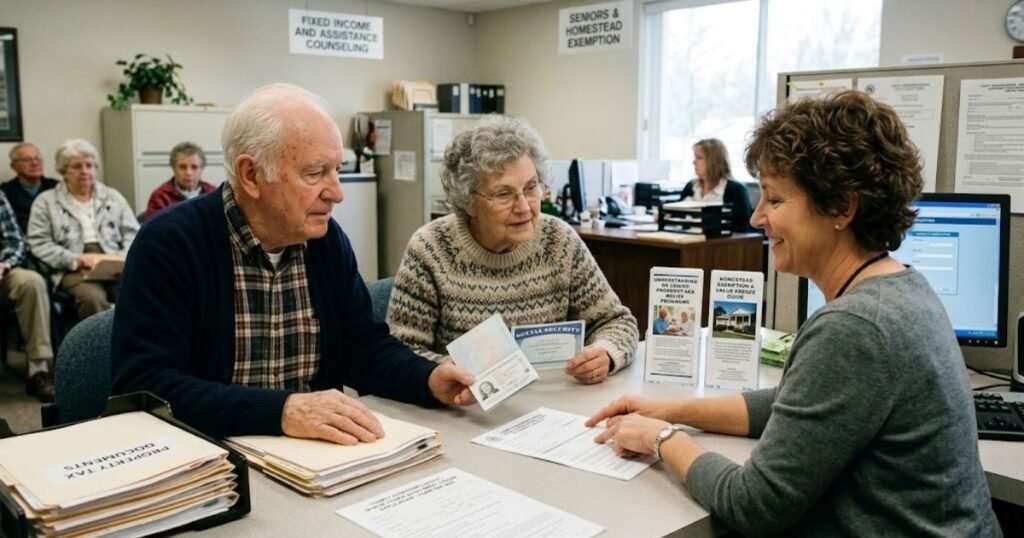
- Gather required documentation: Collect your proof of age, income verification, and home ownership papers.
- Submit your application before the deadline: Missing an annual application deadline can delay your savings by a full calendar year.
- Keep receipt or proof of submission: Keep copies of your completed application and submission proof for your personal records.
- Verify your benefit on your next bill: Once approved, check your next property tax statement to confirm the benefit has been applied correctly.
Documents Seniors May Need
When preparing your property tax relief application, have the following documents ready:
- Government-issued photo ID: Driver’s license, state ID card, or passport proving your age and residence.
- Proof of homeownership: Copy of your property deed, recent tax bill, or mortgage statement.
- Proof of primary residence: Voter registration card, utility bills, or state vehicle registration.
- Social Security benefit statement: Annual SSA-1099 form showing your retirement or disability income.
- Federal and state income tax returns: Copies of your most recent tax filings (Forms 1040), including all schedules.
- Pension and retirement statements: 1099-R forms from pensions, annuities, or IRA distributions.
- Disability documentation: Official determination letter from the Social Security Administration or a physician’s affidavit (if applying under disability rules).
- Military service records: DD Form 214 or VA disability rating letter (if applying for veteran benefits).
- Marriage or death certificate: Required if applying as a qualifying surviving spouse.
What Happens If You Miss the Property Tax Relief Deadline?
Most local governments enforce strict deadlines for property tax exemption applications often falling between January 1 and April 30 of the tax year.
If you miss the filing deadline:
- Your benefit will likely be delayed: In most cases, your application will be processed for the following tax year, meaning you must pay the full tax amount for the current year.
- Some jurisdictions offer grace periods: Certain counties allow late filings if you can demonstrate good cause (such as hospitalization or illness).
- Retroactive refunds are rare but possible: A small number of states allow homeowners to claim retroactive exemptions for 1 to 3 prior years if they met all eligibility rules but failed to apply.
If you discover you missed a deadline, contact your local tax assessor immediately. Ask if late applications are accepted or if an administrative appeal process exists.
READ MORE: Help for Seniors Facing Eviction: Resource Guide
Can Seniors Get More Than One Property Tax Break?
In many states and counties, yes—you can combine multiple property tax benefits.
For example, a senior homeowner might be eligible to stack:
- A Standard Homestead Exemption (available to all primary residents)
- A Senior Property Tax Exemption (based on age)
- A Low-Income Circuit Breaker Credit (based on annual income)
However, some programs cannot be combined. For instance, a county might require you to choose between a disability exemption and a senior exemption, depending on which one offers greater tax savings. Always ask your county assessor to review your file to ensure you receive the maximum total reduction.
Property Tax Deferral vs. Property Tax Exemption
Understanding how property tax deferrals compare to exemptions, freezes, and credits can help you make an informed financial decision.
| Feature | Senior Exemption | Tax Freeze | Income-Based Credit | Tax Deferral |
| Reduces current bill? | Yes | Sometimes | Yes | Usually No |
| Delays payment to future? | No | No | No | Yes |
| Income-based? | Sometimes | Often | Always | Often |
| Creates government lien? | No | No | No | Yes |
| Requires repayment later? | No | No | No | Yes (with interest) |
| Best suited for: | Lowering overall annual tax liability | Preventing future tax rate spikes | Low-income seniors needing direct tax relief | Homeowners with high home equity but severe cash-flow limits |
Example: How a Senior Homeowner Could Lower Their Tax Bill
To see how these programs work in real life, consider this realistic scenario:
Meet Eleanor: Eleanor is 70 years old and lives alone in a home valued at $300,000. Her annual income consists of $22,000 from Social Security and $8,000 from a modest pension, giving her a total household income of $30,000.
Eleanor’s area has a total property tax rate of 2%, resulting in an initial annual tax bill of $6,000—eating up 20% of her gross income.
Here is how Eleanor investigated and lowered her property tax liability:
- Basic Homestead Exemption: Eleanor applied for her state’s basic homestead exemption, which reduced her home’s assessed value by $25,000.
- Senior Property Tax Exemption: Because she is over 65 and earns under $35,000, she qualified for an additional senior exemption of $50,000.
- Total Valuation Reduction: Combining both exemptions reduced her home’s taxable value from $300,000 to $225,000.
- Calculated Savings:
$$\$225,000 \text{ taxable value} \times 2\% = \mathbf{\$4,500 \text{ new tax bill}}$$
(An immediate savings of $1,500 per year). - Senior Tax Freeze: Eleanor also applied for her county’s senior assessment freeze, ensuring her taxable assessment remains locked at $225,000 for as long as she lives in the home.
Note: This hypothetical example demonstrates how programs can work together. Actual savings vary based on local tax rates and program rules.
Common Mistakes Seniors Make With Property Taxes
Avoid these common mistakes that often cost senior homeowners thousands of dollars:
- Assuming relief is automatic: Believing the tax office will automatically reduce your bill when you turn 65 is the most frequent mistake retirees make. You must apply.
- Failing to file a primary homestead exemption: Missing out on basic homestead protections available to all owner-occupiers.
- Assuming a freeze lowers your current tax bill: Confusing a freeze (which prevents future increases) with an exemption (which lowers your current bill).
- Ignoring county and municipal programs: Checking only state tax websites while missing local city or school district breaks.
- Confusing deferral with forgiveness: Not realizing that tax deferrals accumulate interest and must eventually be repaid by your estate or home sale.
- Forgetting annual renewal requirements: Assuming an approved exemption lasts forever. Many low-income programs require annual income verification filings.
- Assuming benefits transfer automatically when moving: Failing to reapply for tax exemptions after selling your home and purchasing a new primary residence.
How to Find Property Tax Relief Programs in Your State
Finding senior property tax programs in your area requires searching official local government channels.
Recommended Steps:
- Visit your county assessor’s official website: Look for menu tabs labeled “Exemptions,” “Senior Benefits,” or “Tax Relief.”
- Contact your local tax collector or appraiser by phone: Ask to speak with an exemption specialist.
- Search official government web pages using terms like:
- “[Your State] senior property tax exemption”
- “[Your County] property tax relief over 65”
- “[Your City] property tax deferral program seniors”
Always make sure you are accessing official government websites ending in .gov to avoid commercial lead-generation sites.
Are Property Tax Relief Programs Available to Seniors Who Rent?
Property tax exemptions, freezes, and deferrals are designed exclusively for property owners. However, senior renters are not entirely left out.
Several states offer renter property tax credits or rebates. These programs recognize that a portion of a tenant’s monthly rent goes toward paying the landlord’s property taxes.
If a senior renter’s income falls below state thresholds, they may receive an annual income tax credit or direct rebate check from the state treasury to help offset these indirect housing costs.
Frequently Asked Questions
Do seniors get a property tax break?
Yes, many states and local municipalities offer property tax relief for seniors. These breaks commonly take the form of property tax exemptions, assessment freezes, tax credits, or tax deferrals. However, programs are not nationwide, and eligibility depends on your age, income, state laws, and whether the home is your primary residence.
At what age do seniors stop paying property taxes?
There is no universal age at which seniors completely stop paying property taxes in the United States. While some states offer significant exemptions for low-income seniors at age 61, 65, or 70, most programs only reduce taxable value or cap tax rates rather than eliminating property taxes entirely.
Which states have the best property tax relief for seniors?
States like Texas, Alabama, Alaska, Florida, and South Carolina offer strong property tax protections for seniors, including large homestead exemptions, total state property tax waivers, or school tax freezes. However, the “best” state depends on your household income, your home’s value, and local county policies.
How can I get my property taxes lowered as a senior?
Start by contacting your county tax assessor to check your eligibility for senior exemptions, standard homestead exemptions, tax freezes, and income-based tax credits. Additionally, review your home’s market assessment annually to determine if filing a property tax assessment appeal is justified.
Can a senior citizen get a property tax exemption if they have low income?
Yes. Many senior property tax programs set income thresholds specifically designed to help low- and moderate-income retirees. Qualifying low-income seniors often receive higher exemption amounts, freeze protections, or refundable tax credits to ensure property taxes remain manageable relative to their income.
Final Takeaway
Rising property taxes should never force you out of the home you have spent a lifetime building. While there is no magic button that eliminates property taxes for every senior, real financial relief is available if you know where to look.
If you are a senior homeowner or if you are helping an aging parent manage their housing costs—take action today:
Call or visit your county tax assessor or property appraiser’s office. Ask specifically: “What senior exemptions, homestead breaks, income-based credits, assessment freezes, or deferral programs do I qualify for, and when is the application deadline?”
Taking a few moments to verify your eligibility and submit an application could save you hundreds or even thousands of dollars on your property tax bill every year.