Managing a monthly budget on a fixed income from Social Security, pensions, or personal savings can feel like a balancing act. When the cost of life-saving medications keeps rising, many older adults are forced to make choices no one should ever face, such as deciding whether to fill a prescription or pay for groceries and heat.
If you or a loved one are struggling with high medication costs, you are not alone. Millions of older adults qualify for programs that reduce out-of-pocket costs at the pharmacy counter.
Several channels of support exist, including federal and state initiatives, pharmaceutical company savings plans, and local charitable organizations. Eligibility for these resources depends on factors like your household income, savings, current Medicare coverage, state of residence, and individual medication needs. Lets deep dive into “Free Prescription Drug Assistance Programs for Seniors | USA 2026”
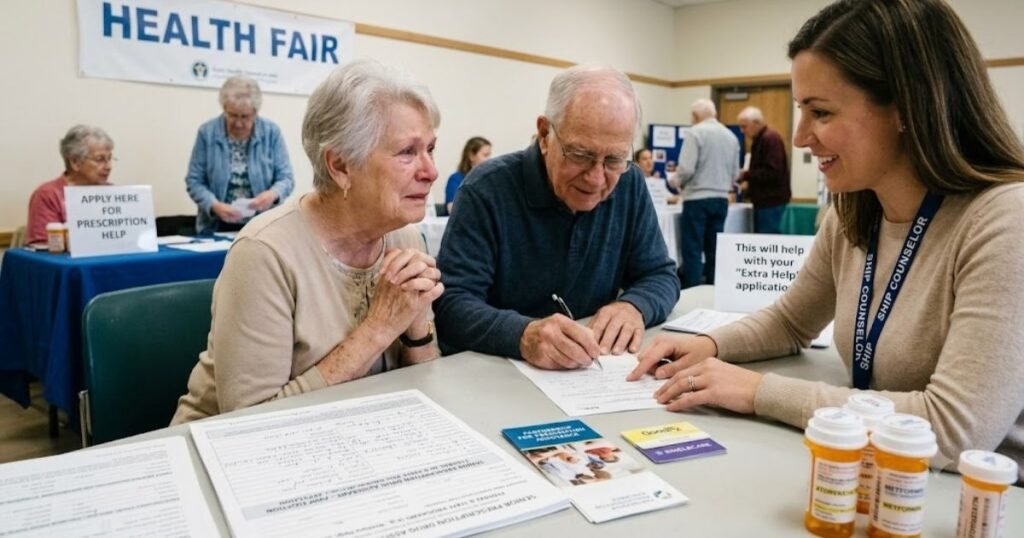
Can Seniors Get Free or Low-Cost Prescription Drugs?
There’s no single program that makes every prescription free for every senior. That would be wonderful, but it isn’t how the system works. Instead, there’s a patchwork of programs, and most seniors end up combining two or three of them to bring costs down significantly.
Here are the main paths seniors use to lower prescription costs:
- Medicare Extra Help — reduces Part D premiums, deductibles, and copays
- Medicare Savings Programs (MSPs) — help pay Medicare premiums and cost-sharing, and often trigger Extra Help
- Medicaid — full prescription coverage for those who qualify based on income
- State Pharmaceutical Assistance Programs (SPAPs) — extra help offered by some states
- Pharmaceutical manufacturer patient assistance programs — free or reduced-cost brand-name drugs
- Nonprofit prescription assistance — copay grants and medication assistance from charities
- Disease-specific assistance programs — help tied to a particular diagnosis
- Medicare Part D cost-sharing protections — built-in caps that limit what you pay
- Generic alternatives — often a fraction of the brand-name price
- Prescription discount programs and pharmacy savings programs — lower the cash price at the register
It helps to understand the difference between three related but distinct ideas:
- Free medication means you pay nothing at all for a specific drug, usually through a manufacturer or nonprofit program.
- Lower-cost medication means you still pay something, but less than the full retail price — this is common with generics, discount cards, and Extra Help copays.
- Financial assistance toward medication costs means a program helps cover part of the bill, such as a copay grant or a subsidy that reduces your monthly premium.
Not every reader will qualify for every program, and that’s okay. Even seniors who don’t qualify for Extra Help or Medicaid can usually still lower their costs through generics, discount programs, or manufacturer assistance.
READ MORE: Medicare Coverage for Weight Loss Drugs Rules
Best Free Prescription Drug Assistance Programs for Seniors
Here’s a quick overview of the major programs before we dig into each one.
| Program | Who It Helps | What It Can Help Pay | Where to Apply |
| Medicare Extra Help | Medicare beneficiaries with limited income/resources | Part D premiums, deductible, and copays | Social Security (ssa.gov/extrahelp) |
| Medicare Savings Programs | Low-income Medicare beneficiaries | Part A/B premiums, deductibles, coinsurance | State Medicaid agency |
| Medicaid | Low-income individuals who meet state rules | Covered prescription drugs and health care | State Medicaid agency |
| State Pharmaceutical Assistance Programs | Residents of participating states | Prescription drug costs | State program office |
| Manufacturer Patient Assistance Programs | Patients on specific medications | Some medicines at no cost or reduced cost | Drug manufacturer |
| Nonprofit Assistance Programs | Patients with financial or medical need | Certain medications or copays | Individual nonprofit organization |
Each program has its own rules, so a senior might qualify for one and not another. Applying to more than one is usually worthwhile.
READ MORE: Medical Grants for Seniors: Free Healthcare Financial Assistance
Medicare Extra Help: One of the Most Important Programs for Seniors
If you are enrolled in Medicare Part D, the Medicare Extra Help program also known as the Low-Income Subsidy (LIS) is one of the most effective ways to lower your drug costs.
What Extra Help Is and Who May Qualify
Extra Help is a federal initiative designed to ensure low-income seniors can afford necessary medications. Recent legal updates expanded full Extra Help benefits to all qualified applicants, eliminating partial subsidies so everyone who qualifies gets maximum assistance.
To qualify, your annual income and countable financial resources must fall below thresholds established by federal guidelines.
- Income Limits: Generally capped around 150% of the Federal Poverty Level. Social Security disregards portions of your income, meaning you may qualify even if your total income appears slightly above the posted limit.
- Resource Limits: Countable resources include checking accounts, savings accounts, stocks, bonds, and mutual funds. Countable resources do not include your primary home, your primary vehicle, personal possessions, or life insurance policies.
Costs Extra Help Can Reduce
When approved for Extra Help, your Medicare prescription costs drop sharply:
- $0 Plan Premium: You pay no monthly premium for standard Part D coverage under benchmark plans.
- $0 Annual Deductible: You do not need to pay out-of-pocket before your insurance kicks in.
- Capped Copayments: In 2026, eligible beneficiaries pay no more than $5.10 for generic drugs and $12.65 for brand-name drugs covered by their plan.
- Catastrophic Protection: Once your total out-of-pocket prescription spending reaches the Part D cap ($2,100 in 2026), your copay drops to $0 for covered drugs for the remainder of the calendar year.
How to Apply and Automatic Eligibility
You can apply online through the official Social Security Administration website, over the phone, or in person at a local Social Security office.
You do not need to figure out everything on your own. If you already receive Medicaid, Supplemental Security Income (SSI), or participate in a Medicare Savings Program, you are automatically enrolled in Extra Help without filling out a separate application. If your financial circumstances change during the year, you can report updates to recalculate your status.
Medicare Savings Programs Can Also Help With Prescription Costs
Medicare Savings Programs (MSPs) are state-run programs funded jointly with the federal government that assist low-income Medicare beneficiaries with medical expenses.
The primary MSP tiers include:
- Qualified Medicare Beneficiary (QMB) Program: Helps pay Part A and Part B premiums, deductibles, coinsurance, and copays.
- Specified Low-Income Medicare Beneficiary (SLMB) Program: Helps pay Medicare Part B premiums.
- Qualifying Individual (QI) Program: Helps pay Part B premiums through an annual application process on a first-come, first-served basis.
When you qualify for QMB, SLMB, or QI, your state automatically enrolls you in Medicare Extra Help, providing dual benefits by reducing both medical and prescription costs. Applications must be submitted through your state’s Medicaid office.
READ MORE: Does Medicare Cover Shingles Vaccine Cost? What Seniors Need to Know
Medicaid Prescription Drug Assistance for Low-Income Seniors
Medicaid is a joint federal and state program designed to help people with limited income and resources afford health care, including prescription drugs. Many seniors assume that because they receive Social Security or have Medicare, they automatically don’t qualify for Medicaid — but that isn’t necessarily true.
Dual eligibility:
Seniors who qualify for both Medicare and Medicaid are known as “dual eligible.” If you’re dual eligible, Medicaid can pick up costs that Medicare doesn’t fully cover, including many prescription drugs, and you’re typically enrolled in Extra Help automatically.
Coverage varies by state:
Because Medicaid is administered at the state level, exactly which drugs are covered, what the copays look like, and what the income limits are can differ quite a bit depending on where you live.
Next step:
Don’t assume you’re ineligible. Contact your state Medicaid office directly, or work with a SHIP counselor (more on that below), to get a clear answer based on your actual numbers.
State Pharmaceutical Assistance Programs (SPAPs)
Many states operate independent State Pharmaceutical Assistance Programs (SPAPs) to help older residents afford prescriptions.
SPAPs work alongside Medicare Part D plans. Depending on your state, an SPAP may help cover:
- Monthly Part D plan premiums
- Annual plan deductibles
- Prescription copayments during coverage phases
- Special medications not listed on standard formularies
Eligibility rules, covered medication lists, and funding availability vary significantly across state lines. To see if your state offers an SPAP, contact your local Area Agency on Aging or review your state’s Department of Health website.
Pharmaceutical Company Patient Assistance Programs
Drug manufacturers often run patient assistance programs (PAPs) that provide brand-name medications at a reduced cost and sometimes at no cost to patients who meet certain criteria.
Typical requirements include:
- Income at or below a set threshold (often based on the Federal Poverty Level)
- Being uninsured or underinsured for that specific medication (rules on Medicare enrollees vary by manufacturer — some PAPs exclude Medicare Part D enrollees, while others have separate provisions)
- A valid prescription from your doctor
- A completed application, sometimes requiring your prescriber’s signature
- Proof of income, such as a tax return or benefit statement
- Periodic renewal, often every 6 to 12 months
Eligibility and generosity vary enormously by medication and manufacturer, so there’s no substitute for checking directly.
Practical tip: Search online for “[drug name] patient assistance program” using the exact brand name of your medication. Then verify what you find through the manufacturer’s official website before submitting any personal information.
READ MORE: Aging in Place Resources for Seniors
Nonprofit Prescription Assistance Programs
Nonprofit organizations play a major role in helping patients afford medication, particularly for chronic or serious conditions. Depending on the organization, they may offer:
- Copay assistance for a specific diagnosis
- One-time or ongoing prescription grants
- Disease-specific financial assistance funds
- Help navigating insurance and Medicare Part D plans
- General financial counseling
Some well-established organizations that help connect patients with assistance include:
- NeedyMeds — a searchable database of assistance programs by drug and diagnosis
- Patient Advocate Foundation — copay relief and case management
- HealthWell Foundation — disease-specific grants for insured patients
- PAN Foundation — copay assistance for underinsured patients with certain conditions
- RxAssist — a directory of manufacturer patient assistance programs
Not every nonprofit can help every applicant. Programs are often limited by diagnosis, income, insurance status, the specific medication, available funding, and sometimes geographic location. Funds can also run out mid-year, so it’s worth checking back periodically or asking to be placed on a waitlist.
Prescription Discount Programs for Seniors
Prescription discount programs such as GoodRx, SingleCare, or pharmacy-specific savings cards lower the cash price of prescription drugs at retail locations.
It is important to distinguish between insurance coverage and discount cards:
Insurance Price vs. Discount-Card Price vs. Cash Retail Price
• Insurance Price: The copay negotiated by your Medicare Part D or private plan.
• Discount Card Price: A lower cash price negotiated between pharmacies and discount networks.
• Cash Retail Price: The full price charged to patients without insurance or discounts.
When you use a discount card instead of Medicare Part D, the purchase amount does not count toward your annual Medicare out-of-pocket calculation. Ask your pharmacist to calculate your cost under both options so you can choose the lowest price for your situation.
How Seniors Can Find Free Prescription Assistance Step by Step
Here’s a practical process to work through, whether you’re doing this for yourself or helping a parent or loved one.
Step 1: Make a list of every medication
Write down the drug name, strength, dosage, quantity, whether it’s generic or brand, the current monthly cost, and which pharmacy fills it. Having this on one page makes every later step faster.
Step 2: Check Medicare Extra Help
If you’re on Medicare, this is usually the first program to check, since it can meaningfully lower your Part D costs. Apply at ssa.gov/extrahelp or call Social Security.
Step 3: Check Medicare Savings Programs
Even if you assume your income is slightly too high, apply anyway. State rules vary, and many states use more generous limits than the federal baseline.
Step 4: Check Medicaid
Contact your state Medicaid office directly rather than assuming you won’t qualify. Dual-eligible status can significantly reduce your drug costs.
Step 5: Check state pharmaceutical assistance
Search for your state’s health or insurance department to see if an SPAP is available where you live.
Step 6: Search for manufacturer assistance
Go to the official website of the specific medication’s manufacturer and look for a patient assistance or savings program.
Step 7: Check nonprofit assistance
Search organizations like NeedyMeds or RxAssist for programs tied to your diagnosis or specific medication.
Step 8: Compare pharmacy prices
The same medication can have very different cash prices at different pharmacies, sometimes even within the same town. It’s worth calling around or checking prices online before filling an expensive prescription.
Step 9: Ask your doctor about lower-cost alternatives
Ask whether a generic version or a different, therapeutically appropriate medication might cost less. Never stop, change, or reduce a prescription on your own — always talk with your healthcare provider first.
READ MORE: How To Get Government Grants for Stroke Victims
What Documents Do Seniors Need to Apply?
Requirements vary by program, but it helps to have these on hand:
- Medicare card
- Social Security number and benefit information
- Current medication list with dosages
- Proof of income (Social Security statement, pension statement, tax return)
- Bank and investment account information, when required
- Recent tax documents, when required
- Insurance card and plan information
- Doctor or prescriber contact information
- Pharmacy name and contact information
- Proof of diagnosis, for certain disease-specific programs
- Proof of residency, for certain state programs
Not every program will ask for all of these, but gathering them ahead of time saves back-and-forth later.
How Income and Resources Affect Eligibility
Eligibility thresholds rely on precise financial measurements:
- Monthly vs. Annual Income: Income includes Social Security benefits, pension payouts, disability benefits, and taxable withdrawals from retirement accounts.
- Countable Resources (Assets): Money in bank accounts, stocks, and real estate other than your primary residence.
- Excluded Assets: Your primary home, personal automobile, household possessions, burial plots, and life insurance policies with cash values below specific limits are excluded from standard countable resources.
Owning a home or vehicle does not disqualify you from federal prescription assistance programs like Extra Help or Medicaid.
Can Seniors on Social Security Get Help Paying for Prescriptions?
Yes. Receiving Social Security does not automatically disqualify you from prescription assistance in fact, Social Security itself administers the Extra Help application process.
What actually matters is your total countable income and resources, which may be lower than your gross Social Security benefit once deductions and exclusions are applied. Many Social Security recipients qualify for Extra Help, Medicare Savings Programs, or Medicaid.
Practical next step: Apply for Extra Help through Social Security, and contact your state Medicaid office to ask about Medicare Savings Programs and Medicaid eligibility, even if you’re unsure.
Can Seniors on Medicare Get Free Prescription Drugs?
Medicare itself does not make every prescription free. Coverage depends on which type of plan you have and which assistance programs you’ve layered on top of it.
- Part D plans cover a portion of drug costs, with your share depending on your specific plan’s formulary and cost-sharing structure.
- Medicare Advantage plans with drug coverage work similarly, bundling drug coverage with medical coverage.
- Extra Help can significantly reduce your Part D premium, deductible, and copays.
- Medicare Savings Programs reduce your Medicare premiums and, in many cases, trigger automatic Extra Help.
- Medicaid, for those who qualify, can cover many drug costs Medicare doesn’t.
- Manufacturer and nonprofit programs can fill in remaining gaps for specific medications.
For 2026, Extra Help copay caps sit around $5.10 for generics and $12.65 for brand-name drugs for those who qualify, and the standard Part B premium is $202.90 a month figures worth knowing if you’re deciding whether to apply for additional help.
READ MORE: Free government money for seniors over 60
What If a Senior Cannot Afford a Prescription Today?
If you’re facing an immediate cost problem, reach out right away rather than skipping or rationing a dose. Options to contact include:
- Your doctor’s office, which may have samples or know of assistance programs
- Your pharmacist, who often knows about discount options and can flag lower-cost alternatives
- Your Medicare Part D plan, which may have a formulary exception process
- Your state Medicaid office
- A SHIP counselor for free, unbiased guidance
- The manufacturer’s patient assistance program for that specific drug
- A relevant nonprofit assistance program
Tell your healthcare provider directly if cost is a barrier to taking an important medication. They may be able to switch you to a more affordable option or connect you with resources you wouldn’t have found on your own.
How SHIP Can Help Seniors Find Prescription Assistance
The State Health Insurance Assistance Program (SHIP) offers free, unbiased Medicare counseling in every state. SHIP counselors aren’t selling anything — their job is to help you understand your options.
A SHIP counselor can help you:
- Understand how Medicare Part D works
- Determine whether you’re likely to qualify for Extra Help
- Walk through Medicare Savings Programs and Medicaid basics
- Compare Part D plan options during open enrollment
- Sort out enrollment issues or billing problems
You can find your local SHIP office through Medicare.gov or by calling 1-800-MEDICARE. This is one of the most underused free resources available to seniors.
Common Mistakes Seniors Should Avoid
- Assuming Medicare pays for everything
- Not applying because income seems slightly too high
- Ignoring Extra Help entirely
- Failing to compare Part D plans each year during open enrollment
- Paying cash without comparing prices first
- Confusing a discount card with actual insurance
- Using unverified, unofficial “medication assistance” websites
- Giving personal or banking information to unfamiliar websites or callers
- Stopping a medication simply because it’s expensive
- Not asking a doctor about lower-cost alternatives
- Forgetting to renew assistance programs on time
- Not checking for state-specific programs
READ MORE: Best 5 Raised Toilet Seat with Handles: Reviews, Comparison & Cost
How to Avoid Prescription Assistance Scams
Unfortunately, scammers target seniors with fake assistance offers. Be cautious of anyone who:
- Guarantees free medication with no application or verification
- Asks for your bank account or Medicare number “to get started” before explaining why
- Demands a large upfront fee to “enroll” you
- Claims to be calling from Medicare directly (Medicare does not cold-call for personal information)
- Uses a website designed to look official but isn’t a government site
- Pressures you to act immediately or lose the offer
Always verify a program through its official government website, the drug manufacturer’s own site, or an established nonprofit before providing any personal information. When in doubt, hang up, close the browser, and call your SHIP counselor or Social Security directly.
How to Save Even More on Prescription Costs
- Ask your doctor or pharmacist whether a generic version is available
- Compare prices between pharmacies before filling an expensive prescription
- Review your Medicare Part D plan every year during open enrollment — the best plan for your medications can change
- Ask about mail-order pharmacy options, which are sometimes cheaper
- Ask whether a 90-day supply costs less per dose than a 30-day supply
- Check whether your medication is on your plan’s formulary before assuming it isn’t covered
- Ask about preferred pharmacies in your plan’s network
- Look into manufacturer assistance for expensive brand-name drugs
- Check nonprofit assistance tied to your diagnosis
- Ask whether a different, appropriate medication in the same class costs less
- Re-check your Extra Help eligibility any time your income changes
As always, any change to your medications should be discussed with your prescribing healthcare professional first.
Frequently Asked Questions
What is the best prescription assistance program for seniors?
The best program depends on your Medicare enrollment, household income, financial resources, and specific medication needs. For most Medicare beneficiaries with low to moderate incomes, Medicare Extra Help is the most comprehensive program because it subsidizes plan premiums, eliminates deductibles, and caps copays for all covered prescriptions.
How can seniors get free prescription drugs?
Seniors can get free medications by qualifying for Medicaid, reaching the annual Medicare Part D out-of-pocket maximum ($2,100), or enrolling in Manufacturer Patient Assistance Programs (PAPs) that supply brand-name drugs at zero cost to qualifying low-income patients.
Does Medicare have a program that helps pay for prescriptions?
Yes. Medicare Part D provides general prescription insurance, while the Extra Help program (Low-Income Subsidy) specifically helps beneficiaries with limited income pay for plan premiums, annual deductibles, and medication copays.
Can low-income seniors get help paying for medications?
Yes, low-income seniors have access to multiple resources, including Medicare Extra Help, state Medicaid coverage, Medicare Savings Programs, State Pharmaceutical Assistance Programs, and pharmaceutical company patient assistance plans.
How do I apply for Extra Help with Medicare prescription costs?
You can apply for Extra Help online at SSA.gov, by calling the Social Security Administration, or by visiting your local Social Security office. You will need details about your household income and financial resources.
Final Thoughts
Rising medication expenses should never prevent you from taking necessary prescriptions. A combination of federal programs, state resources, manufacturer assistance, and nonprofit grants provides viable pathways to manage and lower monthly health costs.
Take time to review your options, organize your financial records, and reach out to local resources like SHIP or Social Security to begin applying. Staying informed and seeking assistance can safeguard both your health and financial wellbeing.