Understanding healthcare can sometimes feel like learning a new language, especially when rules change. If you have been wondering how to see your doctor from the comfort of your living room, you are not alone. Millions of seniors are now using Medicare virtual doctor visits to stay healthy without leaving home.
Medicare telehealth coverage guidelines 2026 bring great news for seniors. Many of the flexible rules that made it easier to get care online over the last few years have officially been extended through December 31, 2027. Whether you need a simple check-up, therapy, or a prescription refill, virtual care is here to stay.
In this comprehensive guide, we will break down exactly how Medicare telehealth 2026 works. We will explain what it costs, how to use it, and what services are covered. This guide is written for U.S. seniors (age 65+), family caregivers, and those approaching retirement who want to navigate their healthcare options with confidence. Lets deep dive into “Medicare Telehealth Coverage Guidelines 2026: Senior Guide”
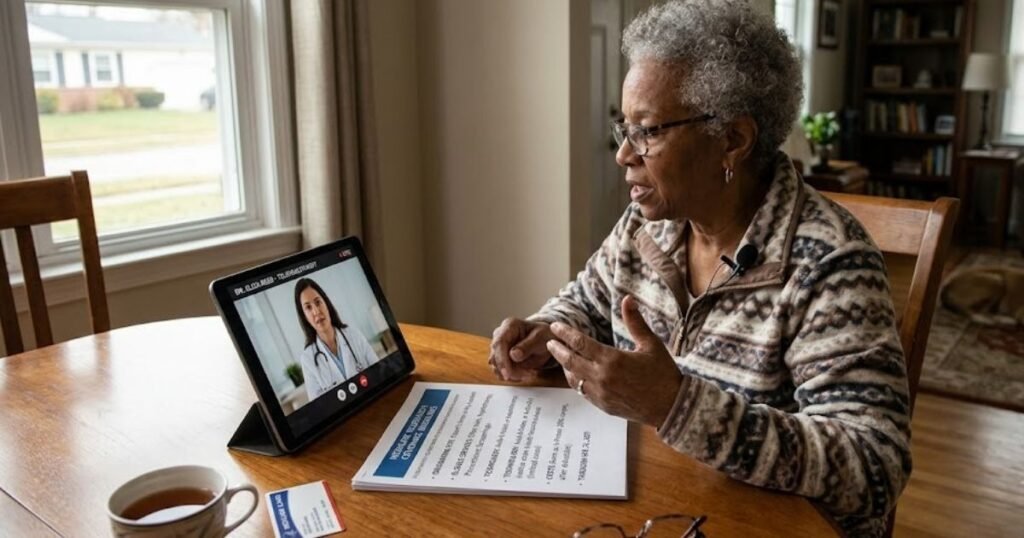
What Is Medicare Telehealth?
Medicare telehealth refers to covered medical appointments you have with a doctor or other health care provider using a phone, tablet, or computer instead of visiting an office in person. It falls under Medicare Part B telehealth benefits and includes several formats:
- Video visits – a live, face-to-face appointment using a camera and screen
- Phone visits – audio-only calls, covered for many services
- Online consultations – secure messages or check-ins through a patient portal
Telehealth vs. Telemedicine
You might hear people use “telehealth” and “telemedicine” interchangeably. While they are very similar, Medicare telemedicine rules traditionally refer strictly to clinical services (like a doctor diagnosing an illness). Telehealth is a broader term that includes clinical care, but also covers services like diabetes education, nutrition counseling, and provider training.
READ MORE: Does Medicare Cover Senior Dental Implants? Complete Guide
What’s New in Medicare Telehealth for 2026?
This is the section most seniors want to read first, so here’s the short version: coverage did not shrink in 2026 — it grew more stable.
After a government funding lapse briefly threatened Medicare telehealth access in late 2025 and early 2026, Congress passed the Consolidated Appropriations Act, 2026, which the president signed on February 3, 2026. That law retroactively extended many Medicare telehealth flexibilities through December 31, 2027.
Here’s what that extension covers:
- Home as an approved location – Medicare patients can receive most non-behavioral telehealth services in their own home through December 31, 2027, not just at a clinic or rural facility.
- No geographic restrictions – Beneficiaries in cities and suburbs, not just rural areas, can use telehealth for most covered services through the extension period.
- Audio-only visits continue – Phone-only appointments remain payable for most services through December 31, 2027.
- Broader provider eligibility – A wide range of Medicare-enrolled providers, plus Federally Qualified Health Centers (FQHCs) and Rural Health Clinics (RHCs), can continue delivering and billing for telehealth.
- Permanent behavioral health protections – Several mental health telehealth rules (covered in detail below) are now a permanent part of Medicare law, not tied to the 2027 deadline.
- Streamlined telehealth services list – Starting in 2026, CMS simplified how it reviews and adds new services to the official Medicare telehealth list, making future additions more predictable.
- Delayed in-person requirement for behavioral health – The rule requiring an in-person visit before and during ongoing mental health telehealth care remains paused through December 31, 2027.
At a Glance: 2026 Medicare Telehealth Summary
| Flexibility | Status in 2026 | Expires |
| Home as originating site (non-behavioral) | Active | Dec 31, 2027 |
| No geographic restrictions (non-behavioral) | Active | Dec 31, 2027 |
| Audio-only visits (non-behavioral) | Active | Dec 31, 2027 |
| Home as originating site (behavioral health) | Active | Permanent |
| No geographic restrictions (behavioral health) | Active | Permanent |
| Audio-only visits (behavioral health) | Active | Permanent |
| In-person visit requirement (behavioral health) | Paused | Resumes after Dec 31, 2027 |
| FQHC/RHC as distant-site provider (behavioral health) | Active | Permanent |
Table sources: CMS.gov, Telehealth.HHS.gov, and Medicare.gov (2026 guidance).
Callout: Why the confusion? You may have seen headlines in late 2025 or January 2026 warning that Medicare telehealth was about to end. That’s because flexibilities briefly lapsed during a funding standoff. Congress restored and extended them through 2027 in February 2026, so most beneficiaries saw little or no disruption to ongoing care.
READ MORE: Best Medicare Advantage Dental & Vision Plans
Who Can Use Medicare Telehealth?
Medicare telehealth eligibility is broader than many people realize. You may qualify if you have:
- Original Medicare (Part B) — covers telehealth alongside your regular medical benefits
- Medicare Advantage (Part C) — required to match Original Medicare’s telehealth benefits, and often adds extras
- Rural or urban residency — location no longer limits most telehealth services through the 2027 extension
- Mobility challenges — telehealth can reduce the need for transportation to appointments
- Homebound status — home visits are an approved originating site for most services
There’s no separate telehealth “enrollment.” If you have Medicare Part B, you’re generally eligible to use covered Medicare virtual doctor visits whenever your provider offers them.
What Telehealth Services Does Medicare Cover?
Medicare covers a wide range of Medicare telehealth services, from routine check-ins to specialized therapy. Coverage depends on whether the specific service is on the official Medicare Telehealth Services List, updated annually by CMS.
| Service Type | Typically Covered? | Notes |
| Primary care visits | Yes | Most common telehealth use |
| Specialist visits | Yes | Availability varies by specialty |
| Annual wellness visits | Yes | Can often be done entirely by video |
| Mental health counseling | Yes | Broad coverage, including audio-only |
| Psychiatry | Yes | Medication management included |
| Individual/group therapy | Yes | Licensed counselors and therapists included |
| Diabetes self-management education | Yes | Often delivered via video |
| Medical nutrition therapy | Yes | Registered dietitians eligible |
| Physical therapy | Limited | Coverage tied to annual extensions |
| Speech-language therapy | Limited | Coverage tied to annual extensions |
| Chronic care management | Yes | Ongoing condition monitoring |
| Cardiac rehabilitation | Yes | Certain follow-up sessions |
| Pulmonary rehabilitation | Yes | Certain follow-up sessions |
| Preventive screenings (counseling) | Yes | Screening counseling, not the physical test itself |
| Follow-up appointments | Yes | Common for post-procedure check-ins |
| Medication management | Yes | Reviews and adjustments |
Because the list changes each year, always confirm with your provider or Medicare directly that a specific appointment qualifies for Medicare telehealth benefits before you schedule it.
READ MORE: Difference Between Medicare and Medicaid Coverage
Behavioral Health Telehealth Rules
Mental and behavioral health is where Medicare has made the most permanent progress. Under Medicare behavioral health telehealth rules:
- Beneficiaries can permanently receive mental health and psychiatric care from home, with no geographic restriction.
- Counseling, psychotherapy, and psychiatric medication management are all eligible.
- Audio-only (phone) behavioral health visits are permanently covered when video isn’t possible or preferred.
- Marriage and family therapists and mental health counselors are recognized Medicare providers, expanding who you can see.
- The requirement for an in-person visit before starting mental health telehealth, and periodically afterward, remains paused through December 31, 2027.
This matters because mental health support is often the hardest type of care to access in person especially for seniors managing mobility limits, transportation barriers, or living in areas with few specialists.
Audio-Only Telehealth Rules
Not every senior has reliable internet or a smartphone, and Medicare’s rules account for that. Medicare audio-only visits are allowed when:
- The service is on Medicare’s approved telehealth list for audio-only use
- The patient cannot use, or does not consent to, video technology
- The provider is technically capable of video but the patient prefers or requires phone-only
For non-behavioral health services, audio-only coverage continues through December 31, 2027. For behavioral health services, phone-only visits are permanently covered. This flexibility is especially valuable for seniors without home internet access or those uncomfortable with video technology. It keeps care accessible without requiring new devices or tech skills.
READ MORE: What Items Medicare Advantage No Longer Covers: Senior Guide
Medicare Telehealth Eligibility Requirements
To use telehealth under Medicare, a few basic conditions generally apply:
- Patient eligibility: You must be enrolled in Medicare Part B (Original Medicare or Medicare Advantage).
- Provider eligibility: Your provider must be enrolled in Medicare and accept Medicare assignment.
- Technology requirements: A phone, tablet, or computer with audio (and video, when required) capability.
- Covered locations: Home, clinic, or other approved sites, depending on the service.
- Identity verification: Providers typically confirm your identity at the start of a visit, similar to checking in at an office.
If a service isn’t on Medicare’s telehealth list, or your provider doesn’t accept Medicare, the visit may not be covered — so it’s worth asking before you book.
Where Can Seniors Receive Telehealth?
| Location | Approved for Telehealth? | Notes |
| Home | Yes | Most flexible option through 2027 |
| Doctor’s office | Yes | Staff can assist with technology |
| Rural health clinic | Yes | Long-standing approved site |
| Federally Qualified Health Center (FQHC) | Yes | Can serve as distant-site provider |
| Skilled nursing facility | Often | Depends on service type |
| Hospital | Often | Depends on service type |
| Assisted living community | Often | Check with facility and provider |
For most seniors, home is now the simplest and most convenient originating site, particularly for behavioral health, which has no location restriction at all.
READ MORE: How to Switch From Medicare Advantage to Medigap
What Does Medicare Pay?
Here’s how Medicare telehealth costs typically work under Original Medicare:
- You pay the Part B deductible first ($283 in 2026).
- After that, you generally pay 20% coinsurance of the Medicare-approved amount.
- Medicare pays the remaining 80%.
- Most telehealth visits cost the same as the equivalent in-person visit.
Medicare Advantage plans must offer at least the same telehealth coverage as Original Medicare, but many offer lower copays — sometimes $0 for in-network virtual visits. Check your plan’s Annual Notice of Change or member portal for exact costs.
If you have supplemental coverage, such as a Medigap policy, employer retiree benefits, or Medicaid, that secondary coverage often pays some or all of your remaining coinsurance.
Cost example: Suppose you’ve already met your Part B deductible for the year. Your provider bills Medicare $100 for a telehealth follow-up visit. Medicare pays $80, and you’re responsible for the remaining $20 coinsurance — the same amount you’d owe for an in-person visit at that price.
How to Schedule a Medicare Telehealth Appointment
- Find a Medicare-approved provider who offers virtual visits.
- Verify telehealth availability for your specific appointment type before booking.
- Prepare your device — phone, tablet, or computer, charged and ready.
- Test your internet or phone connection a few minutes before the visit.
- Gather your medications and any questions so you can reference them during the call.
- Join the appointment a few minutes early through the link or number provided.
- Follow up on any next steps, prescriptions, or referrals afterward.
READ MORE: Medicare Part D: How the $2,000 Cap Works and What Changes
Technology Tips for Seniors
- Smartphones and tablets with a front-facing camera work well for video visits.
- Laptops or desktops with a webcam and microphone are equally effective.
- A stable internet connection reduces dropped calls; if unavailable, ask about phone-only options.
- Video apps used by providers are typically simple — many launch from a text or email link with one tap.
- Family assistance is welcome. A family member or caregiver can help set up the call or even join it with you.
Medicare Telehealth vs In-Person Visits
| Factor | Telehealth | In-Person |
| Convenience | High — no travel needed | Requires transportation |
| Cost | Same cost-sharing in most cases | Same cost-sharing in most cases |
| Waiting time | Usually shorter | Can involve waiting rooms |
| Travel | None | Required |
| Emergencies | Not appropriate | Necessary |
| Physical exams | Limited | Full exam possible |
| Follow-up care | Well-suited | Also effective |
| Chronic disease management | Effective for check-ins | Needed periodically for hands-on care |
Pros and Cons of Medicare Telehealth
Pros:
- Saves travel time and reduces missed appointments
- Especially helpful for seniors with mobility limitations
- Expands access to mental health and specialist care
- Audio-only options support those without internet access
Cons:
- Not suitable for physical exams, injuries, or emergencies
- Requires some comfort with technology, or a helper
- Not every service is covered via telehealth
- Coverage rules can vary by Medicare Advantage plan
READ MORE: $3000 Senior Assistance Program Application
Common Mistakes Seniors Should Avoid
- Assuming every service is covered — always confirm with your provider first.
- Using non-Medicare-approved providers — this can result in denied claims.
- Missing required follow-up appointments, particularly for behavioral health care.
- Ignoring technology problems in advance instead of testing your device beforehand.
- Forgetting about copays and coinsurance — telehealth isn’t automatically free.
- Not checking Medicare Advantage-specific rules, which can differ from Original Medicare.
Medicare Advantage Telehealth Coverage
Medicare Advantage plans (Part C) must cover at least the same telehealth benefits as Original Medicare, but many go further with:
- Expanded virtual care networks, including specialists and urgent care
- Lower or $0 copays for in-network virtual visits
- Extra wellness services, such as virtual fitness or nutrition coaching
- Broader home-based access in some cases, even where Original Medicare has restrictions
The tradeoff is that Medicare Advantage plans use provider networks — an out-of-network telehealth visit may cost more or not be covered at all. Always check your plan’s directory or call member services to confirm before scheduling.
Frequently Asked Questions
Does Medicare cover telehealth visits in 2026?
Yes. Medicare continues to cover a wide range of telehealth services in 2026, including many that had been set to expire. Congress extended most flexibilities through December 31, 2027, so coverage remains broadly similar to recent years.
Can Medicare patients receive telehealth from home?
Yes, for most non-behavioral services through December 31, 2027, and permanently for behavioral and mental health services. Home has become one of the most common and convenient originating sites for Medicare telehealth.
Does Medicare pay for phone-only appointments?
Yes. Audio-only visits are covered for many non-behavioral services through 2027 and are permanently covered for behavioral health care, which helps beneficiaries without reliable internet or video access.
How much does a Medicare telehealth visit cost?
Under Original Medicare, you’ll typically pay the Part B deductible ($283 in 2026), then 20% coinsurance of the Medicare-approved amount — generally the same as an equivalent in-person visit. Medicare Advantage costs vary by plan.
What telehealth services are covered by Medicare Part B?
Medicare Part B telehealth covers primary care, specialist consultations, annual wellness visits, mental health counseling, psychiatry, chronic care management, diabetes education, medication management, and more, based on the annually updated Medicare Telehealth Services List.
Final Thoughts
The Medicare telehealth coverage guidelines 2026 offer incredible flexibility, giving you more control over your healthcare than ever before. Telehealth is highly beneficial for seniors who want routine follow-ups, mental health care, or medication management without the hassle of traveling to a clinic.
However, remember that virtual care does not replace in-person medicine entirely. If you are experiencing an emergency, need bloodwork, or require a physical hands-on exam, an in-person visit is always better.
Because coverage can vary based on whether you have Original Medicare or a Medicare Advantage plan, we strongly encourage you to verify your specific coverage with Medicare (1-800-MEDICARE) or call your healthcare provider before your visit.
Myth vs. Fact
| Myth | Fact |
| “Medicare telehealth ended in 2026.” | Coverage was extended through December 31, 2027. |
| “You must live in a rural area to use telehealth.” | Geographic restrictions no longer apply to most services during the extension. |
| “Phone-only visits aren’t covered.” | Audio-only visits are covered for most services. |
| “Telehealth always costs extra.” | Cost-sharing typically matches in-person visits. |
| “Medicare Advantage telehealth is the same everywhere.” | Benefits and copays vary by plan. |
Important 2026 Rule Highlights
- Extension through December 31, 2027 for most non-behavioral telehealth flexibilities.
- Permanent status for key behavioral health telehealth provisions.
- Streamlined CMS process for adding new services to the telehealth list.
- Continued audio-only access for beneficiaries without video capability.