If you or a loved one are navigating the waters of Medicare coverage, you are likely looking for clear, straightforward answers about your preventive healthcare options. One of the most common questions older adults ask revolves around a particularly painful condition: does medicare cover shingles vaccine cost?
The quick answer is yes, but the way Medicare handles this coverage depends heavily on the specific part of Medicare you are using. To put your mind at ease right away: Medicare Part D covers the shingles vaccine completely, meaning you will generally pay nothing out of pocket. On the other hand, traditional Medicare Part B does not cover the shingles vaccine. Understanding this distinction is the key to avoiding unexpected charges at the counter.
Navigating insurance plans can feel overwhelming, especially when rules change or terms sound like alphabet soup. This guide is designed to break down your shingles shot Medicare coverage in simple, reassuring, and practical terms, ensuring you know exactly what to expect, where to go, and how to claim your benefits smoothly. Lets deep dive into “Does Medicare Cover Shingles Vaccine Cost? What Seniors Need to Know”
READ MORE: Transition from Employer Health Insurance to Medicare
Quick Answer: Does Medicare Cover the Shingles Vaccine Cost?
Yes — but only through Medicare Part D, not Part B.
Under current Medicare rules, Part D plans must cover vaccines recommended by the Advisory Committee on Immunization Practices, commonly called ACIP. The shingles vaccine including the Shingrix vaccine is on that ACIP-recommended list. Because of this, Part D members generally pay no copay and no deductible when they get the shingles shot at an in-network pharmacy or provider.
So if you have Medicare Part D and you go to a pharmacy that can bill Part D directly, the shingles vaccine should cost you nothing.
What about Medicare Part B? Part B does not cover the shingles vaccine. This is one of the most common sources of confusion for seniors. Part B covers certain other vaccines like the flu shot, COVID-19 vaccine, and pneumococcal vaccine but the shingles vaccine is specifically excluded from Part B. This is exactly why having Part D is so important for getting the shingles shot covered.
What Is the Shingles Vaccine?
Before we go deeper into coverage, let’s take a moment to understand what we’re talking about.
Shingles is a painful rash caused by the varicella-zoster virus, the same virus that causes chickenpox. If you had chickenpox as a child, the virus stayed dormant in your body. As you get older and your immune system naturally weakens, the virus can reactivate and cause shingles.
Shingles typically appears as a band of blisters on one side of the body or face. It can be extremely painful, and in some cases it leads to a complication called postherpetic neuralgia, long-lasting nerve pain that can persist for months or even years after the rash goes away.
About 1 in 3 Americans will develop shingles during their lifetime, and the risk goes up significantly after age 50. By age 60, the chances are even higher. Older adults also tend to experience more severe symptoms and complications.
The good news is that vaccination can dramatically reduce your risk. The Shingrix vaccine is the currently recommended option. It is given as two doses, usually two to six months apart, and is highly effective at preventing shingles and its complications.
READ MORE: Medicare Part D: How the $2,000 Cap Works and What Changes
Medicare Part D vs. Part B: What’s the Difference?
Medicare Part B Vaccine Coverage
Medicare Part B is designed to handle outpatient medical care, doctor visits, and specific preventive services. Part B covers a select group of immunizations that are deemed broadly necessary for public health safety or immediate accident intervention. For seniors, Medicare Part B covers:
- The annual influenza (flu) shot
- Pneumococcal (pneumonia) vaccines
- COVID-19 vaccines and boosters
- Hepatitis B vaccines (for individuals at medium to high risk)
- Injury-related vaccines, such as a tetanus shot if you step on a rusty nail
When you get these shots from a provider who accepts Medicare, Part B pays for them entirely, and you owe nothing.
Medicare Part D Vaccine Coverage
Medicare Part D, by contrast, handles commercial prescription drugs that you typically pick up at a retail pharmacy window. Under federal guidelines, any adult vaccine that is recommended by the ACIP but not explicitly covered by Medicare Part B must be covered under Medicare Part D.
Because shingles is categorized as a commercial preventive drug rather than a routine public health intervention like the flu shot, the shingles vaccine falls squarely under Part D. This group also includes other essential adult immunizations like the Tdap vaccine (tetanus, diphtheria, and pertussis/whooping cough) and the newer RSV (Respiratory Syncytial Virus) vaccines.
To see this division clearly, take a look at how Medicare categorizes these common immunizations:
| Vaccine Type | Covered Under Medicare Part B? | Covered Under Medicare Part D? | Typical Out-of-Pocket Cost (In-Network) |
| Shingles (Shingrix) | No | Yes | $0 |
| Flu Shot | Yes | No | $0 |
| Pneumonia Shot | Yes | No | $0 |
| COVID-19 Vaccine | Yes | No | $0 |
| Tdap (Tetanus/Whooping Cough) | No | Yes | $0 |
| RSV Vaccine | No | Yes | $0 |
Understanding this structural split helps explain why your family doctor might gladly give you a flu shot during your annual physical, but tell you to head down to the local pharmacy down the street to get your shingles shot.
READ MORE: Medicare Supplement Plan G vs N: Coverage, Costs and Key Differences
How Much Does the Shingles Vaccine Cost with Medicare?
For most seniors with Medicare Part D, the cost of the shingles vaccine is zero dollars out of pocket.
The Shingrix vaccine itself can cost $200 or more per dose without insurance — and since it requires two doses, the total price without coverage can be over $400. That’s a significant expense for anyone on a fixed income.
With Medicare Part D, however, the financial picture looks much better. Here’s what you can generally expect:
- No copay for the shingles vaccine at in-network pharmacies
- No deductible applied to the cost of the vaccine
- No coinsurance on ACIP-recommended adult vaccines
These protections apply because of federal rules that now require Part D plans to eliminate cost-sharing for vaccines that ACIP recommends for adults.
That said, there are situations where the actual amount you pay can still vary. We’ll cover those exceptions in section 6.
Where Can Seniors Get the Shingles Vaccine?
One of the most convenient things about the shingles vaccine is that you have options for where to get it. Here are the most common places:
Option A: Pharmacies
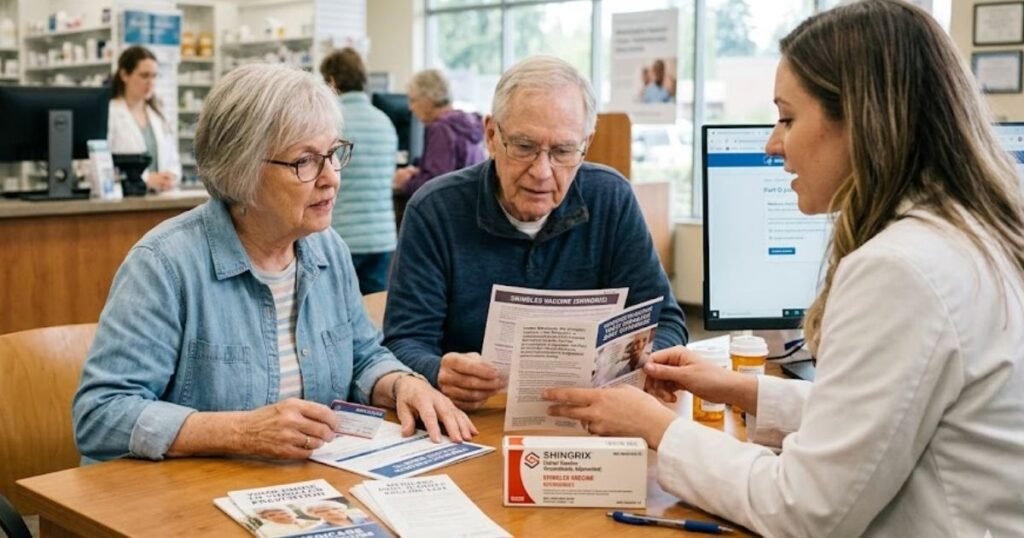
Most major retail pharmacies including Walgreens, CVS, Rite Aid, and many grocery store pharmacies carry the Shingrix vaccine. These pharmacies are typically set up to bill Medicare Part D directly, which means the process is straightforward. You show your Medicare card, the pharmacist runs it through your Part D plan, and in most cases you walk out paying nothing.
Getting your vaccine at a pharmacy is often the simplest route for seniors because the billing is handled on the spot with no extra paperwork.
Option B: Doctor’s Offices and Clinics
You can also get the shingles vaccine at your primary care doctor’s office or a local clinic. However, the billing process can be a little more complex here. Not all doctors’ offices are set up to bill vaccines directly to Medicare Part D. Some offices bill through Part B and as we’ve discussed, Part B does not cover the shingles vaccine.
If your doctor’s office cannot bill the vaccine through Part D, you have two options:
- Ask to get the vaccine at a pharmacy instead.
- Pay upfront at the office and submit a claim to your Part D plan for reimbursement later.
This is an important thing to ask about before you roll up your sleeve. A quick phone call can save you from an unexpected bill.
READ MORE: Difference Between Medicare and Medicaid Coverage
When Might Someone Still Pay Something?
Even though Part D covers the shingles vaccine with no cost-sharing, there are a few situations where you might end up paying something or at least paying upfront and waiting for a refund.
1. Out-of-Network Providers
If you get the shingles vaccine at a pharmacy or clinic that is not in your Part D plan’s network, you may be charged. Some plans will still reimburse you, but you may need to pay first and submit paperwork afterward.
2. Billing Errors
Sometimes a provider accidentally bills the shingles vaccine through Part B instead of Part D. Since Part B doesn’t cover shingles, you’d get a denial or a bill. If this happens, don’t panic contact your Part D plan and ask them to work it out with the provider, or submit a corrected claim.
3. Plans That Haven’t Updated Their Systems
It’s rare, but some plan administrators may not have properly implemented the no-cost-sharing rules. If you’re charged, you have the right to appeal and request a refund.
4. Reimbursement Situations
If you pay out of pocket at a doctor’s office or out-of-network location, contact your Part D plan as soon as possible. They should have a reimbursement process, and many plans allow you to submit a claim within a certain time window (often one year from the date of service).
How to Check Your Medicare Plan Before Getting the Shot
To make absolutely certain that you walk away from your shingles vaccination without spending a single penny, it pays to do a tiny bit of homework beforehand. Think of this simple step-by-step checklist as your roadmap to a smooth appointment:
- Step 1: Locate your prescription drug card. Look for your standalone Part D card or your integrated Medicare Advantage (Part C) membership card. Note down the specific plan name and the customer service phone number listed on the back.
- Step 2: Call your plan’s member services. Dial the number on your card and speak with a representative. Ask them explicitly: “Can you confirm that my plan covers the Shingrix shingles vaccine at $0 out-of-pocket?”
- Step 3: Ask for a list of preferred, in-network pharmacies. While you are on the phone, ask the agent to verify if your regular neighborhood pharmacy is considered an “in-network” location for vaccine administration.
- Step 4: Confirm direct billing with your chosen provider. Before the pharmacist pulls back the curtain to give you the shot, hand them your card and ask directly: “Will you be able to bill my Medicare Part D plan directly in real-time so that I pay nothing today?”
- Step 5: Ask about paperwork instructions. If you choose to get the shot at a doctor’s office, ask the office billing coordinator: “Do you bill Part D directly, or will I need to pay upfront and submit a manual reimbursement form to my insurance?”
READ MORE: How to Switch From Medicare Advantage to Medigap
Before You Get the Shingles Vaccine, Check These 5 Things
To keep things as simple and scannable as possible, print out or save this quick checklist before you head out the door for your appointment:
- 1. Confirm Your Drug Coverage: Make sure you actually have an active Medicare Part D drug plan or a Medicare Advantage plan that includes prescription benefits, as Original Medicare Parts A and B alone do not cover the shingles shot.
- 2. Verify Pharmacy Network Status: Call your insurance plan or use their online member directory to verify that your chosen pharmacy location is fully in-network.
- 3. Ask the Provider About Direct Billing: Ask the pharmacist or medical clinic receptionist if they can submit the claim electronically to your Part D plan so you avoid paying a manual upfront fee.
- 4. Coordinate Your Injection Timing: Check your calendar to ensure your second Shingrix dose is scheduled between two and six months after your initial first dose.
- 5. Carry All of Your Insurance Cards: Bring both your red, white, and blue Original Medicare card and your private Part D or Medicare Advantage insurance card to prevent any identity verification delays at the counter.
Shingles Vaccine Tips for Seniors
Here are a few more practical tips to help things go smoothly:
Know the vaccine name. The currently recommended shingles vaccine is called Shingrix. There was an older shingles vaccine called Zostavax, but it is no longer available in the United States. Knowing the name “Shingrix” helps when you’re asking questions at the pharmacy or confirming coverage with your plan.
Remember it’s two doses. Shingrix requires two separate doses, given two to six months apart. Make sure your plan covers both doses — it should, since both are part of the ACIP-recommended shingles vaccination series.
Don’t delay because of cost worries. One of the most common reasons seniors put off the shingles vaccine is concern about cost. Now that you know Part D covers it with no cost-sharing, there’s no reason to wait. Shingles can be extremely painful and disruptive, and vaccination is the best protection you have.
Schedule both doses at the right time. When you get the first dose, ask the pharmacist or provider to help you schedule the second dose at the appropriate interval. Some people forget the second shot, which means they don’t have full protection.
If you have a Medicare Advantage plan, check whether it includes Part D benefits. Most Medicare Advantage plans include drug coverage, which means you likely have Part D access already. Call your plan to confirm.
READ MORE: What Items Medicare Advantage No Longer Covers in 2026
Common Mistakes to Avoid
- Even well-meaning seniors sometimes run into problems when trying to get the shingles vaccine covered. Here are the mistakes that come up most often and how to avoid them:
- Assuming Part B covers the shingles vaccine. This is the most common mix-up. Part B covers the flu shot and a few other vaccines, so it’s natural to assume it covers shingles too. It doesn’t. Always use Part D for the shingles vaccine.
- Not checking whether the provider bills Part D. If you go to your doctor’s office and they accidentally bill through Part B, the claim will be denied. Always ask upfront whether the provider can bill the vaccine through Part D. If they cannot, go to a pharmacy.
- Not verifying you’re using an in-network provider. Using an out-of-network pharmacy or clinic could result in higher costs or a need to pay upfront and seek reimbursement. A quick call to your Part D plan will tell you which pharmacies are in-network.
- Skipping the second dose. Because Shingrix requires two shots, some people get the first dose and forget or avoid the second. Partial vaccination gives you limited protection. Commit to both doses.
- Not keeping your receipt if you pay out of pocket. If you do end up paying for the vaccine for any reason, keep all paperwork. You’ll need it when submitting a reimbursement claim to your Part D plan.
- Waiting too long to file a reimbursement claim. Part D plans have deadlines for reimbursement claims. If you paid out of pocket, submit your claim as soon as possible. Don’t let weeks turn into months.
Final Takeaway
Here’s what it all comes down to: for most seniors with Medicare Part D, the shingles vaccine is fully covered with no out-of-pocket cost. The key is making sure you’re using your Part D coverage not Part B and that the pharmacy or clinic you visit can bill Part D directly.
The Shingrix vaccine is one of the best things you can do for your health after 50. Shingles is painful, and the complications can be serious. The vaccine is safe, effective, and thanks to Medicare Part D free for most seniors.
Take 15 minutes to confirm your coverage, find an in-network pharmacy, and schedule your appointment. Your future self will be grateful you did.
READ MORE: Salvation Army Free Car Program (Eligibility & How to Apply)
Frequently Asked Questions (FAQ)
Does Medicare cover the shingles vaccine at no cost?
Yes, if you have Medicare prescription drug coverage (Part D), the shingles vaccine is covered at no cost to you. Federal guidelines permanently eliminated all deductibles, copayments, and coinsurance for adult vaccines recommended by the Advisory Committee on Immunization Practices (ACIP).
Does Medicare Part B pay for shingles shots?
No, Medicare Part B does not pay for the shingles vaccine. Medicare Part B only handles specific preventive immunizations like the flu shot, pneumonia vaccines, COVID-19 immunizations, and Hepatitis B shots for individuals at higher risk.
Is Shingrix covered by Medicare Part D?
Yes, Shingrix is fully covered by Medicare Part D. Because Shingrix is currently the only FDA-approved, ACIP-recommended vaccine used for shingles prevention in the United States.
Can I get the shingles vaccine at a pharmacy with Medicare?
Yes, a retail pharmacy is actually the ideal location to get your shingles vaccine under Medicare. Most retail pharmacies are set up to bill your Medicare Part D prescription drug plan directly and electronically.
Why was I charged for a shingles vaccine even though I have Medicare?
If you received a bill, it usually happens for one of three reasons: you only have Original Medicare (Parts A and B) and lack a Part D prescription plan; you received the shot from an out-of-network pharmacy; or you got the shot at a doctor’s office that cannot bill Part D directly.
READ MORE: Can Seniors Get Free Window Replacement Grants
READ MORE: Best Smart TV for Seniors: Easy to Use & Large Screen Picks