Losing a spouse is one of life’s most profound challenges. Beyond the emotional weight of grief, there are countless practical decisions to make many of which involve your financial future. Among the most important of these is understanding how to handle Social Security survivor benefits.
For many retirees, Social Security forms the backbone of their monthly income. However, the rules surrounding survivor benefits are different from standard retirement benefits. Unfortunately, many surviving spouses lose thousands of dollars over their lifetime simply because they claim too early or don’t understand the “switching” strategies available to them.
This guide is designed to help you navigate these waters with confidence. We will break down the complex rules into simple, actionable steps so you can ensure you are receiving every penny you are entitled to. You’ve worked hard, and your spouse worked hard; these benefits are a safety net designed for your protection. Let’s look at how to make the most of them. Lets deep dive into “How to Maximize Social Security Survivor Benefits for a Spouse”
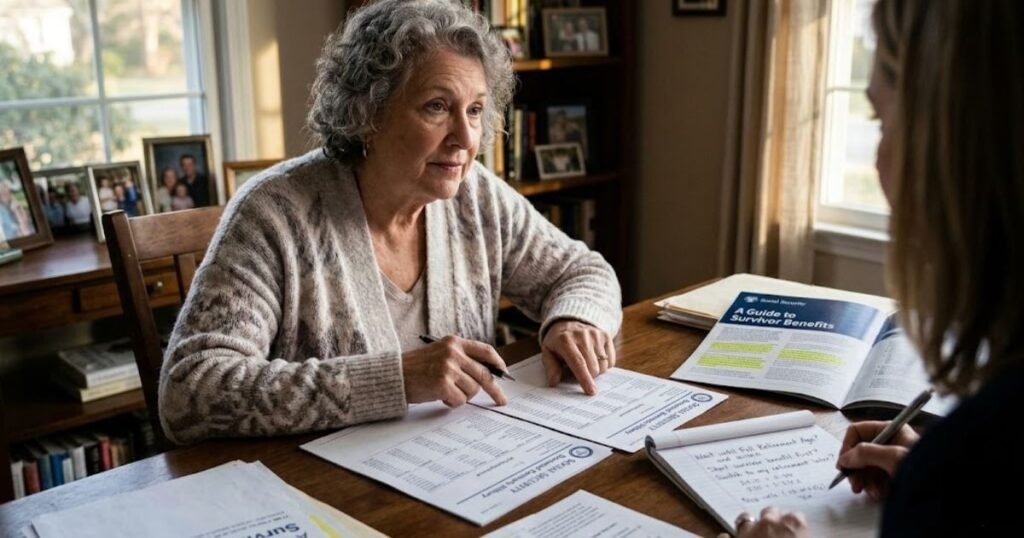
What Social Security Survivor Benefits Are
In the simplest terms, Social Security survivor benefits are monthly payments made to the family members of a deceased worker. Think of it as a form of life insurance that your spouse paid into through their payroll taxes (FICA) throughout their working life.
When a spouse passes away, the Social Security Administration (SSA) allows the surviving partner to “step into the shoes” of the deceased worker, potentially receiving a benefit based on the deceased spouse’s earnings record.
Why They Matter
For a married couple, the household often receives two Social Security checks. When one spouse dies, one of those checks disappears. Survivor benefits are meant to help bridge that gap, ensuring that the surviving spouse can maintain their standard of living.
A Simple Definition
If your spouse was eligible for Social Security or was already receiving it at the time of their death, you may be eligible to receive a portion or even 100% of their monthly payment amount.
READ MORE: 6000 Dollar Senior Tax Deduction for Over 65 Rules
Who Can Receive Survivor Benefits?
Eligibility isn’t limited to just a current spouse living in the home at the time of death. The SSA has specific categories for who can claim:
1. Surviving Spouse
The most common recipient is the widow or widower. Generally, you must have been married for at least nine months before your spouse passed away to qualify. (There are exceptions for accidental deaths or deaths in the line of military duty).
2. Surviving Divorced Spouse
Many people are surprised to learn they can claim benefits on an ex-spouse’s record. You may qualify if:
- Your marriage lasted at least 10 years.
- You are at least age 60 (or 50 if disabled).
- You are currently unmarried (unless you remarried after age 60).
3. Disabled Surviving Spouse
If you have a disability that started before or within seven years of your spouse’s death, you can begin receiving survivor benefits as early as age 50.
4. When Remarriage Matters
Remarriage is a major “speed bump” in Social Security rules. Here is the golden rule:
- If you remarry BEFORE age 60: You generally lose your eligibility for survivor benefits on your deceased spouse’s record (as long as you stay married).
- If you remarry AFTER age 60: You remain eligible for survivor benefits based on your deceased spouse’s record. The SSA does not “punish” you for finding companionship later in life.
READ MORE: Reverse Mortgage Line of Credit Explained: Unlock Your Home Equity
How Survivor Benefit Amounts Work
The amount you receive depends on two main factors: how much your spouse earned during their life, and at what age you decide to start the benefit.
1. The Age-Based Scale
If you wait until your Full Retirement Age (FRA) as a survivor, you receive 100% of the deceased spouse’s benefit. If you claim earlier, that amount is reduced for every month you are under your FRA.
- Claiming at age 60: You receive approximately 71.5% of the benefit.
- Claiming at Full Retirement Age: You receive 100% of the benefit.
2. What is the “Survivor Full Retirement Age”?
It’s important to note that the Full Retirement Age for survivors can be slightly different from the FRA for your own retirement benefits. Generally, for those born in 1962 or later, the survivor FRA is 67. If you were born earlier, it may be 66 and a few months.
A Simple Example
Let’s say your late husband was receiving $2,000 a month from Social Security.
- If you are at your Full Retirement Age when you apply, you will get the full $2,000.
- If you apply at age 60, your benefit would be reduced to roughly $1,430 (71.5%).
Taking the lower amount early might be necessary for your budget, but waiting could mean an extra $570 every single month for the rest of your life.
Best Time to Claim Survivor Benefits
Choosing when to claim is a balancing act between your current financial needs and your long-term security.
- Age 60: The earliest you can claim (unless disabled). Best for those who have no other income and need the funds immediately. Downside: You lock in the lowest possible monthly payment.
- Age 62: A middle ground. You get a higher payment than at 60, but still significantly less than your full amount.
- Full Retirement Age (66–67): The “sweet spot” for many. You receive the maximum survivor benefit (100%).
READ MORE: Best Budget TVs for Older Adults: 2026 Easy, Comfortable, and Senior-Friendly Picks
When to Claim: A Quick Comparison
| Feature | Claiming at 60 | Claiming at 62 | Claiming at FRA (66-67) |
| Approx. Payment | 71.5% | 81% – 82% | 100% |
| Best For | Immediate financial need | Early retirees with some savings | Those who want the max monthly check |
| Main Advantage | Cash flow starts immediately | Higher than the age 60 minimum | Maximum possible survivor benefit |
| Main Downside | Permanent reduction in benefit | Still a significant reduction | No checks for several years |
How to Maximize Survivor Benefits
Maximizing your benefits isn’t just about waiting; it’s about strategy. Here are the three most effective ways to get more from the system:
1. The “Switching” Strategy
This is the most powerful tool for surviving spouses. Social Security allows you to claim one benefit while letting the other one grow.
- Option A: You can claim your survivor benefit at age 60 and let your own retirement benefit grow until age 70. At 70, you switch to your own (now much larger) benefit.
- Option B: You can claim your own retirement benefit at 62 and wait until your Full Retirement Age to switch to the survivor benefit to get the full 100%.
2. Check the “Earnings Test”
If you are still working and are under your Full Retirement Age, the SSA may temporarily withhold some of your benefits if you earn over a certain limit ($23,400 in 2025; this changes annually). Once you hit FRA, the earnings limit disappears, and your benefit is recalculated to “repay” you for what was withheld.
3. Coordinate with Other Family Benefits
If you have minor children or a child with a disability, they may also be eligible for survivor benefits. This doesn’t reduce your amount, but there is a “Family Maximum” that applies to the total amount paid on one worker’s record.
READ MORE: Kohl’s Senior Citizens Discount: Eligibility, Savings, and How It Works
Common Mistakes to Avoid
- Claiming too early without a plan: Many widows claim at 60 out of habit or fear. If you don’t need the money yet, check if your own retirement benefit will be larger at age 70.
- Forgetting the remarriage rule: Remarrying at 59 could cost you thousands in benefits. Waiting until 60 keeps that door open.
- Not applying promptly: Unlike some insurance policies, Social Security generally does not pay retroactively back to the date of death. They pay from the date you apply. Delaying the application often means losing months of income.
- Assuming you “get both”: You do not receive your own benefit plus the survivor benefit. You essentially get the higher of the two.
- Missing the 10-year mark: Divorced spouses often forget they are eligible. If you were married for 9 years and 11 months, you aren’t eligible. If you hit 10 years, you are.
Survivor Benefits Required Documents and How to Apply
You cannot apply for survivor benefits online. You must do it by phone or in person.
How to Apply
- By Phone: Call the SSA at 1-800-772-1213 (TTY 1-800-325-0778).
- In Person: Visit your local Social Security office. It is highly recommended to call and make an appointment first to avoid long wait times.
What You Will Need
Don’t worry if you don’t have everything right now—apply anyway. The SSA will help you find the information, and getting your application date on record is the most important step. Generally, you will need:
- Proof of death (Death Certificate).
- Your Social Security number and the deceased spouse’s number.
- Your birth certificate.
- Marriage certificate (and divorce papers if applicable).
- Your most recent W-2 forms or self-employment tax return.
- Bank account information for direct deposit.
READ MORE: Best OTC Hearing Aids for Tinnitus (2026) | Affordable & Effective Picks
When Survivor Benefits and Work Income Interact
If you decide to continue working while receiving survivor benefits, keep it simple:
- If you are over Full Retirement Age: You can earn as much as you want with no reduction in benefits.
- If you are under Full Retirement Age: If you earn more than the annual limit (around $23,000–$24,000), Social Security will withhold $1 for every $2 you earn above that limit.
This isn’t a “tax”—the money isn’t gone forever. When you reach your Full Retirement Age, the SSA will increase your monthly check to make up for the months they held back your pay. However, for immediate cash flow, it’s something to watch closely.
Final Advice for Seniors
Maximizing your survivor benefits is about more than just numbers; it’s about providing yourself with the security you deserve during a major life transition.
Take a deep breath. You do not have to make every decision the day after the funeral. However, because benefits are usually paid from the application date, you should reach out to Social Security within the first month or two to discuss your options.
Compare your own potential retirement benefit with the survivor benefit. Look at the “switching” strategies. And most importantly, if you are unsure, ask the SSA representative to show you the math for claiming at age 60 versus waiting until your Full Retirement Age.
READ MORE: LiDAR ECOVACS Goat Lawn Mowers for Seniors: Review, Comparison & Top Picks
Key Takeaways
- Survivor benefits can be between 71.5% and 100% of your late spouse’s amount.
- Remarriage after 60 does not stop you from collecting survivor benefits.
- Divorced spouses qualify if the marriage lasted at least 10 years.
- You can “switch” between your own retirement benefit and a survivor benefit to maximize your total lifetime income.
- Apply early to avoid missing out on payments, as they aren’t usually retroactive.
Frequently Asked Questions
How do I maximize my Social Security survivor benefits as a spouse?
The best way to maximize is to wait until your Full Retirement Age (usually 66 or 67) to claim the full 100% amount. Additionally, consider claiming the survivor benefit early while letting your own retirement benefit grow until age 70.
At what age should a widow or widower claim survivor benefits?
It depends on your needs. Age 60 is the earliest, but results in a 28.5% reduction. If you can afford to wait until your Full Retirement Age, you will receive a much larger monthly check.
Can I get survivor benefits if I remarry?
Yes, but only if you remarry at age 60 or older. If you remarry before 60, you generally cannot claim survivor benefits unless that subsequent marriage ends.
Can a divorced spouse get Social Security survivor benefits?
Yes. If your marriage lasted 10 years or more, you are eligible for the same survivor benefits as a current spouse, and your claim will not affect the benefits of the deceased’s current widow/widower.
Should I take my own Social Security or survivor benefits first?
This is a personal choice based on math. Often, it is smart to take the smaller benefit first (whether that’s yours or the survivor one) and let the larger one “grow” to its maximum value before switching to it later.
READ MORE: Salvation Army Free Car Program (Eligibility & How to Apply)
Conclusion
Navigating the loss of a spouse is a journey that requires patience and support. By understanding these Social Security rules, you are taking a massive step toward protecting your financial health. Review your documents, talk to a representative, and choose the path that offers you the most peace of mind for the years ahead.