For many single mothers across the United States, the dream of homeownership feels like an uphill battle. Balancing a household budget on a single income is hard enough; trying to save thousands of dollars for a down payment while paying rising rents can feel entirely out of reach.
However, you do not need a massive bank account or perfect credit to buy a home for your family. If you are a single mother looking to secure a stable foundation for your children, there is good news: a vast network of federal, state, local, and nonprofit resources is designed to help you succeed. By leveraging targeted home buying grants for single mothers and low-income homebuyer grants, you can dramatically cut your upfront costs.
In this article, we’ll explore the various federal, state, and local programs that provide assistance, as well as tips, eligibility requirements, and inspiring success stories. Hey single moms! Ready to make your homeownership goals happen? This guide is here to show you how. Lets deep dive into “First Time Home Buyer Grants For Single Moms”
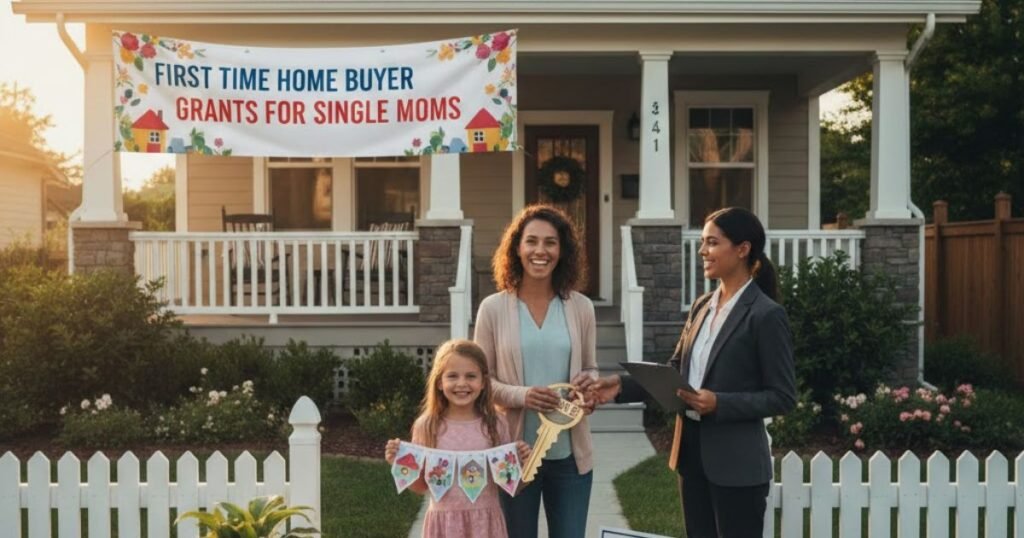
Can Single Moms Get First-Time Home Buyer Grants?
The short answer is yes, but it requires understanding how housing assistance actually works in the United States.
A common point of confusion is whether the federal government issues a universal, nationwide check explicitly labeled for single mothers. To be completely direct: there is no single federal grant program exclusively set aside for single moms. Beware of websites claiming the government hands out “free home-buying money” to everyone without restrictions.
Instead, assistance is distributed through federal, state, county, municipal, and nonprofit entities. These programs evaluate applicants based on income, location, credit history, and first-time homebuyer status. Because single-parent households often fall into low-to-moderate-income brackets, single mothers disproportionately qualify for and benefit from these initiatives. When you apply for single mom home buying assistance, you are tapping into broader programs that prioritize households with dependent children and single incomes.
Understanding Home Buyer Grants
Home buyer grants are financial gifts not loans that help buyers cover the costs associated with purchasing a home, such as down payments, closing fees, or even repairs. The best part? You usually don’t have to pay them back, as long as you meet the program’s conditions (like staying in the home for a certain number of years).
Unlike loans, which add to your debt, grants are designed to ease the financial strain for low-to-moderate-income individuals and families. For single moms, this can make all the difference between renting indefinitely and owning a place to truly call home.
Many of these programs are offered by government agencies, nonprofits, and community organizations. They aim to increase homeownership rates, strengthen communities, and help families build generational wealth. For single moms who often juggle financial responsibilities on one income, these grants can be life-changing.
READ MORE: Low-Income Senior Housing With No Waiting List (2026) | Immediate Move-In
Best First-Time Home Buyer Programs for Single Moms
If you do not have a massive pile of savings, your choice of mortgage loan matters immensely. The following first-time home buyer programs offer low down payments, flexible credit guidelines, and reduced lending fees.
FHA Loans
Backed by the Federal Housing Administration, the FHA loan for single moms is one of the most accessible paths to homeownership.
- Down Payment: As low as 3.5% if your credit score is 580 or higher. If your score is between 500 and 579, you may still qualify with a 10% down payment.
- Credit Score: Minimum 500 to 580 depending on the down payment tier.
- Mortgage Insurance: FHA loans require both an Upfront Mortgage Insurance Premium (UFMIP) and an annual Mortgage Insurance Premium (MIP) paid monthly, which lasts for the life of the loan if you put less than 10% down.
- Pros: Highly lenient credit requirements; accepts higher debt-to-income (DTI) ratios; allows 100% of the down payment to come from a gift or state grant.
- Cons: Mandatory monthly mortgage insurance premiums can make the monthly payment slightly higher than conventional loans.
HomeReady (Fannie Mae)
HomeReady is a conventional mortgage program designed by Fannie Mae to help low-to-moderate-income borrowers purchase a primary residence.
- Down Payment: Minimum 3% down payment.
- Credit Score: Generally requires a minimum credit score of 620.
- Income Limits: The borrower’s income cannot exceed 80% of the Area Median Income (AMI) for the home’s location.
- Pros: Lower private mortgage insurance (PMI) costs than standard conventional loans, and the PMI can be canceled once you reach 20% equity. It also allows you to count boarder income (like rent from a relative) to help you qualify.
Home Possible (Freddie Mac)
Very similar to HomeReady, Freddie Mac’s Home Possible program offers flexible underwriting for buyers with limited savings.
- Down Payment: Minimum 3% down payment.
- Credit Score: Minimum 620 to 660 depending on automated or manual underwriting systems.
- Income Limits: Capped strictly at 80% of the local Area Median Income.
- Pros: Co-signers who do not live in the house are permitted under certain terms, and you can use flexible sources for your down payment, including family gifts and municipal grants.
USDA Rural Development Loans
If you are willing to live in a designated suburban or rural area, the U.S. Department of Agriculture offers a 100% financing loan program.
- Down Payment: 0% down payment required.
- Credit Score: Typically a minimum score of 640 is required for streamlined processing, though lower scores may be manually underwritten.
- Income Limits: Household income cannot exceed 115% of the local area median income.
- Pros: No down payment whatsoever; lower monthly mortgage insurance rates than FHA.
- Cons: The property must be located within a USDA-eligible geographic zone (though many quiet suburban neighborhoods qualify).
VA Loans
For single mothers who have served or are currently serving in the U.S. Armed Forces (or are surviving spouses), the Department of Veterans Affairs provides an exceptional loan program.
Cons: Requires a one-time VA funding fee (which can be rolled into the loan amount) unless waived due to a service-connected disability.
Down Payment: 0% down payment required.
Credit Score: No official minimum credit score set by the VA, though most lenders require a 580 to 620.
Pros: No down payment, no monthly mortgage insurance, and competitive interest rates.
READ MORE: Home Loans for Seniors on Social Security
Down Payment Assistance Programs
For a single parent, saving the initial cash needed at the closing table is often the hardest hurdle. This is where down payment assistance for single moms comes into play. These programs work alongside your primary mortgage to cover your down payment and closing costs.
Program Structures
- Grants: True grants are funds that do not have to be paid back. They are gift funds given at closing to reduce your out-of-pocket costs.
- Forgivable Second Loans: A second mortgage that carries 0% interest. The balance is gradually forgiven over a set period (usually 5 to 10 years) as long as you remain in the home as your primary residence.
- Deferred-Payment Loans: A 0% interest loan that you do not have to pay back until you sell the home, refinance the mortgage, or pay off your primary loan.
- Matching Savings Programs (IDAs): Individual Development Accounts match every dollar a low-income buyer saves with two, three, or four dollars from a community nonprofit.
Where to Find Assistance
Employer-Assisted Housing (EAH): Some healthcare systems, school districts, and universities offer forgivable housing loans to employees buying close to their workplace.
State Housing Finance Agencies (HFAs): Operating in all 50 states, HFAs issue lower-interest mortgages tied directly to down payment assistance grants or forgivable seconds.
City and County Housing Departments: Local municipalities frequently receive federal Community Development Block Grants (CDBG) or HOME funds, which they distribute to local buyers as closing cost assistance.
Nonprofit Organizations: Nationwide groups like Habitat for Humanity or local community action agencies provide specialized lending resources, sweat-equity opportunities, and down payment support.
Federal Housing Programs Worth Knowing
Beyond standard loan products, the federal government funds deeper affordability programs via the Department of Housing and Urban Development (HUD) and its partners.
Housing Choice Voucher (HCV) Homeownership Program
Also known as the Section 8 Homeownership Program, this initiative allows low-income families currently holding a rental voucher to apply those monthly funds toward a mortgage payment instead of rent. Eligibility requires meeting local minimum income thresholds, maintaining full-time employment (exemptions apply for elderly or disabled head of households), and completing homeownership counseling.
Good Neighbor Next Door
If you work as a K-12 teacher, firefighter, emergency medical technician, or law enforcement officer, HUD’s Good Neighbor Next Door program offers a massive 50% discount on the list price of single-family homes located in designated revitalization areas. You must commit to living in the property for at least 36 months.
Section 184 Indian Housing Loan Guarantee
Designed specifically for American Indian and Alaska Native families, this program offers a path to homeownership with a low down payment requirement of just 1.25% on loans under $50,000 and 2.25% on loans over $50,000. It features flexible underwriting and is available both on and off native reservations.
READ MORE: Free Home Repair for Seniors | Grants, Programs & Help Near You
State First-Time Home Buyer Grants
Because real estate is highly localized, state Housing Finance Agencies offer some of the most lucrative first-time home buyer programs. Here is a look at what specific states offer to help solo parents bridge the affordability gap:
- California (CalHFA): Offers the MyHome Assistance Program, providing a deferred-payment junior loan of up to 3% to 3.5% of the purchase price to cover down payment or closing costs.
- Texas (TSAHC & TDHCA): The Texas State Affordable Housing Corporation offers the Home Sweet Texas program, providing low-interest loans alongside down payment assistance grants or forgivable loans up to 5% of the loan amount.
- Florida (Florida Housing): The Florida Homeownership Loan Program (FHLP) offers a second mortgage up to $10,000 with a 0% interest rate, deferred until the home is sold or refinanced.
- New York (NYState HCR): Features the Achieving the Dream mortgage with low down payment requirements and the Down Payment Assistance Loan (DPAL) providing up to $3,000 or 3% of the purchase price (whichever is greater).
- Illinois (IHDA): The Illinois Housing Development Authority offers programs like IHDA Access Forgivable, giving buyers up to $6,000 in assistance that completely dissolves after 10 years of residency.
- Georgia (Georgia Housing Search / DCA): The Georgia Dream Homeownership Program provides low-interest financing and up to $10,000 in down payment assistance for qualified liquid asset-limited households.
- Ohio (OHFA): Provides first-time buyer loans paired with either 2.5% or 5% of the home’s purchase price to be applied directly toward closing costs and down payments.
- North Carolina (NCHFA): Offers the NC Home Advantage Mortgage, giving buyers down payment assistance up to 5% of the loan amount, which is completely forgiven after 15 years.
- Pennsylvania (PHFA): The Keystone Forgivable in Ten Years (KFIT) loan provides up to 5% of the purchase price or $6,000 to assist with down payments and closing costs, forgiving 10% each year.
- Michigan (MSHDA): Offers the MI 10K DPA program, providing up to $10,000 in down payment assistance via a 0% interest, non-amortizing loan deferred until the home is sold or paid off.
Pro Tip: Always search for your specific state name followed by “Housing Finance Agency.” Contacting an HFA-approved lender is the quickest way to check availability for these specific funds.
Who Qualifies for Single Mom Home Buying Assistance?
To protect public funds, every grant and affordable loan program implements strict qualification rules. While being a single mother strengthens your case under specific local targeting criteria, you must still meet general underwriting requirements:
- Income Limits: Most programs cap household income at 80% to 115% of the Area Median Income (AMI). Your total household income includes child support, alimony, and social security benefits.
- Credit Score: While FHA allows scores as low as 580 for a 3.5% down payment, conventional assistance programs (like HomeReady) or state HFA grants typically require a minimum credit score of 620 to 640.
- Debt-to-Income (DTI) Ratio: Lenders calculate your DTI by dividing your fixed monthly debts (car payments, student loans, credit card minimums, plus your prospective mortgage) by your gross monthly income. Most assistance programs prefer a DTI under 43% to 45%, though FHA allows higher with compensating factors.
- First-Time Buyer Definition: HUD defines a first-time homebuyer as anyone who has not owned a primary residence within the last three years. Displaced homemakers and single parents who previously owned a home with a spouse also qualify under this rule.
- Homebuyer Education Courses: Nearly all grant programs require you to complete a HUD-certified homebuyer education course. These courses teach budgeting, home maintenance, and the mortgage process.
- Occupancy Rules: The home must serve as your primary residence. You cannot use these grants to buy investment properties or vacation homes.
- Residency: You must be a U.S. citizen, permanent resident legal alien, or non-permanent resident alien with a valid work visa.
READ MORE: Salvation Army Free Car Program (Eligibility & How to Apply)
Documents You’ll Need
When applying for a mortgage and seeking grants for single mothers buying a house, you need to prove your financial situation clearly. Gathering these documents beforehand will prevent processing delays:
- Government-Issued ID: Driver’s license or passport.
- Tax Returns: Signed copies of federal tax returns for the past two consecutive years.
- W-2 Forms: W-2 statements from all employers spanning the last two years.
- Pay Stubs: Your most recent 30 consecutive days of consecutive pay stubs.
- Bank Statements: Complete statements (all pages) for the last 60 days of checking, savings, and retirement accounts.
- Credit Report: Usually pulled directly by the lender, but helpful to review early.
- Employment Verification: Contact details for your HR department to verify continuous employment.
- Legal Documents: Divorce decrees, child support court orders, and history of regular child support payments (requires proof of consistent receipt for at least the last 3–6 months to count as qualifying income).
Step-by-Step Application Process
Buying a home single-handedly requires organization. Follow this clear roadmap to secure your home without unnecessary stress:
- Check Your Credit: Pull your free credit reports. Look for errors, pay down high credit card balances, and ensure your score is in the best shape possible.
- Determine Your True Budget: Do not let a lender tell you what you can afford. Calculate a monthly payment that leaves plenty of breathing room for groceries, childcare, savings, and healthcare.
- Research and Compare Grants: Visit your state’s Housing Finance Agency website alongside local city or county portals to pinpoint active down payment assistance programs.
- Find an HFA-Approved Lender: Not every lender can process state or local grants. Find a loan officer specifically certified to handle the down payment assistance program you want to use.
- Complete a Homebuyer Education Course: Sign up for a HUD-approved class. You can complete many of these courses online for a small fee or for free.
- Get Pre-Approved: Submit your financial documentation to your chosen lender to secure an official mortgage pre-approval letter showing sellers you are a serious buyer.
- Shop for a Home: Work with a licensed real estate agent who understands first-time buyer programs to find a home within your budget.
- Get a Home Inspection: Once under contract, hire an independent home inspector to verify the structural integrity of the home. Do not skip this step; unexpected repairs can devastate a single-income household budget.
- Clear Underwriting & Close: Your lender will finalize your loan package and tie in your grant approvals. Review your final Closing Disclosure, sign the paperwork, and collect your keys.
How Much Money Can You Receive?
The financial assistance available varies widely based on where you live, your household income, and the home’s purchase price.
- $2,500 to $5,000: Standard flat-rate grants offered by national lenders or local credit unions to cover minimal closing costs for low-income buyers.
- $10,000 to $15,000: Typical amounts distributed by state Housing Finance Agencies via forgivable or deferred second mortgages.
- Up to Full Down Payment: Certain high-need county and city programs offer matching programs or silent seconds that can provide up to 10% or even 20% of the home’s purchase price, minimizing your out-of-pocket costs at the closing table.
READ MORE: Free Smart Watch for Seniors: How to Find Legitimate Help
Core Program Comparisons
The table below compares the core entry-level mortgage programs available to first-time buyers.
| Program | Min. Down Payment | Min. Credit Score | Income Limits | Best For | Repayment Required? |
| FHA Loan | 3.5% | 580 | None | Buyers with lower credit scores | Yes (Standard Mortgage) |
| HomeReady | 3.0% | 620 | Max 80% of AMI | Strong credit, lower savings | Yes (Standard Mortgage) |
| Home Possible | 3.0% | 620 to 660 | Max 80% of AMI | Flexible funding sources | Yes (Standard Mortgage) |
| USDA Loan | 0.0% | 640 (Typical) | Max 115% of AMI | Rural & suburban buyers | Yes (Standard Mortgage) |
| VA Loan | 0.0% | None (Varies) | None | Veterans & military spouses | Yes (Standard Mortgage) |
| State HFA Grants | Varies | 620 to 640 | Varies by state | Covering down payment gaps | Often forgiven over time |
Nonprofit Organizations Offering Assistance
In addition to government programs, several nonprofit organizations are dedicated to helping single moms achieve homeownership. These groups not only offer financial support but also education, credit counseling, and community development programs.
1. Habitat for Humanity
The most well-known is probably Habitat for Humanity, which assists low-income families and people, especially single moms, in creating reasonably priced homes. In exchange for interest-free, reasonably priced mortgages, homebuyers provide “sweat equity” by renovating their own homes or volunteering. The group is a great option for mothers who wish to be a part of something greater because it emphasizes community development and empowerment.
2. National Homebuyers Fund (NHF)
As previously stated, NHF provides non-repayable subsidies to help with closing fees and down payments. Making houses available to people who might otherwise find it difficult to qualify for conventional mortgages is their aim.
3. Neighborhood Assistance Corporation of America (NACA)
NACA is a great option since there aren’t any closing costs or down payments, and you won’t need private mortgage insurance. Their main goal is fair financing, helping working families and single moms buy homes they can actually afford.
These nonprofits focus on helping single mothers not just buy houses, but keep them too, by teaching them how to manage their money.
4. Employer-Assisted Housing Programs
Some employers offer Employer-Assisted Housing (EAH) benefits as part of their compensation packages. These programs provide grants, forgivable loans, or down payment assistance to employees looking to buy homes near their workplaces.
This kind of support can change the lives of single mothers. Employers frequently collaborate with neighborhood housing organizations to offer financial counseling, homeownership instruction, or cash help. Large organizations, hospitals, and schools are particularly well-known for providing these advantages.
If you’re employed, it’s worth asking your HR department if your company has such programs. Even small grants say $3,000 to $5,000 can make a significant difference when you’re saving for your first home.
5. Credit Requirements and Financial Preparation
Before applying for any grant or loan program, it’s essential to understand your credit standing. Most programs require a minimum credit score of 580–640, depending on the lender and the loan type.
If your credit score is below that, don’t panic there are ways to improve it:
- Pay bills on time – Payment history makes up 35% of your credit score.
- Reduce debt – Aim to keep credit card utilization below 30%.
- Check your credit report – Review it for errors and dispute any inaccuracies.
- Avoid new loans or credit cards right before applying for a mortgage.
READ MORE: Free government money for seniors over 60
Common Mistakes to Avoid
- Applying Too Late for Grants: Many buyers wait until they have already found a home to look for grant money. Down payment assistance programs must be integrated into your initial loan pre-approval before you sign a purchase contract.
- Ignoring Hyper-Local Programs: Don’t just look at national or state assistance. Your local city or county housing authority might have specialized grant pools with less competition.
- Not Comparing Lenders: Lenders set their own interest rates and fees. A single mom home buying assistance program won’t save you money if the lender charges exorbitant closing fees or inflates your interest rate.
- Missing Household Income Rules: Remember that assistance limits usually look at household income, meaning the earnings of every adult living in the home, not just the primary borrower.
- Forgetting Closing Costs: Your down payment is only part of the equation. You must also cover lender fees, title insurance, escrows, and recording fees (typically 2% to 5% of the home price) if you don’t secure closing cost assistance.
- Damaging Credit Before Closing: Do not open new credit cards, finance furniture, change jobs, or miss bill payments between getting pre-approved and closing on your home.
- Skipping the Homebuyer Education: Procrastinating on your required education course can delay your closing date, putting your earnest money deposit at risk.
Tips to Improve Approval Chances
Establish a Dedicated Home Emergency Fund: Even if a grant covers your entire down payment, try to have a separate stash of cash reserved exclusively for unexpected post-closing home repairs.
Optimize Your Child Support Documentation: If child support makes up a major part of your income, ensure it is court-ordered and that you have bank statements proving it has arrived consistently every month for at least the past six months.
Build a Clean 12-Month Rental History: Lenders love to see regular, on-time rent payments made via check or electronic transfer. Avoid paying rent in cash without a formal receipt.
Pay Down Credit Card Balances: Reducing your revolving debt lowers your utilization rate, boosts your credit score, and instantly opens up room in your debt-to-income (DTI) ratio.
Conclusion
As a single mother owning a home may feel overwhelming, but it’s not impossible. Numerous single mothers have already realized their aspirations of homeownership through federal, state, municipal, and nonprofit programs, and you can too.
Opportunities abound, ranging from employer-sponsored programs and charitable aid to DPA grants and HUD initiatives. Research, financial preparation, and early application are crucial. You are getting closer to providing your kids with the safe, stable home they need with every step you take.
FAQS
Can a single mom get a first-time home buyer grant?
Yes. While there is no exclusive federal grant program solely for single mothers, single moms frequently qualify for federal, state, and local low-income homebuyer grants based on their single-income status, household size, and first-time buyer profile.
What credit score do I need to qualify for first-time home buyer grants?
Most programs require a credit score between 580 and 640, depending on the lender and loan type. Some may accept lower scores if you meet other financial criteria.
Are first-time home buyer grants taxable?
In the vast majority of cases, government-funded first-time homebuyer grants and forgivable down payment assistance loans are not considered taxable income by the IRS because they are structured as housing subsidies or non-taxable gifts at closing. However, you should always consult a tax professional regarding your specific situation.
Can I combine multiple grants or assistance programs?
Yes, many single moms successfully combine federal, state, and local assistance programs to maximize benefits. Just ensure the programs you choose allow stacking.
Do I have to pay back a home buyer grant?
In most cases, no. Grants are gifts, not loans. However, some may require repayment if you sell or move out before a specific period (usually 3–5 years).
Can I qualify for assistance if I’ve owned a home before?
It depends on the program. Many define “first-time buyer” as someone who hasn’t owned a home in the past three years, so you may still qualify.