For millions of Americans living with mobility impairments, transportation isn’t just about convenience it’s about freedom, independence, and opportunity. Being able to drive or travel comfortably in a vehicle makes it possible to attend school, go to work, receive healthcare, and stay socially connected. However, the high cost of wheelchair-accessible vehicles (WAVs) frequently prevents many families from purchasing them. In order to guarantee equal access to transportation, WAV grants and funding programs are essential sources of finance.
The price of a new wheelchair-accessible minivan can range from $50,000 to $80,000, depending on the style of modification, adaptive technologies, and base vehicle. The expense of even converting an old car might range from $10,000 to $30,000. For most households, this cost is unaffordable without grants or assistance.
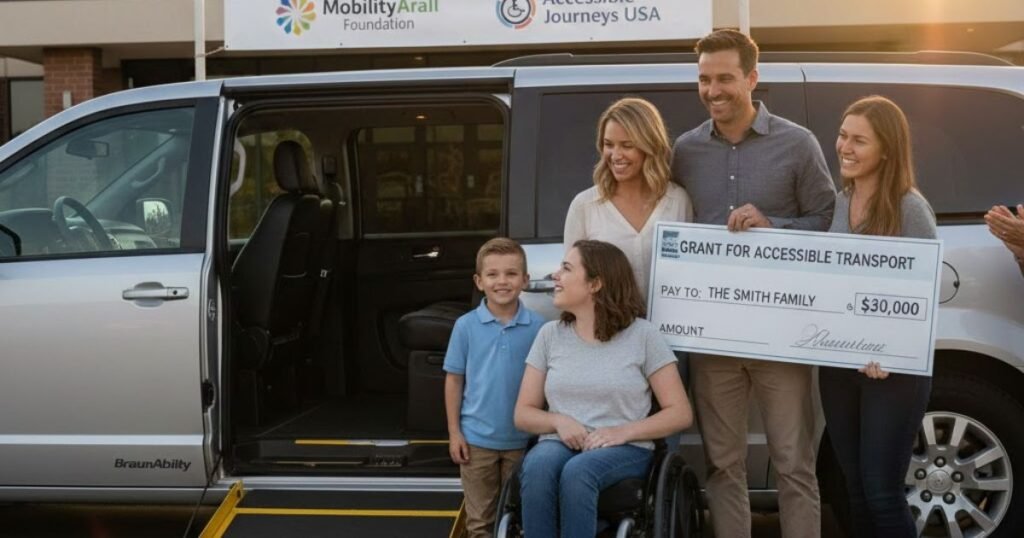
Understanding Wheelchair Accessible Vehicles (WAVs)
Wheelchair users can travel in safety and comfort using a Wheelchair Accessible Vehicle (WAV), which is a vehicle that has been modified or constructed to accommodate wheelchair users. Important changes consist of:
- Lowered floors or raised roofs
- Side-entry or rear-entry ramps
- Hydraulic or power lifts
- Wheelchair tie-down systems
- Transfer seats and hand controls
Some WAVs allow the wheelchair user to drive from the wheelchair, while others are designed for them to ride as a passenger. These modifications must meet ADA (Americans with Disabilities Act) and National Highway Traffic Safety Administration (NHTSA) standards.
READ MORE: Habitat For Safe Seniors Free Ramp Program (Eligibility & How to Apply)
The Financial Challenge of Buying a WAV
Buying or converting a WAV is not just about the base vehicle. Costs include:
| Expense Type | Average Cost Range (USD) |
| New WAV (minivan/SUV) | $50,000 – $80,000 |
| Conversion cost (ramp, lift, etc.) | $10,000 – $30,000 |
| Used WAV | $25,000 – $40,000 |
| Specialized driving controls | $5,000 – $20,000 |
For many individuals on fixed incomes, including veterans, seniors, and people on disability benefits, these costs are overwhelming. Grants bridge that financial gap.
Federal and State-Level Grant Opportunities
Vocational Rehabilitation (VR) Programs
Each U.S. state operates a Vocational Rehabilitation agency that helps individuals with disabilities prepare for, find, or keep employment. If a WAV is needed to achieve that goal, VR may cover part or all of the cost. Contact your state Department of Vocational Rehabilitation for eligibility requirements.
Veterans Affairs (VA) Vehicle Grants
Veterans with service-connected disabilities may qualify for VA Automobile and Special Adaptive Equipment Grants.
- Automobile Grant: Up to $25,603.02 (as of 2025) toward purchasing a vehicle.
- Adaptive Equipment Grant: Covers adaptive equipment such as lifts, ramps, or hand controls.
Apply through your local VA Regional Office or online via va.gov.
Medicaid / Medicare Assistance
While Medicare typically doesn’t cover vehicle purchases, some Medicaid waiver programs provide assistance for mobility aids and vehicle modifications. Coverage depends on your state and the medical necessity of the adaptation.
State-Specific Mobility Programs
States such as California, Texas, and Florida have unique vehicle modification programs under their disability or aging services departments. For example, California’s Department of Rehabilitation sometimes funds modifications for employment-related transportation.
READ MORE: How To Get Free Denture Grants For Seniors
Nonprofit and Private Organization Grants
1. MobilityWorks Foundation
gives people with mobility impairments a portion of the money for WAV purchases or modifications. Candidates must exhibit a need for money.
2. United Access – Bridge to Mobility Program
This group fills financing gaps by providing scholarships up to $10,000 to assist Americans afford wheelchair-accessible cars. Candidates must provide documentation of their financial hardship and disability.
3. National Multiple Sclerosis Society (NMSS)
The NMSS provides funding for mobility devices, such as vehicle adaptations, to help people with multiple sclerosis.
4. Muscular Dystrophy Association (MDA)
Provides assistance to members for purchasing or modifying vehicles. Funding depends on need and availability.
5. Local Charities and Disability Support Groups
Many local churches, community foundations, and service organizations like Kiwanis or Rotary Clubs offer one-time grants or fundraising support for mobility vehicle costs.
Manufacturer and Dealer Rebates
Vehicle manufacturers often provide mobility rebate programs when you purchase a new car and add accessibility equipment.
| Manufacturer | Program Name | Rebate Amount |
| Toyota | Toyota Mobility Assistance Program | Up to $1,000 |
| Ford | Ford Mobility Motoring | Up to $1,000 |
| Chrysler | Chrysler Automobility Program | Up to $1,000 |
| Honda | Honda Mobility Assistance | Up to $1,000 |
| GM | GM Mobility Program | Up to $1,200 |
Additionally, customers of modified vehicles can take advantage of recurring rebates or promotional discounts from organizations such as Vantage Mobility International (VMI) and BraunAbility.
READ MORE: Free Financial Assistance for the Seniors & Elderly
How to Apply for WAV Grants in the USA
- Research available programs – Start by looking at state, federal, and nonprofit alternatives.
- Get vehicle quotes – For the WAV or conversion, the majority of grant applications call for an official dealer price.
- Gather documentation – such as a driver’s license, proof of income, a disability certification, and a personal statement of need.
- Apply early – Many programs are first-come, first-served, and funding cycles are limited.
- Follow up regularly – Communicate with grant administrators and provide any additional documents promptly.
Other Financial Support Options
- Crowdfunding: Families frequently raise a portion of the WAV cost with the use of websites like GoFundMe.
- Financing / Leasing: A few WAV dealers provide flexible or low-interest financing options.
- Tax Deductions: Medically essential vehicle modifications may be deductible medical expenses under IRS Publication 502.
Common Mistakes to Avoid
- Submitting incomplete applications or missing deadlines.
- Buying a vehicle before funding approval.
- Not using certified conversion specialists (risking grant invalidation).
- Overlooking smaller, state-level programs that could add up.
Benefits of WAV Grants
Receiving a WAV grant can transform daily life:
- Freedom to travel independently.
- Safer and more reliable access to healthcare and employment.
- Enhanced quality of life for both wheelchair users and caregivers.
Challenges and Limitations
Despite their importance, WAV grants face challenges:
- Funding caps limit annual availability.
- Strict eligibility criteria may exclude middle-income families.
- Processing times can stretch over months due to high demand.
READ MORE: How To Get Government Grants for Stroke Victims
Future of WAV Grants in the USA
The terrain is changing. A future of cleaner, smarter mobility for individuals with disabilities is being promised by federal agencies and commercial manufacturers who are investing in electric WAVs (eWAVs) and autonomous vehicle accessibility. To increase funds and awareness across the country, activism must continue.
Conclusion
Americans with mobility issues can live freely, work, and participate fully in their communities thanks to grants for wheelchair-accessible cars. Ownership is now more accessible than ever thanks to a variety of initiatives, including federal aid, nonprofit grants, and manufacturer rebates, even though the price and paperwork might be intimidating. It is completely possible to achieve accessible transportation with the right planning, diligence, and study.
FAQs
1. Can I combine multiple grants for one vehicle purchase?
Yes. You can often combine state, nonprofit, and manufacturer grants, provided each program allows it. Always disclose all funding sources to remain compliant.
2. Are WAV grants available for used vehicles?
Some organizations (like Bridge to Mobility) allow grants for used WAVs if the vehicle meets safety and certification standards.
3. Do I have to pay taxes on WAV grant money?
Generally, no. Most grants are considered charitable or assistance funds and are not taxable. Consult a tax advisor for your specific situation.
4. How long does the grant approval process take?
Anywhere from 2 weeks to several months, depending on the program and the completeness of your application.
5. Can I get a grant for an electric wheelchair-accessible vehicle?
Yes. As of 2025, federal programs and manufacturers are expanding incentives for electric WAVs to support sustainable mobility.