Air conditioning isn’t just about comfort; for senior citizens, it can be a matter of survival. As they age, their body becomes less efficient in regulating temperature. This means that seniors are more vulnerable to heatwaves, which can cause dehydration, heatstroke, and even heart complications. In fact, studies show that older adults make up the majority of hospitalizations and fatalities during periods of extreme heat.
Imagine living in a small apartment during a sweltering summer with no way to cool down. For many younger people, this might be uncomfortable but manageable. For seniors, however, it can be life-threatening. Many also suffer from chronic conditions such as diabetes, heart disease, or respiratory issues, which worsen when temperatures soar.
Unfortunately, not every senior can afford the luxury of an air conditioner. With many living on fixed incomes from Social Security or pensions, the cost of buying, installing, and running an air conditioner can feel overwhelming. That’s why free or subsidized air conditioner programs are so critical they provide relief while protecting seniors from dangerous health risks.
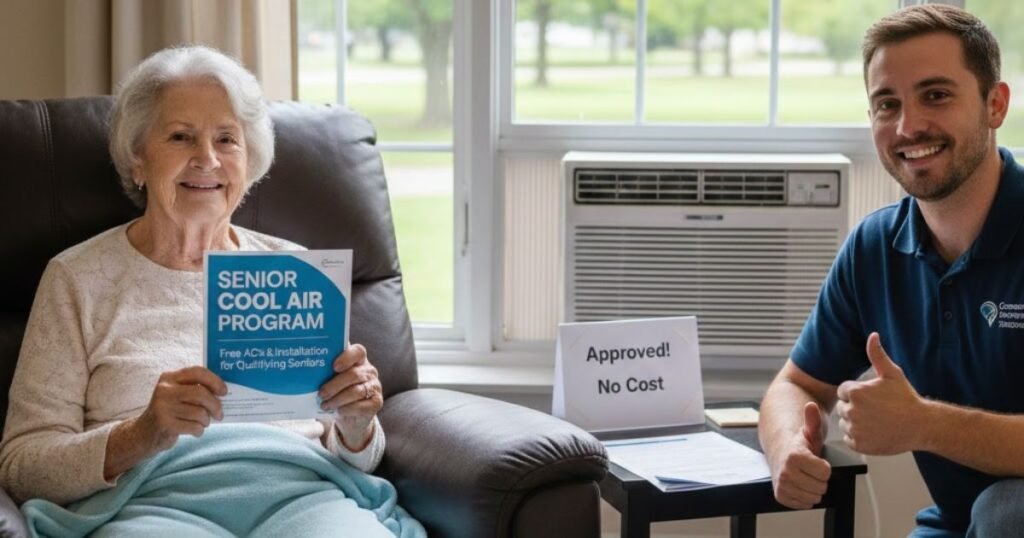
Government Programs That Offer Free or Discounted Air Conditioners
When seniors look for financial assistance, government-backed programs are usually the best place to start. There are several federal and state initiatives to help the low -income houses to be safe during the extreme season. These programs not only provide air conditioners, they also help in reducing utility bills, waterproofing homes and overall energy use.
The two most prominent nationwide programs are low -income home Energy Assistance Program (Liheap) and Meteorological Assistance Program (WAP). Together, they have helped millions of seniors to remain calm in summer and to be warm in winter. Many states also run additional senior-specific benefit programs that either provide free AC units directly or distribute vouchers to help with cooling equipment.
1. LIHEAP Cooling Assistance
LIHEAP is one of the most widely recognized programs for energy assistance in the U.S. It offers seasonal help for both heating and cooling, making it an essential resource for seniors. During the summer, LIHEAP often distributes grants to help cover the cost of buying and installing an air conditioner.
Eligibility for LIHEAP is based on household income, size, and whether someone in the home is especially vulnerable (like seniors, young children, or individuals with disabilities). Seniors applying will usually need to provide proof of age, proof of income (such as Social Security statements), and details about their energy costs.
One of the best parts of LIHEAP is that it doesn’t just stop at providing cooling devices. Seniors can also get help with utility bills, energy-related emergencies, and even home improvements that make their space more energy-efficient. This means that applying for Liheap can have long -term benefits, not only short -term relief.
2. Weatherization Assistance Program (WAP)
The Weatherization Assistance Program takes a broader approach by making homes more energy-efficient. Instead of just handing out air conditioners, WAP helps reduce overall energy consumption through insulation upgrades, energy-efficient appliances, and weatherproofing.
For seniors, this program is especially valuable. It doesn’t just provide temporary relief; it lowers monthly bills in the long run. While seniors may still need a separate air conditioner, the program ensures that their homes stay cooler with less strain on the unit, leading to lower electricity bills.
Priority is usually given to seniors, families with young children, and individuals with disabilities. Applications are handled at the state level, and assistance can vary depending on funding and location.
READ MORE: Free Car for Seniors in the USA (2026) | Government & Charity Programs
Nonprofit Organizations Helping Seniors Get Free Air Conditioners
Every senior will not qualify for government assistance, and sometimes funding quickly comes out. Where non -profit organizations and community groups step into filling gaps. Many charities run seasonal programs to distribute air conditioners or provide emergency assistance for cooling needs.
Salvation Army and Catholic Charities are two of the two most famous organizations that help in cooling relief. Additionally, local community action agencies often run donated drives, where the funds may contribute to the funds or air conditioning units for needy seniors can be gently used.
These organizations not only provide air conditioners, but also provide assistance for utility bills, food assistance and housing assistance, making them excellent resources for seniors that are struggling in many areas.
1. Salvation Army’s Cooling Programs
The Salvation Army has a long history of providing emergency relief, and during the summer months, it often involves distributing air conditioners. In some cities, the Salvation Army runs “Summer Cooling Program”, where senior citizens can apply to get free AC units if they meet some income or health-based criteria.
In addition to physical air conditioners, the Salvation Army may also offer help with paying utility bills. This ensures that seniors not only receive the equipment they need but can also afford to run it.
To find out if a local branch is offering this type of assistance, seniors or caregivers can contact their nearest Salvation Army office. Each branch operates independently, so services may vary by location.
2. Catholic Charities and Faith-Based Programs
Catholic charity is another organization that steps in to support superiors in needs. Through partnership with local churches, utility companies and health organizations, they often provide cooling relief in the form of free AC units or financial assistance to buy one.
Many of their programs prioritize low -income seniors, especially those who document the medical requirements. Beyond the air conditioner, Catholic charities provide food programs, rent assistance and healthcare referral, making them a holistic source of support.
Faith-based organizations like local churches, mosques, and synagogues may also run community cooling drives, collecting donations from members to help the elderly. Seniors shouldn’t hesitate to reach out to religious groups in their community, even if they are not active members.
Utility Company Cooling Assistance Programs
Many seniors don’t realize that their local utility companies often run programs to help vulnerable households. Since utility providers are highly regulated, they are sometimes required by law or encouraged through government incentives to provide relief during extreme weather. For seniors, this can mean free or discounted air conditioners, reduced energy bills, or access to special emergency cooling initiatives.
One major benefit of utility company programs is that they are designed for local needs. For example, companies in hotter regions like the South and Southwest often provide summer cooling support, while northern companies may focus more on heating aid. Some utilities even distribute free air conditioning units during declared heatwaves to protect the most at-risk residents.
Many utilities also provide “lifeline” or “medical necessity” programs. These programs help seniors with health issues that require consistent indoor cooling. A doctor’s note confirming medical necessity can often make a senior eligible for reduced bills or a free cooling unit.
To apply, seniors usually need to contact their utility provider directly. While not all programs are advertised widely, speaking with a customer service representative and asking about “low-income or senior cooling assistance” often reveals hidden opportunities.
Examples of Utility Programs
To better understand how these programs work, let’s look at some examples from across the U.S.:
- PG&E (California): Pacific Gas and Electric offers a medical baseline program that reduces bills for seniors who require extra energy use for medical equipment, including cooling devices. Seniors may also qualify for free or low-cost energy-efficient appliances.
- Con Edison (New York): Con Ed partners with local agencies to distribute air conditioners to vulnerable seniors during heat emergencies. They also offer rebates for energy-efficient AC purchases.
- Midwest Utilities (Illinois, Ohio, Michigan): Many Midwest energy providers participate in cooling assistance programs where seniors can apply for bill credits during the summer. Some also provide free fans or air conditioners through partnerships with nonprofits.
- Southern Utilities (Texas, Florida, Georgia): Utilities in hotter southern states often run seasonal “beat the heat” campaigns that include free or discounted AC distribution, cooling centers, and financial help with electricity costs.
READ MORE: Free Laptop for Seniors
Charitable Foundations and Community Resources
Besides the government and utility company schemes, there are various community-based schemes that strive tirelessly to ensure that the seniors who are struggling in the summer. The local senior centers typically serve as distribution sites for donated air conditioners, and the Community Health Department coordinates cooling relief during life-threatening heatweaves.
Some charitable foundations organize seasonal campaigns, where they collect funds specifically for purchasing AC units for seniors. In many towns, community action agencies also accept donated window units from households upgrading their appliances and redistribute them to low-income seniors.
Another emerging trend is crowdfunding and donation drives. Platforms such as gofundme or Facebook funding are sometimes used by communities to help raise funds for local seniors who require cooling devices. Volunteers also often deliver and install the devices themselves in some communities so that the elderly residents would not have to endure heavy lifting or technical installments.
Seniors and caregivers should check local community bulletin boards, social media groups, and senior center newsletters to find out about these opportunities. Often, word-of-mouth is the fastest way to discover local programs before they run out of resources.
Medicare, Medicaid, and Health Insurance Support
Many seniors wonder if Medicare or Medicaid will cover the cost of an air conditioner, especially when it is prescribed by a doctor. The answer isn’t simple, it depends on the program and the state.
Medicare: Generally, Medicare does not cover air conditioners because they are not considered “durable medical equipment.” However, there are exceptions. If a doctor prescribes an AC as medically necessary for a specific condition, seniors may be able to get partial reimbursement or coverage under certain Medicare Advantage plans.
Medicaid: Medicaid offers more flexibility. In many states, Medicaid-funded home and community-based services (HCBS) programs may cover the cost of air conditioners if they are deemed essential for health and safety. Seniors with documented respiratory or cardiac conditions often have the best chance of approval.
Private Health Insurance: Some insurance companies may reimburse cooling devices if a physician certifies them as a medical necessity. This is less common but worth checking, especially for seniors with supplemental insurance beyond Medicare.
The key for seniors is to always ask their doctor for written documentation of medical necessity. This paperwork can make a big difference in securing coverage from Medicaid or insurance providers.
How Seniors Can Apply for Free Air Conditioners
The application process for free or subsidized air conditioners may feel overwhelming, but breaking it into steps makes it easier. Here’s a simple roadmap seniors can follow:
- Identify Local Programs – Start by checking federal programs (LIHEAP, WAP), then contact state agencies, local utility providers, and nonprofits.
- Gather Documentation – Most programs require proof of income (Social Security, pension statements), proof of residency, proof of age (ID or birth certificate), and sometimes medical documentation.
- Submit Application – Applications can often be completed online, over the phone, or in person at a local community action agency.
- Follow Up – Many programs have limited funding, so it’s important to check on the status of your application. If denied, ask if they can recommend alternative resources.
- Plan Ahead – Apply early in the year before summer heatwaves arrive. Many programs run out of funding quickly once demand spikes.
READ MORE: Free Dental Implants for Seniors
Tips to Improve Eligibility for Free AC Programs
Not everyone who applies for free cooling assistance gets approved, but there are ways to increase the chances:
- Emphasize Medical Needs: A letter from a doctor confirming that an air conditioner is necessary for health can move an application to the top of the list.
- Apply Early: Don’t wait for a heatwave. Many programs start accepting applications months before summer. Early applicants often get priority.
- Combine Programs: Seniors may qualify for multiple forms of assistance—such as LIHEAP for bill payments and a nonprofit for the unit itself.
- Use Senior Advocacy Groups: Organizations like AARP often provide guidance and connections to local programs. They can also help appeal if an application is denied.
- Document Everything: Keeping copies of medical records, financial statements, and previous energy bills makes the process smoother.
Common Challenges Seniors Face in Getting Free AC Units
While many programs exist, seniors often encounter roadblocks when trying to access them. One of the most common challenges is limited funding. Many programs only have a set number of air conditioners to distribute each summer, meaning late applicants may be placed on long waiting lists or denied altogether.
Another issue is regional availability. Some states and cities have robust programs, while others offer little to no assistance. Seniors in rural areas may face additional barriers, such as long travel distances to application centers or a lack of local nonprofits providing aid.
The application process itself can also be difficult. Seniors who are not tech-savvy may struggle with online applications, while others may find the paperwork overwhelming. Income documentation, medical records, and proof of residency are often required, which can feel like a lot of red tape.
Finally, there’s the issue of running costs. Even when a senior receives a free air conditioner, the cost of electricity can discourage them from using it. That’s why programs that also cover utility bills are so important—they ensure the equipment actually gets used.
Despite these challenges, perseverance stops. Seniors who apply early, take help from advocacy groups, and detect many programs, often get success.
READ MORE: Free government money for seniors over 60
Conclusion
The question, “Can I get free air conditioners for senior citizens?” has a hopeful answer: yes, in many cases, seniors can access free or low-cost cooling solutions. With government programs like LIHEAP and WAP, nonprofit organizations such as Salvation Army and Catholic Charities, and utility company initiatives, there are multiple avenues available for relief.
While challenges exist like limited funding, regional differences, and application hurdles the need for these programs is undeniable. Air conditioning is not a luxury only for seniors; It is an important tool for existence, health and dignity. Whether government assistance, charitable donations, or insurance coverage, seniors and carers should know that help is out of there.
FAQs
1. Can seniors get free portable air conditioners instead of window units?
Yes. Some programs offer portable units, especially if window installations are not safe or practical for seniors. Availability depends on the local program.
2. Do all states in the U.S. provide free air conditioning programs for seniors?
Not all states offer the same level of support. Larger states with hotter climates often provide more robust programs, while smaller or cooler states may have limited options.
3. Can seniors on Social Security Disability (SSD) also qualify?
Yes. Seniors on SSD or SSI often meet the income requirements for programs like LIHEAP and may also qualify for medical-based assistance.
4. Are free AC units available year-round or only during heatwaves?
Most programs are seasonal and open in late spring or early summer. However, seniors can prepare by applying as soon as applications open.
5. What should seniors do if they are denied assistance?
If denied, seniors should ask about appeal processes and request referrals to other local resources. Many nonprofits and churches fill in gaps when official programs fall short.