The Government Car Voucher Program in the United States refers to a series of federal and state initiatives designed to make vehicles especially fuel-efficient and electric vehicles (EVs) more affordable for citizens. These programs provide financial incentives, rebates, or vouchers to encourage people to trade in old, polluting cars and purchase newer, cleaner ones.
The idea took off nationally during the 2009 economic crisis through the “Cash for Clunkers” program, officially known as the Car Allowance Rebate System (CARS). Since then, other U.S. states and the federal government have kept up similar initiatives to boost the economy and encourage cleaner transportation. Lets deep dive into “Government Car Voucher Program in the USA (Eligibility & Benefits)”
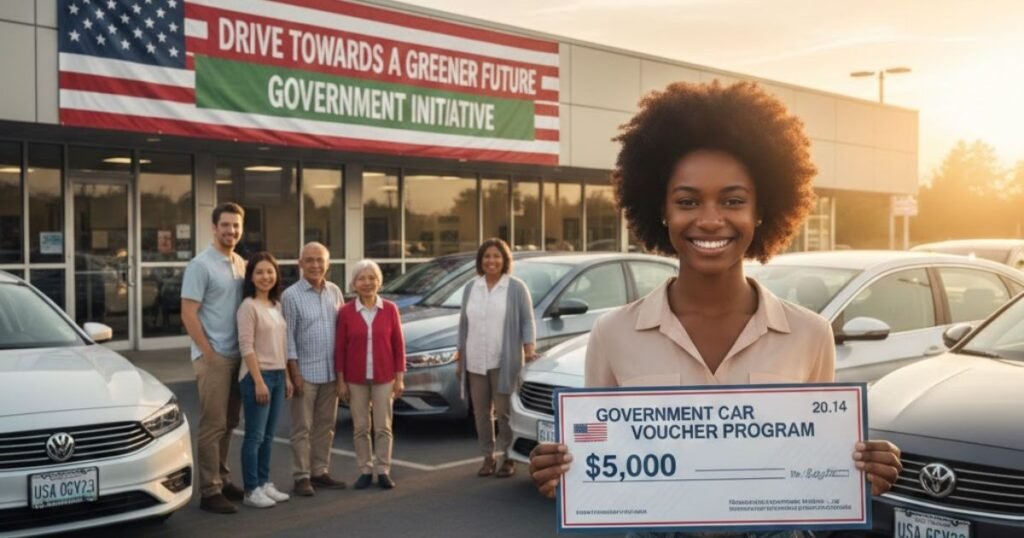
What Is a Government Car Voucher Program?
When people search for a car voucher program, they are usually looking for a direct financial coupon or certificate provided by a public agency to purchase a vehicle. In reality, public and private transportation assistance comes in many different forms. Understanding these terms prevents confusion when dealing with case managers or community organizations.
Transportation Services: Door-to-door shuttle systems, volunteer driver networks, or paratransit options funded by the government to ensure vulnerable populations can access essential services.
Vouchers: Typically, a voucher covers specific, targeted costs like public transit passes, gas cards, or temporary rideshare credits rather than the entire purchase price of a car.
Grants: These are direct financial awards given to individuals or organizations for a specific purpose (such as modifying a van for wheelchair access) that do not have to be paid back.
Rebates: Financial incentives provided after a purchase, such as electric vehicle (EV) clean energy tax incentives, which reduce your tax liability or are applied directly at the dealership.
Donated Vehicles: Programs run primarily by charitable nonprofits that accept donated used cars from the public, repair them, and transfer title ownership to qualifying low-income individuals.
Repair Assistance: Small grants or localized funds designed to pay for essential mechanical repairs so an individual can keep their current vehicle safely on the road.
READ MORE: Free Car for Seniors in the USA (2026) | Government & Charity Programs
Is There a Federal Government Car Voucher Program?
Let’s address the most common misconception directly: There is no single, nationwide federal program called the “Government Car Voucher Program” that hands out free cars to any citizen who applies.
If you see a website claiming that the federal government is giving away free vehicles via a simple online form, proceed with extreme caution. These are almost always predatory clickbait sites designed to steal your personal data or charge you fake “processing fees.”
Why Does the Misinformation Exist?
The myth of the universal government car voucher program persists for two main reasons:
- Historical Context: Many online articles still reference the old “Cash for Clunkers” program (officially known as the Car Allowance Rebate System, or CARS). This was a highly publicized, temporary federal program run way back in 2009 designed to stimulate the economy by giving consumers a trade-in credit for older, fuel-inefficient vehicles. That program ended over a decade ago and has not returned.
- Federal Funding, Local Administration: The federal government does spend hundreds of millions of dollars on transportation assistance every year. However, this money is distributed to states, counties, and local community action agencies via block grants. These local entities then design their own specific vehicle assistance programs, which vary widely depending on where you live.
The Reality Check: While Uncle Sam won’t mail you a voucher for a brand-new sedan, federal funds actively flow into localized low-income car assistance initiatives, vehicle repair programs, and community-driven transportation frameworks.
Who May Qualify for Transportation or Vehicle Assistance?
Because there is no single program, eligibility rules depend strictly on the specific grant, state agency, or nonprofit you are working with. However, localized vehicle assistance programs almost always prioritize specific vulnerable or high-need groups.
Key Target Populations
- Seniors and Retirees: Older adults who need help maintaining independence or getting to medical appointments.
- Veterans: Former service members, particularly those with service-connected disabilities or those transitioning back into the civilian workforce.
- Disabled Adults: Individuals who require adaptive vehicle equipment or specialized transportation to bypass physical barriers.
- Public Assistance Recipients: Individuals currently enrolled in safety-net programs such as Supplemental Security Income (SSI), Social Security Disability Insurance (SSDI), Medicaid, SNAP (Food Stamps), or TANF (Temporary Assistance for Needy Families).
- Workforce Participants: Low-income parents or individuals who need a vehicle specifically to get to work or vocational training programs.
- Rural Residents: Individuals living in geographically isolated regions where public transit is entirely unavailable.
Real-World Eligibility Scenarios
To see how these rules apply in real life, review these common scenarios:
Scenario A (The Working Mother): Sarah is a single mother of two participating in her state’s TANF Employment & Training program. Her job is 15 miles away, and there are no bus routes. Her local Community Action Agency uses federal block grant funds to provide her with a vehicle purchase grant worth $4,000 alongside a local auto-donation program to help her secure a reliable used car.
Scenario B (The Veteran with a Disability): Robert is a veteran who experienced severe leg injuries during his service. Through the Department of Veterans Affairs (VA), he qualifies for an automobile allowance grant that pays directly for a specially equipped, wheelchair-accessible van.
Scenario C (The Fixed-Income Senior): Eleanor is an 76-year-old living entirely on a modest Social Security retirement check. She can no longer drive safely. Her local Area Agency on Aging provides her with monthly transportation vouchers that allow her to book free, door-to-door medical rides.
Easy Eligibility Pre-Checklist
Before spending hours filling out paperwork, use this baseline checklist to see if you meet the typical foundation requirements for localized vehicle assistance:
- [ ] My household income falls below 150% or 200% of the Federal Poverty Level (FPL).
- [ ] I have a valid, clean U.S. driver’s license.
- [ ] I have a clean driving record free of recent major violations or DUIs.
- [ ] I am currently employed, actively searching for work, or enrolled in an official training program (unless applying for age/disability exemptions).
- [ ] I can afford the ongoing costs of car ownership, including auto insurance, fuel, and registration fees.
READ MORE: Best Robot Lawn Mowers for Seniors Review: Comparison & Buying Guide
Federal-Level Car Voucher Initiatives
1. Federal Transit Administration (FTA) Section 5310
This federal program, titled Enhanced Mobility of Seniors and Individuals with Disabilities, allocates formula grants directly to states. This money buys accessible buses and passenger vans for local nonprofits and public transit providers. It also funds local voucher initiatives that help eligible individuals book specialized rides when traditional public transit is insufficient or unavailable.
2. Clean Vehicle Tax Credit (2024 Update)
Under the Inflation Reduction Act (IRA), the federal government offers up to $7,500 for new EVs and $4,000 for used EVs purchased from registered dealers.
Key points:
- Vehicles must meet battery manufacturing and assembly location rules (North America).
- Income limits apply: $150,000 for individuals, $300,000 for joint filers.
- Price caps: Sedans under $55,000; SUVs/trucks under $80,000.
3. Federal Plug-In Hybrid and Hydrogen Vehicle Incentives
The Department of Energy (DOE) and Environmental Protection Agency (EPA) support rebates for clean hydrogen or plug-in hybrid vehicles through tax credits and grants.
4. Veterans Affairs (VA) Automotive Allowance and Adaptive Equipment Grants
For service members who sustained specific service-connected disabilities (such as the loss or permanent loss of use of a hand or foot, or severe vision impairment), the VA offers a substantial, direct financial benefit.
As of 2026, the VA Automobile Allowance provides a one-time grant of up to $27,074.99 paid directly to a vehicle seller to help purchase a specially equipped vehicle. Additionally, the VA offers separate, renewable adaptive equipment grants to cover the ongoing costs of modifying vehicles with wheelchair lifts, hand controls, or specialized braking systems.
5. Workforce Innovation and Opportunity Act (WIOA) Programs
WIOA is a federal program designed to help job seekers access employment, education, and training. If a lack of reliable transportation is the primary barrier keeping you from completing a WIOA training course or keeping a new job, your local workforce development board can utilize “supportive services” funds to pay for car repairs, public transit passes, or gas vouchers.
6. Medicaid Non-Emergency Medical Transportation (NEMT)
By federal law, Medicaid must provide a way for recipients to get to and from covered medical services if they do not have their own working transportation. Depending on your state’s specific administration, NEMT will cover the cost of public transit, pay a volunteer driver to transport you, provide a specialized wheelchair van, or issue mileage reimbursements if you have a friend or family member who can drive you.
READ MORE: Robotic Vacuum for Seniors: Best Features, Comparison, Reviews, and Buying Guide
State-Level Car Voucher Programs
While federal incentives are universal, many states offer stackable rebates allowing drivers to combine state and federal benefits for greater savings.
California – Clean Vehicle Rebate Project (CVRP)
- Rebates from $1,000 to $7,500 for new EVs, plug-in hybrids, and fuel-cell vehicles.
- Income limits ensure benefits target low- and moderate-income households.
- Learn more at cleanvehiclerebate.org.
New York – Drive Clean Rebate
- Up to $2,000 rebate for new electric car purchases.
- Works in partnership with the NYSERDA (New York State Energy Research and Development Authority).
Oregon – Clean Vehicle Rebate Program
- Offers $2,500–$7,500 rebates for eligible EVs.
- Additional rebates for low-income households under the “Charge Ahead” initiative.
Colorado – Innovative Motor Vehicle Credit
- Offers up to $5,000 for new EVs and $2,500 for used EVs.
- Can be applied at the point of sale starting in 2025.
READ MORE: Emergency Car Payment Assistance
EV-Specific Voucher Programs
Many new initiatives focus exclusively on electric and zero-emission vehicles (ZEVs):
- Federal Point-of-Sale EV Rebates: Starting 2024, the federal EV tax credit can be applied instantly at the dealership.
- Used EV Rebates: Incentives for purchasing pre-owned electric vehicles ($4,000 max).
- EV Charging Grants: The NEVI Program (National Electric Vehicle Infrastructure) provides funding for home and public EV chargers.
Nonprofit Organizations That Help With Cars
When looking for a tangible physical vehicle, national and regional non-profit organizations are often your best option. These groups bridge the gap between government funding and the community.
1. Working Cars for Working Families
This is a major national initiative run by the National Consumer Law Center. They advocate for low-income car ownership and maintain a comprehensive online directory of regional programs across the country that help families acquire cars, repair vehicles, or get low-interest loans.
2. Vehicles for Change
Operating heavily across the Mid-Atlantic region (including Maryland and Virginia), Vehicles for Change receives donated vehicles, uses an automotive training academy to repair them to strict safety standards, and then sells them to qualified low-income families referred by social services for around $950.
3. Good News Garage
One of the oldest car-donation charities in the nation, Good News Garage operates throughout New England (including Vermont, Massachusetts, and New Hampshire). Since its founding, it has provided thousands of repaired, reliable vehicles to families in need so they can achieve financial independence.
4. 1-800-Charity Cars
This nationwide non-profit organization runs an online application portal where individuals in desperate need of transportation can apply for a donated vehicle. They prioritize victims of domestic violence, families living in transitional shelters, and families affected by sudden natural disasters.
READ MORE: Best Smart TV for Seniors: Easy to Use & Large Screen Picks
How to Apply for Transportation or Vehicle Assistance
Securing localized transportation assistance requires a systematic approach. Follow this step-by-step framework to maximize your chances of approval.
Step 1: Document Your Exact Need
Clearly define why you need vehicle assistance. Are you unable to get to work? Do you have an autistic child who cannot ride public transit to therapy? Do you need emergency repairs? Having a single, compelling, verifiable reason anchors your application.
Step 2: Locate Your Local Gatekeepers
Do not contact the federal government in Washington, D.C. Instead, call 211 or visit 211.org. This free, confidential service connects individuals to local health and human services resources. Ask specifically for contact information for your regional Community Action Agency and your local Department of Social Services.
Step 3: Gather a Master Application File
Most application denials happen because of missing paperwork. Gather all necessary documents before your first appointment (see the full document checklist below). Keep physical copies in a dedicated folder and digital copies on your phone or computer.
Step 4: Schedule an Intake Interview
Meet with a case manager at a local nonprofit or social services office. Be completely honest about your financial situation and your driving history. If you are eligible for an automobile matching grant or a referral to a car donation program, they will initiate the official paperwork.
Step 5: Follow Up Consistently
Local programs are often understaffed and highly demanded. If you submit an application, call or email your case manager once every two weeks to check on your status. If your application is denied, politely ask for the specific reason in writing and inquire about the formal appeals process.
Documents You’ll Need
When applying for any government-backed or non-profit vehicle assistance program, you will be required to verify your identity, income, and need. Use this exact checklist to prepare your application packet:
Identity & Licensing
- [ ] Government-issued photo ID or Passport
- [ ] Valid, unexpired U.S. Driver’s License
- [ ] Certified copy of your official Driving Record (available via your state DMV)
Income & Financial Verification
- [ ] Tax returns from the previous two years
- [ ] Pay stubs covering the last 60 consecutive days
- [ ] Official benefit award letters (SSI, SSDI, VA Compensation, Retirement Benefits)
- [ ] Checking and savings account bank statements for the last three months
Residence & Need Verification
- [ ] Utility bills or a signed lease agreement proving residency in the service county
- [ ] Written proof of employment or an official letter of hire from a future employer
- [ ] Formal enrollment documentation for vocational training courses or college programs
- [ ] Medical verification forms detailing physical or developmental disabilities signed by a physician
READ MORE: 8 Best Smartwatch for Hiking With GPS and Heart Rate
Common Reasons Applications Are Denied
Understanding why applications fail helps you avoid the same mistakes:
Incomplete Paperwork: Leaving blank lines or failing to attach required bank statements is the fastest way for an application to be rejected or archived.
Exceeding Strict Income Thresholds: Many programs are legally locked to specific income limits (such as 125% of the federal poverty guidelines). Earning even $50 a month over the limit can result in a programmatic denial.
Poor Driving or Insurance Records: Nonprofits cannot give a car to someone with a suspended license, a history of reckless driving, or multiple recent DUIs because their organization’s fleet insurance will not allow it.
Funding Exhaustion: Local agencies operate on finite annual budgets. If an agency runs out of grant money in March, they cannot approve new vehicle purchases until the next fiscal cycle begins, regardless of how much you qualify.
READ MORE: Salvation Army Free Car Program (Eligibility & How to Apply)
Government Car Voucher vs. Vehicle Donation Programs
While both options aim to solve your transportation challenges, their structures, funding mechanisms, and long-term expectations differ significantly.
| Feature | Localized Government Car Vouchers / Grants | Charitable Vehicle Donation Programs |
| Primary Eligibility | Focuses heavily on employment status, TANF enrollment, or certified service disabilities. | Focuses on extreme low-income status, domestic violence survival, or family emergency. |
| Funding Source | Federal/State tax revenues (CSBG, WIOA, FTA, VA). | Private vehicle donations from public citizens (Tax write-offs). |
| Average Waiting Period | 2 to 6 months depending on local administrative speeds. | 6 to 18+ months due to limited vehicle inventory. |
| Repayment Rules | 100% free grant or an ultra-low-interest matching loan. | Free vehicle transfer or a tiny admin fee ($500–$950). |
| Vehicle Ownership | You hold clear title ownership immediately upon purchase. | Title is transferred to you, sometimes with a 1-year non-resale clause. |
| Geographic Availability | Available in most states through county human services. | Varies entirely by local donation volume and regional charity presence. |
Beware of Scams
Because people searching for car vouchers are often desperate for a solution, online scammers view them as prime targets. Protect your finances and identity by watching for these critical warning signs:
Red Flag #1: The Advance Fee Scam. A website claims you have been selected to receive a free government car, but you must first wire $250 via Venmo, CashApp, or a gift card to cover “shipping or delivery fees.” Legitimate government programs and real charities will never ask you to pay money upfront to receive a benefit.
Red Flag #2: Guarantees of Approval. Any advertisement stating “100% Guaranteed Free Government Cars for Everyone” is a lie. Real programs have strict vetting processes, deep background checks, and limited funding.
Red Flag #3: Unofficial Websites. Legitimate federal and state government portals always end in .gov. If you are reading an article about a benefit on a site ending in .org, .com, or .net, look closely to make sure it is a verified nonprofit or an educational source, not an ad farm trying to scrape your personal data.
Conclusion
The Government Car Voucher Program in the USA plays a vital role in building a cleaner, more affordable, and sustainable transportation future. Whether it’s the classic “Cash for Clunkers” or today’s EV rebates, these initiatives drive progress toward lower emissions, economic growth, and greater mobility for all citizens.
For anyone considering a new or electric car, it’s worth exploring federal, state, and local incentives you might save thousands while helping protect the planet.
FAQs
What’s the difference between a car voucher and a tax credit?
A voucher or rebate is an instant discount applied at purchase, while a tax credit reduces what you owe on your tax return.
Can I get a voucher for a used electric vehicle?
Yes. Purchasers of used EVs from licensed dealers are eligible to receive up to $4,000 under the Inflation Reduction Act.
Do I need to trade in my old car to qualify?
Some programs (like “Cash for Clunkers”) require a trade-in, but most EV voucher programs do not.
Are leases eligible for car vouchers?
Yes, many federal and state programs now extend rebates to leased vehicles, especially for electric and hybrid models.
How do I check if I qualify for multiple rebates?
Visit fueleconomy.gov and your state’s Department of Energy or Transportation website for an updated list of eligible programs.