If you’re struggling to keep the lights on and the phone bill paid at the same time, you’re not alone and there’s help available. The Oregon Lifeline Program is a federal and state partnership that helps income-qualified Oregon households afford phone or internet service, so a job application, a doctor’s appointment reminder, or a call to a grandchild doesn’t have to compete with groceries.
This guide walks through who the program helps, who qualifies, what it actually pays for, and exactly how to apply using the most current guidance published by the Oregon Public Utility Commission (PUC), the state agency that runs the program. Because benefit amounts, income thresholds, and participating providers are updated periodically, we’ll flag where you should double-check the latest numbers before you apply. Lets deep dive into “Oregon Lifeline Program 2026: Free & Discounted Phone/Internet”
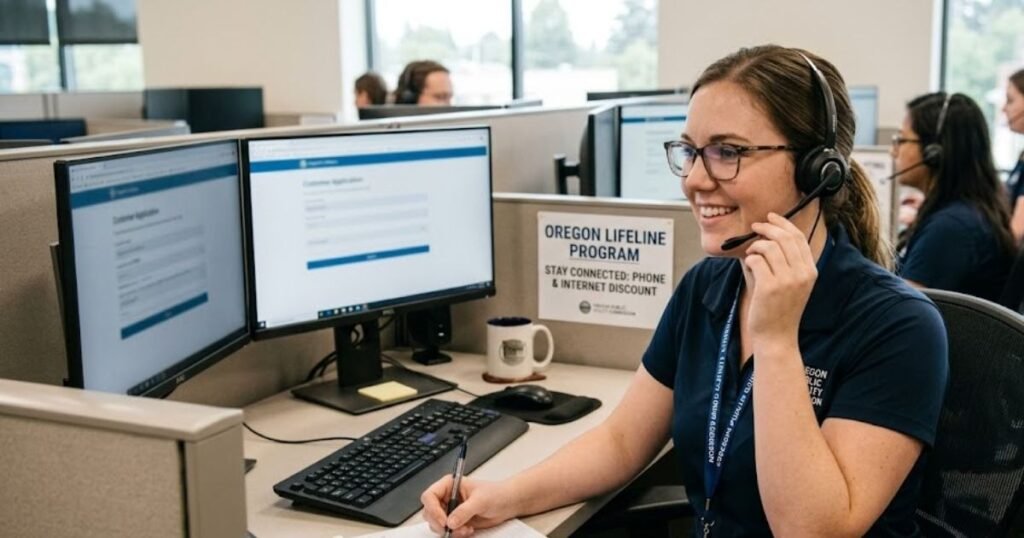
What Is the Oregon Lifeline Program?
Oregon Lifeline is a joint federal-state benefit. The federal piece comes from the FCC’s national Lifeline program, funded through the Universal Service Fund. Oregon adds its own state-level support on top of that through the Residential Service Protection Fund, which is why Oregon’s discounts tend to be more generous than the bare federal minimum offered in some other states.
In plain terms, the program does one of three things for an eligible household:
- Knocks a set dollar amount off a monthly phone bill
- Knocks a set dollar amount off a monthly high-speed internet bill
- Provides free wireless voice and data service through a participating carrier, if you don’t already have phone or internet service
You choose one of these paths the program is not stackable, and it’s limited to one benefit per household, not per person.
READ MORE: Can I Get a Free iPhone With Food Stamps? Complete Guide
Oregon Lifeline Benefits
Here’s a snapshot of what the program currently offers, based on the Oregon PUC’s published program details:
| Benefit | Description |
| Monthly phone discount | Discount off a landline or wireless phone bill through a participating provider |
| Monthly internet discount | Discount off a qualifying high-speed internet bill |
| Free wireless service | Free voice minutes and data through Access Wireless, Oregon’s designated free-service provider, for households that don’t currently have phone service |
| Tribal Lifeline | An additional monthly discount for residents of federally recognized Tribal lands, on top of the standard Lifeline discount |
| Tribal Link Up | A one-time discount on the cost of activating or installing phone service, plus an interest-free deferred payment option, for qualifying Tribal residents |
| One benefit per household | Only one person per household may receive Lifeline — either the phone discount, the internet discount, or free service, not more than one at a time |
Discount amounts are set by the PUC and can change, so always confirm the current figure on the Oregon PUC Lifeline page or with your provider before applying. As of this writing, the phone discount and internet discount are both meaningful monthly reductions often in the $20-plus range with an additional discount layered on for Tribal Lifeline participants.
Who Qualifies for Oregon Lifeline?
You must be at least 18 years old, and you (or someone in your household) generally need to qualify either through participation in a qualifying government assistance program or through household income.
Government Programs That Qualify You
You typically qualify automatically if you or someone in your household participates in one of these:
- Supplemental Nutrition Assistance Program (SNAP)
- Medicaid (Oregon Health Plan)
- Supplemental Security Income (SSI)
- Federal Public Housing Assistance
- Veterans or Survivors Pension Benefit
- Bureau of Indian Affairs General Assistance
- Tribal Temporary Assistance for Needy Families (TANF)
- Food Distribution Program on Indian Reservations
- Tribal Head Start (for households meeting the applicable income standard)
Of these, SNAP and Medicaid typically don’t require you to submit extra documentation with your application, since the state can often verify participation directly. The others generally do require supporting paperwork.
Income-Based Qualification
If you don’t participate in one of the programs above, you can still qualify if your total household income falls at or below 135% of the federal poverty guidelines for your household size.
A simple example: A single applicant with no other household members whose total annual income falls under the published threshold for a household of one would qualify on income alone, even without receiving SNAP, Medicaid, or another listed benefit as long as they can document that income.
READ MORE: Free Phones for Seniors on Medicare
Oregon Lifeline Income Limits (2026)
Income limits are tied to the federal poverty guidelines and are updated annually, typically each spring after the U.S. Department of Health and Human Services releases new figures. Here is the household income table currently published by the Oregon PUC:
| Household Size | Annual Income Limit (135% of Federal Poverty Guidelines) |
| 1 | $21,546 |
| 2 | $29,214 |
| 3 | $36,882 |
| 4 | $44,550 |
| 5 | $52,218 |
| 6 | $59,886 |
| 7 | $67,554 |
| 8 | $75,222 |
| Each additional person | Add $7,668 |
Important: These numbers change every year, and sometimes mid-year. Don’t rely on a screenshot or an old blog post verify the current table directly on the Oregon PUC’s website or by calling the Lifeline support line at 800-848-4442 before you submit an application based on income.
How to Apply for Oregon Lifeline
Applying isn’t complicated, but it does take a few steps and some patience while your application is processed.
- Check your eligibility. Confirm you qualify through a government program or through income, using the guidance above.
- Gather your documents. Have proof of program participation or income ready (see the next section).
- Choose a participating provider. Decide whether you want the phone discount, the internet discount, or free wireless service, and pick a provider that serves your ZIP code.
- Complete the application. Oregon Lifeline offers two separate applications depending on the path you’re taking — a Discounted Service Application for the phone or internet bill credit, and a Free Service Application for no-cost wireless service. Applicants can apply online or by mail, depending on the provider and service option chosen.
- Submit verification. If your qualifying program isn’t SNAP or Medicaid, attach the required supporting documents.
- Wait for approval. The Oregon PUC reviews the application to confirm eligibility and to make sure you’re not already receiving Lifeline benefits through another provider or household member.
- Activate your service. Once approved, your provider applies the discount to your account, or activates your free service line.
Processing times differ by path discounted service can take up to roughly two months to show up on a bill, while free wireless service approvals tend to move a bit faster. Build in some buffer time and don’t cancel any existing service until your new benefit is confirmed active.
READ MORE: Free Government iPhone: Eligibility, Providers & How to Apply
Documents You May Need
Depending on how you qualify, be ready to provide:
- A government-issued photo ID
- Proof of income (pay stubs, tax return, benefits statement)
- A benefit award letter from a qualifying program (SSI, VA pension, etc.)
- Proof of your Oregon residential address (not a P.O. box)
- Social Security documentation, if requested
- A completed Lifeline Household Worksheet, if the state can’t confirm you’re a separate economic unit from another Lifeline participant at the same address
Oregon Lifeline Participating Providers
Provider availability depends heavily on your ZIP code; a rural landline cooperative that serves one county may not operate anywhere near Portland, and vice versa. The Oregon PUC publishes a full list, which includes a broad mix of statewide carriers and small local providers such as:
| Type | Examples |
| National wireless | AT&T Mobility (call to confirm local availability) |
| Free wireless (Lifeline-only) | Access Wireless |
| Regional broadband/phone | CenturyLink, Ziply Fiber, Hunter Communications, Douglas Fast Net |
| Satellite internet | Viasat |
| Cable (select service areas) | Spectrum, in parts of Clatsop, Coos, Columbia, Jackson, Josephine, Lane, and Tillamook counties |
| Small local/rural telecoms | Beacon Broadband, Colton, DirectLink, Eagle, Molalla Communications, Peak Internet, Pioneer, Scio Mutual, and dozens of other community providers |
Because this list is updated periodically, use the PUC’s ZIP code lookup tool or call the applicable provider directly to confirm they currently offer the Lifeline discount at your address before you apply.
READ MORE: Best Medical Alert Systems for Seniors | Top Picks & Reviews
Can Seniors Get Oregon Lifeline?
Yes. Seniors are one of the largest groups the program is designed to help, and there are several common paths in:
- Medicaid enrollees (Oregon Health Plan) generally qualify without extra documentation.
- SSI recipients qualify, though documentation is typically required.
- Fixed-income retirees who aren’t on SSI or Medicaid can often still qualify through the income-based path if their total household income is under the applicable threshold.
- Veterans receiving a VA Pension or Survivors Pension benefit qualify with documentation.
- Disabled adults, whether receiving SSI, Medicaid, or another qualifying benefit, are also eligible.
Note that Medicare alone does not make you eligible Medicare is a health insurance program, not one of the qualifying benefit programs listed by the PUC. If a senior only has Medicare, they’d need to qualify through income or another program instead.
Oregon Lifeline for Internet Service
The internet discount works similarly to the phone discount: it’s applied directly to a qualifying broadband bill through a participating internet service provider. A few things to know:
- The discount applies to service that meets the FCC’s minimum broadband speed definitions for the Lifeline program.
- You can choose the internet discount instead of the phone discount, but not both remember, it’s one benefit per household.
- Participating ISPs vary widely by region, from major players like CenturyLink and Ziply Fiber to smaller regional cooperatives and satellite provider Viasat for households in areas without wired broadband access.
- Because ACP (discussed below) is no longer available, Lifeline is currently the primary ongoing federal-state internet affordability benefit for qualifying Oregon households.
Oregon Lifeline Free Phone Program
Access Wireless is currently Oregon’s designated free-service Lifeline provider. A few practical notes if you’re considering this path:
- Access Wireless no longer provides a free handset by default. Instead, eligible customers are typically offered a SIM card to activate in a compatible, unlocked phone they already own (Bring Your Own Device, or BYOD).
- If you don’t have a compatible unlocked phone, check with the provider about current low-cost device options, since offerings change.
- Free service typically includes a set amount of monthly voice minutes, texts, and data.
- Usage matters: to keep free Lifeline service active, you generally need to make a call, send a text, use data, or purchase additional minutes/data at least once every 30 days. Going 30 days with no activity puts your free service at risk of being canceled.
READ MORE: Best Health Tracking Smartwatch for Seniors— Top 8 Picks Compared
Tribal Lifeline Benefits
If you live on federally recognized Tribal lands in Oregon, you may qualify for extra support on top of standard Lifeline:
- Tribal Lifeline adds a monthly discount on top of the regular Lifeline benefit.
- Tribal Link Up provides a one-time discount on the cost of activating or installing wireline or wireless phone service, plus the option to pay any remaining balance on an interest-free deferred schedule.
- Not every phone company participates in Tribal Link Up, so check with your provider.
- You can generally use Tribal Link Up again only after moving to a new primary residence.
Oregon Lifeline Renewal (Annual Recertification)
Lifeline isn’t a one-time signup. To stay enrolled:
- You’ll generally need to recertify your eligibility once a year, either by responding to a form mailed to you or, in some cases, through automatic database verification.
- Missing the recertification deadline, or failing to respond to a request to verify your household status, can result in your benefit being canceled.
- If you’re on free service, remember the separate 30-day usage requirement discussed above recertification and usage are two different obligations, and either one being missed can end your benefit.
- Keep your mailing address current with both your provider and the PUC so you don’t miss renewal notices.
Common Reasons Applications Are Denied
A little preparation goes a long way. Applications are commonly rejected because of:
- Duplicate benefits — someone else in the household is already receiving Lifeline
- Missing documentation for a qualifying program that isn’t SNAP or Medicaid
- Income above the published limit for your household size
- Applying through a provider that doesn’t serve your address
- Incomplete applications, such as missing signatures or an unanswered required field
- Using a P.O. box as a residential address, which isn’t accepted for eligibility purposes
- Failing the Lifeline Household Worksheet requirement when the state can’t confirm you’re a separate economic unit from another applicant at the same address
READ MORE: Best 6 Anti Aging Supplements for Seniors: Reviews, Comparison & Buying Guide
Oregon Lifeline vs. ACP (Affordable Connectivity Program)
It’s worth clearing up a common point of confusion. The Affordable Connectivity Program (ACP) was a separate, larger federal internet subsidy that provided qualifying households up to $30 per month toward internet bills (more on Tribal lands), plus a one-time device discount. ACP ran out of congressional funding and officially ended on June 1, 2024. As of 2026, ACP is not accepting new applications, and no ongoing ACP discount is being issued, despite periodic legislative proposals to revive it.
Here’s the key difference: Lifeline is still active and ongoing. It’s a smaller monthly benefit than ACP was, and it only covers one service (phone or internet, not both), but it continues to accept new applications from eligible Oregon households. If you’re searching for “ACP application” in 2026, what you likely want is the still-operating Lifeline program instead.
Tips to Maximize Your Lifeline Benefits
- Compare participating providers in your ZIP code before committing — plans, coverage, and included data vary.
- Keep your documents current, especially income verification and benefit award letters, so recertification goes smoothly.
- Complete recertification on time every year to avoid a lapse in service.
- Use your free service regularly if you’re on the free wireless path, to avoid the 30-day inactivity cancellation.
- Notify your provider promptly after moving, since your address affects both provider availability and eligibility verification.
- Apply for only one benefit per household to avoid delays caused by duplicate-enrollment checks.
Common Mistakes to Avoid
- Applying through a provider that doesn’t actually serve your address
- Assuming Medicare alone qualifies you (it doesn’t — Medicaid does)
- Using a P.O. box as your residential address on the application
- Letting a qualifying benefit (like SSI documentation) expire before recertification
- Forgetting the free-service 30-day usage requirement
- Applying for both a phone and internet discount at once
- Missing the annual recertification deadline
- Submitting an application with unsigned sections or missing initials
- Relying on outdated income limit tables from old articles or expired flyers
- Not updating your address with your provider after moving
- Assuming ACP is still available and applying for it instead of Lifeline
- Two household members applying separately without completing a required Household Worksheet
Frequently Asked Questions
What is the Oregon Lifeline Program?
It’s a federal-state benefit administered by the Oregon Public Utility Commission that provides a monthly discount on phone or internet service, or free wireless service, to qualifying low-income Oregon households.
Who qualifies for Oregon Lifeline?
Adults who participate in a qualifying program like SNAP, Medicaid, SSI, or a VA pension, or whose total household income is at or below 135% of the federal poverty guidelines for their household size.
How do I apply for Oregon Lifeline?
Choose either the Discounted Service Application or the Free Service Application through the Oregon PUC, select a participating provider in your area, and submit any required documentation. Applications can be completed online or by mail.
Can seniors receive free phone service through Oregon Lifeline?
Yes, seniors who qualify through Medicaid, SSI, income limits, or a veterans pension can apply for free wireless service through Access Wireless, Oregon’s designated free-service provider.
Which internet providers participate in Oregon Lifeline?
Participation varies by ZIP code, but current participants include CenturyLink, Ziply Fiber, Hunter Communications, Viasat, Spectrum in select counties, and numerous smaller regional broadband cooperatives across the state.
Final Thoughts
The Oregon Lifeline Program exists for exactly the situation a lot of households find themselves in: needing reliable phone or internet access on a tight budget. Whether you qualify through SNAP, Medicaid, SSI, veterans benefits, or simply your household income, the application process is straightforward once you know which documents to gather and which local provider actually serves your address.
Because income limits, discount amounts, and the list of participating providers are all subject to change, treat this guide as a starting point rather than the final word — confirm the current details directly with the Oregon Public Utility Commission (800-848-4442) or on the official Oregon Lifeline webpage before you apply.