As the dementia deteriorates, it becomes difficult for older people to be associated with their loved ones. Mobile phones may become a valuable lifeline for contact, safety and reassurance if they are well selected. But with choosing the appropriate gear, with use and protection features -readily considering work that accommodates the needs of cognitively rejected people.
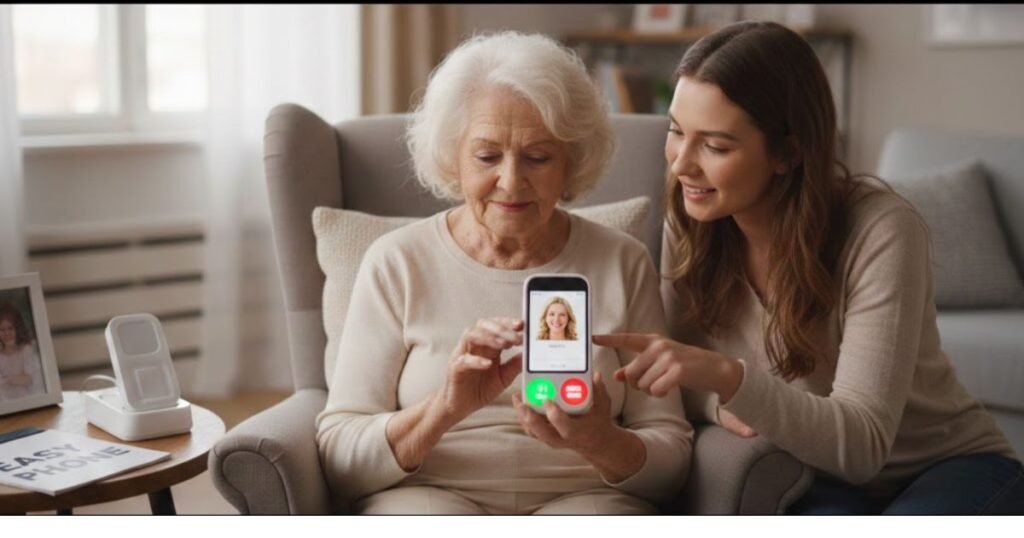
Key Features to Look For Cell Phones For Seniors With Dementia
Simple to use interface: A big button mobile phone with a smooth performance and minimal navigation options reduces disorientation.
Emergency button: An independent SOS button for instant access to assistance in emergency situations.
Speed Dial and Voice Command: Pre-stored numbers and voice commands can ease communication.
GPS Tracking & Remote Monitoring: Certain phones let caregivers track position and have remote access to adjust settings.
Durability & Long Battery Life: A ruggedly constructed phone with a long-lasting battery promotes infrequent charging and repairs.
Hearing Aid Compatibility: Clear sound and hearing aid compatibility facilitate communication.
Limited or Customizable Features: Some devices can disable unused apps and reduce distractions.
READ MORE: Best Landline Phone Service for Seniors (2026) | Plans, Costs & Reviews
Recommended Cell Phones For Seniors With Dementia
1. LIVELY Jitterbug Smart4: The Ideal Smartphone for Seniors
The newest smartphone in Lively’s lineup for seniors is the LIVELY Jitterbug Smart4. It is designed with ease of use in mind, featuring a simplified interface, large buttons, and accessibility features designed for older adults.
It features a large display, simplicity of navigation, and voice assistance to make sure that older adult users stay connected effortlessly. Unlike other phones which may confuse older users, Smart4 has a simple menu layout that is easy to use for calling, texting and surfing.
Major Jitterbug Smart4 Features:
- Colossal Screen with an Easy-to-Use Interface-The Smart4 has an excellent readable display and a user-friendly menu structure.
- Voice Assistance and Hearing Aid Compatibility-It is M4/T4 hearing aid compatible and responds to voice commands.
- It also has an Emergency Response Button-direct access to the emergency response service provided by Lively.
- The improved longevity of battery life and an all-day power supply.
- Affordable Plans-There are no long-term commitments, and plans can fill gaps between flexible data, talk, and texting.
- Lively Health & Safety Services-Access including urgent care and caregiver support.
Pros & Cons of the LIVELY Jitterbug Smart4:
| Pros | Cons |
| Easy-to-use interface | Limited advanced features |
| Large, clear display | Slower performance |
| Urgent Response button | No high-quality camera |
| Hearing aid compatible (M4/T4) | Locked to Lively network |
| Voice assistance support | No 5G support |
| Long battery life | Limited app selection |
| Affordable, no-contract plans | Not water-resistant |
| Health & safety services | No wireless char |
2. AT&T BL102-2 DECT 6.0 Cordless Phone: A Reliable Home Phone System
Cordless home phones are still a basic gadget for many households, especially for the customers who would prefer obtaining clear call connections, dependability, and convenience. For consumers who desire having an expandable home phone that is filled with features and easy to handle, AT & T BL102-2 deck 6.0 cordless telephone is one of the best options.
Key Features of the AT&T BL102-2:
- DECT 6.0 Technology
One of the latest handsets, the BL102-2, runs on the DECT 6.0 standard which is meant to provide improved quality audio, lower interference and be safer than previous generations of cordless telephones.
- Some Call Blocking & Smart Features
Robocall Blocker: Blocks even up to 1,000 unwanted numbers and detects spam calls.
Talking Caller ID: Announces who is calling to you so you can screen your calls more easily.
Answering System : Integrated digital answering machine, up to 22 minutes recording time.
- User-Friendly Design
Keyboards and lighted screens are big, which also offer great reading as well as navigation even with inadequate illumination from a dim environment. Moreover, disposable system-They support up to five handsets, which are great for big homes. The speakerphone feature allows to talk loudly as well as with clear voices to talk without hands. Moreover, supports multiple handsets.
- Battery Backup & Range
Exceptionally Long Battery Life: Long talk time and standby duration. Extended Range: Strong coverage throughout a house provided by DECT 6.0.
Pros & Cons:
| Pros | Cons |
| Excellent call quality (DECT 6.0) | No Bluetooth or smartphone connectivity |
| Blocks up to 1,000 robocalls | Limited answering machine storage (22 min) |
| Expandable to 5 handsets | No color display |
| Talking Caller ID & large keypad | Lacks advanced smart features |
| Good battery life & range | Basic design (not modern-looking) |
READ MORE: Best Affordable Hearing Aids Review
3. VTech SN5147
Finding a suitable and reliable phone with amplified sound and call blocking features becomes an urgent task for seniors and people with hearing impairment. The VTech SN5147 is especially designed to enhance the clarity of any call made through it. It is a home phone system that takes care of volume rendering so that hearing impaired can have the necessary base requirements fulfilled. It has visual call alerts and simple controls, all meant for easy usage.
Key Features of the VTech SN5147:
- Loud & Clear Audio-a 50dB volume boost for calls, with an additional extra loud 90dB ringer that has a flashing light.
- Corded & Cordless Combo: A corded base with a cordless handset, expandable by 4 handsets.
- Call Blocking-up to 1,000 unwanted numbers blocked with a dedicated button.
- Talking Caller ID-an announcement of who is calling makes screening easy.
- Message Storage in an Answering Machine- Stores message records for up to 22 minutes. User Design-Friendly- Feature includes large buttons, a backlit display, and easy navigation.
Pros & Cons:
| Pros | Cons |
| Extra-loud 90dB ringer & 50dB volume boost | No Bluetooth or smartphone connectivity |
| Call blocking for up to 1,000 numbers | Basic answering machine (22 min storage) |
| Both corded and cordless options | Corded base limits placement options |
| Talking Caller ID & visual ring indicator | Handset range may be limited in large homes |
| Easy-to-use large buttons & backlit display | Lacks modern smart features like app integration |
4. Panasonic KX-TGU432W
Panasonic KX-TGU432W is a cordless phone system that is designed with comfort and ease of use, hence becoming the perfect phone for seniors and lovers of large buttons, who love an easy-to-read performance and excellent sound. This phone includes two cordless handsets, call blocking, and a built-in flashlight for convenience and accessibility.
Key Features of the Panasonic KX-TGU432W:
- It features a user-friendly display and large buttons: the large backlit screen and oversized buttons for effortless dialing.
- There is a flashing key on favorites for one-touch illuminated speed dial calling to important contacts.
- It has a built-in flashlight that helps with navigation in the dark; thus, making it quite convenient.
- Call Blocking: blocks as many as 150 nuisance numbers cutting down on robocalls and spam.
- Crystal Clear Voice and Loudness Boost: Voice Sound Clear, and Loud Control can provide clear call.
- Talking Caller ID: The name of the collar has been announced and it is very easy to see who is calling next.
- Two wireless handsets are included as an expandable system for flexibility in home use.
Pros & Cons:
| Pros | Cons |
| Large buttons & easy-to-read display | Limited call-blocking capacity (150 numbers) |
| Flashing speed dial key for quick access | No answering machine |
| Built-in flashlight for added convenience | No Bluetooth or smartphone connectivity |
| Talking Caller ID for hands-free call screening | Not expandable beyond two handsets |
| Volume boost for improved hearing | Basic design, lacks advanced smart features |
READ MORE: 10 Best Hearing Aids in 2026 | Reviews, Prices & Buyer Guide
5. Jitterbug Flip2 from Lively
The Jitterbug Flip2 has been introduced by Lively. The phone is purposely designed for the older people and the stupid heads who use it, that’s its design. It has huge buttons, a bright screen, a very powerful speaker, and emergency features, which means it works and makes you feel safe.
Key Features of the Jitterbug Flip2:
- Effortless set-up – Having large and well-spaced buttons with bright, well-lit screens make dialing and texting easier for users.
- Amazon Alexa ready: Thus, provides all voice commands with the capability to search for hand-free calling, texting and info.
- Position the instant response button – a click of a button opens an emergency assistance of 24 hours a day, 7 days a week.
- For the clear and powerful audio – T4/M4 compatibility, excellent emphasis for speakers gives more clarification in the call.
- Long Battery Life – Phone is able to last longer over time with minimal charging time.
- Inside Camera – An 8 MP camera is easy to take and share.
- Affordable plans without contracts- Various talk and text plans are flexible with no long-term commitments.
Pros & Cons:
| Pros | Cons |
| Large buttons & bright display | No internet browsing or apps |
| Amazon Alexa for voice commands | Basic camera, not for high-quality photos |
| Urgent Response button for emergencies | No touchscreen |
| Hearing aid compatible (M4/T4) | Limited storage for photos & messages |
| Loud speaker & clear call quality | Not ideal for tech-savvy users |
| Long battery life | Locked to Lively network |
Device Safety for Elderly Patients Dealing with Dementia
Fall Detection: Telephones that alert emergency responders when falls are detected.
Tracking Location: Devices that allow tracking the location of an older person, using GPS satellites.
Day and Night Monitoring Services: Telephones that have communication with a monitoring center for action during emergencies.
The Role of Caregivers in Adapting or Customizing Cell Phones for Seniors with Dementia
- How caregivers adapt the setting and configure everything for an elder resident.
- Training and familiarizing the elder to the use of phones.
- Set up reminders and alerts for medication and appointments.
Solutions to Anticipated Challenges
Trying to tackle the problem caused by loss of memory in using the telephone through cognitive limitations.
Technological overload i.e. Not overwhelming senior citizens with too many features.
Loss or Misplacement Solutions for tracking the phone: e.g., lanyards, trackers.
READ MORE: Jabra Enhance Hearing Aids Reviews | Features, Pricing & Pros
Final Verdict:
In the case of seniors suffering from dementia, the right cell phone can add to their quality of living by serving on two important fronts: communication and safety. Caregivers need to prioritize ease of use, safety options, and connectivity while selecting this device. If cleverly designed, technology can facilitate the intersection of independence and caregiving.
FAQs
1. What are the best cell phones for seniors with dementia?
Look for phones with big buttons or a simplified touchscreen, loud speakers, an easy-to-read display, GPS tracking, SOS/emergency call buttons, and strong battery life. Brands and models marketed as “senior phones” or basic smartphones with caregiver apps are common choices.
2. Can a cell phone help keep a senior with dementia safe?
Yes — phones with GPS location, an SOS/emergency button, automatic fall-detection features (on some devices), and caregiver-monitoring apps can improve safety and provide peace of mind. Remember to balance safety with the person’s comfort and privacy.
3. How do I set up a phone for a senior with dementia?
Simplify the home screen, enlarge text/icons, disable unnecessary apps and notifications, add emergency contacts, enable location sharing and SOS features, and set up any caregiver-access apps. Choose a plan with reliable coverage and consider a phone case that’s easy to grip.
4. Are there simple or flip phones good for dementia patients?
Yes — many flip or large-button phones are easier to use than full smartphones. Some include GPS, one-touch emergency dialing, and simplified menus designed for seniors who prefer minimal features.
5. Can family members remotely monitor or manage a senior’s phone?
Yes. Several apps and services let caregivers locate a device, see battery status, share emergency alerts, or remotely manage settings. Always get consent where possible and discuss privacy with the senior and other family members before enabling remote access.