Giving up the car keys is one of the most difficult transitions for many older adults. When driving is no longer safe or possible, maintaining independence can suddenly feel like a daily struggle. How will you get to your doctor’s appointments? How will you buy groceries? How can you stay connected with friends and your local community?
If you or a loved one are facing these questions, you are not alone. Transportation is one of the most common challenges for older Americans. Fortunately, there are many local, state, and federal programs designed to help.
While there is no single nationwide program that automatically gives every senior a free ride whenever they want, free transportation for seniors is absolutely available through a patchwork of different community resources.
In this comprehensive guide, we will walk you through exactly how to find reliable, safe, and affordable transportation. You will learn about government programs, local senior transportation, Medicaid options, paratransit, volunteer driver networks, and exactly how to find the right programs in your specific community. Lets deep dive into “Free Transportation for Seniors: Find Free & Low-Cost Rides”
READ MORE: Best Lightweight Transport Wheelchair for Seniors: Reviews & Comparison
Is Free Transportation Really Available for Seniors?
The straightforward answer is: Yes, free transportation for seniors exists, but it depends heavily on where you live and your specific circumstances.
It is important to know right away that not every older adult will automatically qualify for free rides just by reaching a certain age. The landscape of senior transportation is local. Here is what you need to understand before you start looking:
- Some programs are completely free. These are often funded by local charities, grants, or specific government programs.
- Others charge a very small fare. You might see “suggested donations” of $1 or $2 per ride.
- Medical trips are prioritized. Free rides to medical appointments for seniors are much easier to find than free rides for social outings or errands.
- Eligibility varies. Some programs base their services strictly on age, while others look at income, disability status, or whether you live in a specific city or county limit.
- Advance planning is required. Very few free programs offer on-demand, same-day taxi service. Most require you to book days or even weeks in advance.
The key to finding free rides for seniors is knowing where to look and who to ask. Let’s break down the best options available across the United States.
REDA MORE: Grants for Wheelchair Accessible Vehicles in the USA | Eligibility & How to Apply
10+ Ways Seniors Can Get Free or Low-Cost Transportation
If you are looking for transportation assistance for seniors, you should explore multiple avenues. Here are the ten best ways older adults can access affordable rides.
1. Area Agencies on Aging (AAA)
One of your very first stops should be your local Area Agency on Aging (AAA). Established under the Older Americans Act, AAAs are public or nonprofit agencies designated to address the needs of older adults at the local level.
There are over 600 AAAs across the country, and one of their primary goals is to help seniors live independently. While the AAA itself might not own a fleet of buses, they act as the ultimate local directory. They coordinate, fund, or can connect you directly with local senior transportation programs in your county. Because AAA services are localized, the exact programs they offer will vary, but they are always the best local starting point.
2. Eldercare Locator
If you don’t know how to find your local Area Agency on Aging, the Eldercare Locator is your answer.
The Eldercare Locator is a free public service provided by the U.S. Administration for Community Living (ACL). It is a trustworthy, federally funded database designed specifically to connect older adults and their caregivers with local support resources including transportation.
You can visit their website, but they also have a highly helpful, human-staffed toll-free number. Simply call 1-800-677-1116 during their operating hours, tell the representative your zip code, and state that you are looking for local senior transportation. They will point you directly to the organizations in your community that can help.
3. Medicaid Non-Emergency Medical Transportation (NEMT)
If you or your loved one are eligible for Medicaid, you may have access to a highly valuable benefit called Non-Emergency Medical Transportation (NEMT).
NEMT provides free transportation for low-income seniors to and from covered medical appointments. This is completely different from emergency transportation (like an ambulance when you call 911). NEMT uses taxis, specialized vans, or public transit passes to help beneficiaries get to doctor visits, physical therapy, dialysis, or the pharmacy.
It is important to note that Medicaid NEMT is strictly for medical needs; you cannot use it to go to the grocery store. Furthermore, NEMT is tied to Medicaid eligibility, not age. Because Medicaid is managed jointly by the state and federal government, the rules, ride limits, and contracted transportation companies differ from state to state. You must contact your state’s Medicaid agency to ask how to schedule NEMT rides.
4. Medicare Transportation Benefits
There is a massive misconception regarding Medicare and transportation. Original Medicare (Parts A and B) generally does NOT provide unlimited free rides for routine doctor visits or errands simply because someone is 65 or older. Original Medicare primarily covers emergency ambulance transportation when your health is in serious danger.
However, if you have a Medicare Advantage (Part C) plan, you might be in luck. Because private insurance companies run Medicare Advantage plans, they often offer supplemental benefits that Original Medicare does not. Today, many Medicare Advantage plans include transportation benefits, offering a set number of free rides to medical appointments or pharmacies per year.
If you have a Medicare Advantage plan, pull out your current “Evidence of Coverage” booklet or call the customer service number on the back of your insurance card to ask if you have a transportation benefit.
5. Local Senior Shuttle Programs
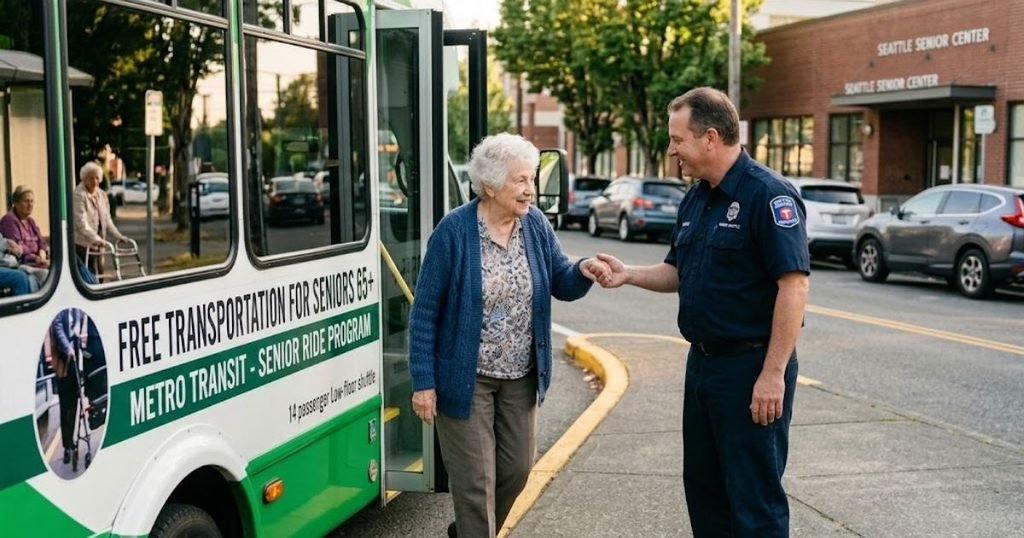
Many cities, counties, and local parks and recreation departments operate specific senior shuttle services. These are often small, wheelchair-accessible buses that serve the local community.
These programs take many forms:
- Door-to-door rides: The shuttle picks you up at your home and drops you at your destination.
- Demand-response transportation: You call ahead to schedule a ride anywhere within the city limits.
- Fixed-route shuttles: The bus runs a specific loop, often stopping at major senior living communities, local grocery stores, pharmacies, and the senior center.
Fares for these shuttles are usually heavily subsidized by local taxes, meaning rides are either completely free or cost just a dollar or two.
6. Paratransit Services
If a senior has a disability that prevents them from using standard public public transportation (like a regular city bus), they may qualify for paratransit.
Under the Americans with Disabilities Act (ADA), public transit agencies must provide a complementary paratransit service for eligible individuals. Paratransit for seniors generally provides shared-ride, door-to-door, or curb-to-curb service in accessible vans.
Important note: Paratransit is based on disability and mobility limitations, not simply being older. To use paratransit, you typically must fill out an application and have your doctor verify that your health or mobility prevents you from navigating regular bus routes. Paratransit is usually not entirely free, but by law, the fare cannot be more than twice the regular fixed-route bus fare.
7. Volunteer Driver Programs
Across the USA, there are incredible networks of volunteer transportation for seniors. These programs are usually run by nonprofit organizations, faith-based groups, or community networks (such as “Village” movement organizations).
In these programs, vetted and background-checked volunteers use their own private vehicles to drive older adults where they need to go. They often provide rides to doctor visits, grocery shopping, the bank, or religious services. Because they are driven by volunteers, these services are incredibly warm and personal, but their availability depends entirely on how many volunteers are working that day. Most require a few days of advance notice to match you with a driver.
8. Public Transit Senior Discounts and Reduced Fares
If you are still mobile enough to walk to a bus stop or train station safely, traditional public transit is an excellent option.
Any transit agency that receives federal funding from the Federal Transit Administration (FTA) is required to offer half-price fares (or less) to seniors and people with disabilities during off-peak hours. Many transit agencies go further than the federal requirement. Some cities offer a special senior transit card that allows older adults to ride local buses and subways completely for free, while others offer deeply discounted monthly passes.
Contact your local transit authority and ask how to apply for a senior citizen transportation card.
9. Nonprofit and Community Organizations
Various charitable organizations offer transportation services for elderly community members, though they usually focus on specific needs.
- Cancer Societies: Organizations like the American Cancer Society often have programs (like the Road To Recovery) to drive patients to cancer-related treatments.
- Veterans Organizations: Groups like Disabled American Veterans (DAV) run extensive transportation networks taking older veterans to VA medical centers.
- Community Action Agencies: These local organizations help low-income families and seniors, sometimes providing free transit passes or gas vouchers.
10. Transportation Programs for Rural Seniors
Finding free senior transportation in rural areas is exceptionally challenging because fixed-route buses don’t exist in the country. However, many rural counties operate demand-response transit or “dial-a-ride” programs.
In these programs, the county dispatches a van to pick up residents at their rural homes and brings them into town for shopping or medical care. Some rural areas also rely heavily on volunteer driver programs coordinated by local churches or rural Aging and Disability Resource Centers. If you live in a rural community, your best bet is to call your county government office or the Eldercare Locator.
READ MORE: Habitat For Safe Seniors Free Ramp Program (Eligibility & How to Apply)
Free Transportation for Seniors to Medical Appointments
When families search for “free transportation to doctor appointments for seniors,” they are usually dealing with an urgent healthcare need. Missing a doctor’s appointment because of a lack of a ride can lead to severe health complications.
If you specifically need a ride to a medical appointment, you should prioritize these resources in this order:
- Medicaid NEMT: If the senior has Medicaid, call the state Medicaid number immediately.
- Medicare Advantage: Check the senior’s private Medicare plan for ride benefits.
- Disease-Specific Charities: If the appointment is for a specific condition (like cancer or kidney dialysis), search for local chapters of national charities related to that disease.
- Volunteer Driver Programs & AAAs: Contact the local Area Agency on Aging for a list of volunteer medical drivers.
What you need to book a medical ride:
When you call to arrange a ride, have the following information written down and ready:
- Exact appointment date and time
- The doctor’s name and the exact pickup/drop-off address
- Expected duration of the appointment (for the return trip)
- The senior’s mobility needs (Do they use a wheelchair? A walker?)
- Whether a caregiver or escort will be riding along
- Insurance or program ID numbers
Emphasize to the senior or caregiver that medical rides should be booked as soon as the doctor’s appointment is made. Do not wait until the day before.
How to Find Free Transportation for Seniors Near Me
Searching for “free transportation for seniors near me” on Google can sometimes yield confusing results, bringing up expensive private medical taxi companies instead of free community programs. To cut through the noise, follow this exact step-by-step process.
Step 1: Contact the Eldercare Locator
Call 1-800-677-1116 or visit eldercare.acl.gov. This is the fastest, safest way to get legitimate, non-commercial phone numbers for resources in your specific zip code.
Step 2: Find the Local Area Agency on Aging
Once you have the number for your AAA, call them. Say, “I am looking for affordable or free transportation programs for an older adult who needs to get to the grocery store and doctor. Can you tell me what programs operate in our county?”
Step 3: Contact the Local Transit Agency
Look up your city or county’s public bus or transit system. Call their customer service line and ask two specific questions: “What is your senior discount program?” and “How do I apply for ADA paratransit services?”
Step 4: Check Medicaid Eligibility
If the senior’s income is limited, check if they are enrolled in Medicaid. If they are, find the state’s Medicaid transportation phone number on their official website or the back of their Medicaid card.
Step 5: Check Medicare Advantage Benefits
Look at the senior’s health insurance card. If it says “Medicare Advantage” (or lists a private company like Humana, Aetna, UnitedHealthcare, etc.), call the member services number on the back and ask, “Does this plan include a non-emergency transportation benefit?”
Step 6: Ask Local Senior Centers
Senior center directors are deeply plugged into the local aging community. They often know about local church vans, small neighborhood nonprofits, or volunteer networks that might not show up on a general internet search.
READ MORE: Free Roof Repair Grants for Seniors: USA Guide
Who Qualifies for Free Senior Transportation?
Eligibility is the biggest hurdle when looking for free rides for elderly individuals. Because programs are funded differently, their rules differ. Here is a general guide to the factors that determine if you qualify:
| Eligibility Factor | Why It May Matter |
| Age | Some programs have strict minimum age requirements (often 60 or 65). |
| Income | Certain assistance programs, like Medicaid or community action grants, are income-based. |
| Disability | May qualify someone for accessible transportation or paratransit, regardless of age. |
| Medicaid enrollment | May provide access to qualifying non-emergency medical transportation (NEMT). |
| Medicare Advantage plan | Some private MA plans include specific transportation benefits in their annual contracts. |
| Location | Programs are often funded by city or county taxes and require you to live within specific borders. |
| Medical need | Some services are strictly limited to medical trips and will not take you to social events. |
| Mobility limitations | Using a wheelchair or walker may affect which vehicles can safely transport you. |
| Residency | Some local shuttle programs require proof of residence in a specific town or service area. |
(Note: This is a general guide. Always verify the exact eligibility rules directly with the local program.)
Do Seniors Have to Be 65 to Get Free Transportation?
A very common question is whether you have to wait until you are 65 to get senior transit benefits. The answer is no, you do not always have to be 65.
The age of eligibility varies wildly depending on the program:
- Age 60: Programs funded by the federal Older Americans Act (which trickles down to Area Agencies on Aging) typically set their senior threshold at age 60.
- Age 62 to 65: Many public transit agencies set their reduced senior fare age at either 62 or 65.
- Any Age: If you are seeking paratransit due to a disability, or NEMT through Medicaid, age is not the deciding factor. A 55-year-old with a qualifying disability or income level can access these services.
Do not assume that being under 65 disqualifies you from transportation assistance.
READ MORE: Best 5 Electric Lift Chair for Elderly: Reviews & Comparison
Can Low-Income Seniors Get Free Transportation?
Yes, low-income seniors often have the most options for completely free transportation. If finances are tight, a senior citizen should immediately look into Medicaid. As discussed earlier, Medicaid offers comprehensive medical transportation.
Beyond Medicaid, low-income seniors may qualify for:
- Free public transit passes distributed by local community action agencies.
- Sliding-scale fee programs offered by Area Agencies on Aging (where lower-income seniors pay nothing, while higher-income seniors pay a small fee).
- Assistance from local charities, such as St. Vincent de Paul or the Salvation Army, which sometimes provide gas cards, bus tokens, or taxi vouchers to those in financial distress.
Free Transportation for Seniors With Disabilities
Seniors who use mobility devices such as wheelchairs, motorized scooters, walkers, or canes face an extra layer of difficulty. Not every volunteer driver’s Honda Civic can fit a wheelchair.
When looking for transportation for disabled seniors, ADA Paratransit is the gold standard. These programs use specialized vans equipped with hydraulic wheelchair lifts and heavy-duty tie-downs. The drivers are specially trained to assist passengers with mobility issues from the curb into the vehicle.
When arranging a ride for a senior with a disability, you must be incredibly clear about their needs. Ask the provider:
- Does the vehicle have a wheelchair lift or ramp?
- Can the driver help the senior from the front door to the vehicle (door-to-door), or do they only pick up at the curb (curb-to-curb)?
- Can the senior bring a Personal Care Attendant (PCA) with them for free? (Under ADA rules, if you require a PCA, they usually ride for free).
What to Ask Before Booking a Free Senior Ride
Because senior transportation programs operate with different rules, asking the right questions before you book can prevent missed appointments and major frustrations. Use this practical checklist:
- Is the ride completely free, or is there a required fare or suggested donation?
- Who qualifies for this service, and do I need to apply or register first?
- How far in advance must I book my ride? (24 hours? A week?)
- Where exactly will the vehicle pick me up?
- Is door-to-door service available, or must I wait at the curb?
- Can I bring a caregiver, family member, or companion with me?
- Can the vehicle safely accommodate my specific wheelchair or walker?
- How do I schedule my return trip? Will the driver wait for me?
- What happens if my doctor’s appointment runs late?
- Are rides limited only to medical appointments, or can I go to the grocery store?
- Is there a waiting list to join the program?
- What is the cancellation policy if I get sick?
Free Transportation vs. Low-Cost Transportation for Seniors
Understanding the difference between completely free programs and low-cost subsidized programs will help you budget and plan.
| Option | May Be Free? | Typical Purpose | Eligibility |
| AAA transportation | Sometimes | Medical/general trips | Varies locally |
| Medicaid NEMT | Often for qualifying covered trips | Medical | Medicaid eligibility/rules |
| Medicare Advantage transportation | Plan-dependent | Often medical/health-related | Plan-specific |
| Paratransit | Usually low-cost or subsidized | Accessible transportation | Disability-based eligibility |
| Senior shuttle | Sometimes | Local trips | Location/program dependent |
| Volunteer rides | Often free | Medical/essential trips | Program-specific |
| Public transit | Sometimes discounted | General travel | Transit-system rules |
How to Apply for Senior Transportation Assistance
While some volunteer programs allow you to call and get a ride the same week, most official government or transit agency programs require a formal application process.
To ensure the process goes smoothly, gather the necessary documentation ahead of time. Depending on the program, seniors may need to provide:
- Proof of age: A driver’s license, state ID, birth certificate, or passport.
- Proof of residency: A recent utility bill or lease agreement showing they live in the service area.
- Identification: A government-issued photo ID.
- Income information: Social Security award letters or bank statements (if applying for low-income assistance).
- Medicaid/Medicare information: The actual insurance cards.
- Disability documentation: For paratransit, you will almost always need a doctor to fill out a medical verification form explaining why the senior cannot use standard public transit.
Expect the eligibility assessment to take anywhere from a few days to a few weeks, especially for ADA paratransit.
Common Mistakes Seniors Should Avoid
When navigating transportation services for elderly adults, there are a few common pitfalls that can leave you stranded. Keep these practical warnings in mind:
- Assuming Original Medicare pays for every senior ride: It does not. Don’t call a taxi expecting Medicare Part B to reimburse you.
- Assuming every senior automatically qualifies for free transportation: Resources are limited; age alone doesn’t guarantee a free private car.
- Waiting until the day of an appointment to arrange a ride: Most community and volunteer programs require 3 to 7 days of advance notice.
- Forgetting to ask about wheelchair accessibility: Never assume a vehicle is accessible unless you specifically request it.
- Not confirming the return ride: Getting to the doctor is only half the battle. Make sure you understand how the return trip is triggered (e.g., does the driver wait, or do you call a dispatcher when you are done?).
- Paying a third party without verifying the organization: Unfortunately, scams exist. Never pay an upfront “registration fee” to an internet company without verifying them through your local AAA.
- Assuming a program available in one county operates in another: County lines matter. If you move across town, your transit eligibility might change.
- Ignoring reduced-fare options because they aren’t totally free: A $1.50 paratransit ride is still incredibly valuable compared to a $40 private medical taxi.
How Caregivers Can Help Seniors Find Transportation
If you are an adult child or caregiver helping a senior, your organizational skills are invaluable. Losing the ability to drive can cause seniors to feel a profound loss of dignity and independence. Caregivers should approach this transition with patience and respect.
Here is how caregivers can step in and help effectively:
- Identify local programs: Do the heavy lifting of researching. Call the Eldercare Locator and local transit agencies while your loved one is resting.
- Help complete applications: Paratransit applications can be long and require doctor signatures. Manage the paperwork and faxing.
- Keep phone numbers organized: Create a large-print “Transportation Cheat Sheet” to place on the senior’s refrigerator, listing the names, phone numbers, and hours of local ride programs.
- Schedule rides in advance: Take over the task of calling dispatchers as soon as medical appointments are booked.
- Confirm pickup times: Call the provider the day before the ride to confirm the time and address.
- Ask about accessibility: Always advocate for your loved one’s mobility needs.
- Keep backup options: Community transportation is great, but vans break down and volunteers get sick. Always have a backup plan, even if it means budgeting for an occasional rideshare (like Uber or Lyft) or a private medical transport.
Best Places to Start if You Need a Free Ride Today
If you are reading this because you need a ride today, the reality is that same-day free transportation is very difficult to find. Most formalized programs require pre-registration and advance booking.
However, if you are in a bind, here is the most realistic action plan for immediate help:
- Call the Eldercare Locator (1-800-677-1116): Ask if they know of any emergency or same-day senior transit options in your zip code.
- Check with their Medicare Advantage plan: If they have a plan with a ride benefit, see if they partner with on-demand rideshare services.
- Call the local Senior Center or their local place of worship: Sometimes a church pastor or senior center director can connect you with a community volunteer in an emergency.
- Local Transit: If they are physically able to take a regular city bus, check if the city has a free fare policy for seniors showing an ID.
(Note: If it is a medical emergency, call 911. Do not wait for community transportation.)
Frequently Asked Questions
How can seniors get free transportation?
Seniors can get free or low-cost transportation by utilizing local Area Agencies on Aging, Medicaid Non-Emergency Medical Transportation (NEMT), volunteer driver programs, local senior shuttles, and specific Medicare Advantage plans. Because availability is highly localized, seniors should start by calling the Eldercare Locator to find out exactly what is offered in their specific zip code.
Does Medicare pay for transportation for seniors?
Original Medicare (Parts A and B) generally does not pay for routine transportation to doctor appointments or grocery stores; it only covers emergency ambulance rides. However, many private Medicare Advantage (Part C) plans now include supplemental benefits that offer a set number of free rides to medical appointments or pharmacies. You must check your specific plan details.
Does Medicaid provide free transportation for seniors?
Yes, if a senior is eligible for Medicaid, they typically qualify for Medicaid Non-Emergency Medical Transportation (NEMT). This program provides free rides to and from Medicaid-covered medical appointments. However, rules, ride limits, and booking procedures differ by state, so beneficiaries must contact their state Medicaid office to arrange travel.
How can I find free transportation for seniors near me?
The most reliable way to find legitimate, local transportation programs is to contact your local Area Agency on Aging. You can find their direct phone number by calling the federally funded Eldercare Locator at 1-800-677-1116. You can also check with your local public transit agency, senior centers, and county health departments.
What transportation is available for seniors who no longer drive?
Seniors who have stopped driving have several options, including ADA paratransit (for those with qualifying mobility disabilities), door-to-door community senior shuttles, volunteer driver networks, discounted public transit passes, and demand-response rural transit vans. The right choice depends on the senior’s mobility level, income, and geographic location.
Final Takeaway
Navigating life without a personal vehicle can be a major adjustment, but seniors should not assume they have to stop attending medical appointments, shopping, or socializing just because driving has become difficult.
Free transportation for seniors—or highly affordable, subsidized transit—is available in almost every part of the country. Whether it is through your local Area Agency on Aging, Medicaid benefits, ADA paratransit, local transit authorities, or the kindness of community volunteer drivers, there is a network designed to keep older adults connected and independent.
Take the first step today. We highly encourage readers to contact the Eldercare Locator (1-800-677-1116) or their local Area Agency on Aging. Verify your local eligibility, fill out the necessary applications before you urgently need a ride, and explore the resources your community has built for you.