For many American seniors and individuals with disabilities, managing healthcare costs can be a source of stress. You may already have Medicare, yet out-of-pocket costs like monthly Part B premiums, hospital deductibles, and doctor visit copayments can quickly drain a modest budget.
Having Medicare does not mean you are required to shoulder these financial burdens on your own. Millions of low-income Medicare beneficiaries receive secondary assistance through Medicaid or a Medicare Savings Program (MSP). When you qualify for coverage under both of these public healthcare programs, you hold what federal authorities classify as dual eligibility for Medicare and Medicaid.
Navigating two distinct government agencies can feel overwhelming. This comprehensive guide breaks down how dual eligibility works, who qualifies, what benefits are available, how prescription coverage is handled, and how to apply in your state. Lets deep dive into “Dual Eligibility for Medicare and Medicaid: Eligibility & How It Works”
READ MORE: Extra Help Paying Medicare Part B Premiums
What Does Dual Eligibility for Medicare and Medicaid Mean?
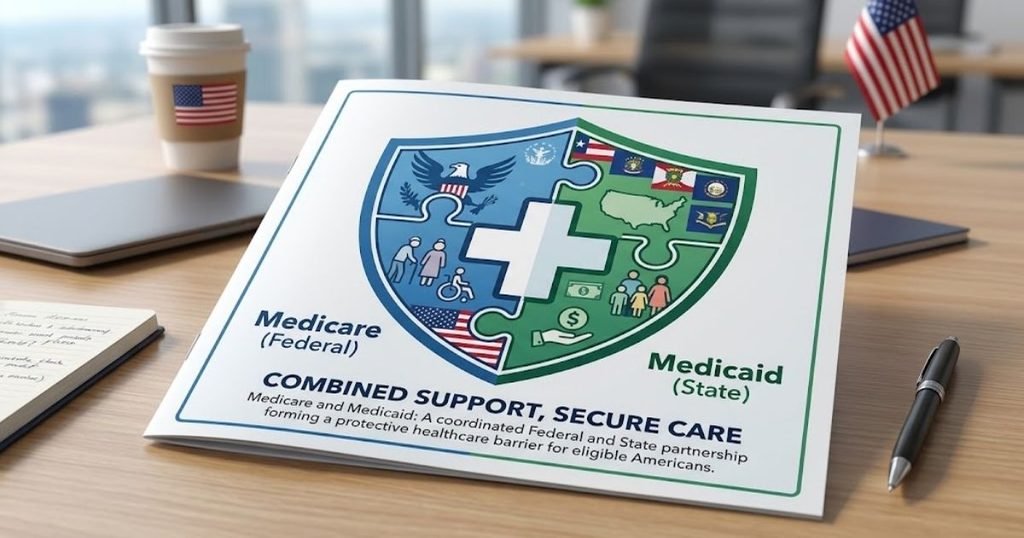
To understand dual eligibility, it helps to distinguish the core roles of both Medicare and Medicaid:
- Medicare: A federal health insurance program primarily serving adults aged 65 and older, as well as younger individuals with specific qualifying disabilities or End-Stage Renal Disease (ESRD). Medicare eligibility is largely tied to age or disability status and work history, regardless of personal income.
- Medicaid: A joint federal-state program designed for low-income individuals, families, seniors, and people with disabilities. Medicaid eligibility is strictly financial and categorical, and each state administers its own program within broad federal guidelines.
Dual eligibility for Medicare and Medicaid occurs when an individual meets the criteria for both Medicare (via age or disability) and Medicaid or a state-run Medicare Savings Program (via limited income and countable assets).
A Practical Example
Consider Arthur, a 71-year-old retired assembly worker living on a $1,200 monthly Social Security benefit. Arthur qualifies for Medicare Part A and Part B based on age. Because his income and assets fall below his state’s threshold, he also qualifies for full Medicaid assistance. Medicare pays his primary medical bills, while his state Medicaid program covers his monthly Part B premium, waives his doctor visit copays, and provides routine dental care.
How Medicare and Medicaid Work Together
When you hold dual eligibility, Medicare and Medicaid function as a coordinated pair rather than competing insurers. Under federal law, Medicaid acts as the payer of last resort. This means when you receive a medical service, your healthcare provider bills Medicare first. Once Medicare processes the claim and pays its portion, the remaining balance (such as a deductible or coinsurance) is billed to Medicaid.
| Coverage Area | Medicare Coverage | Medicaid Coverage |
| Hospital Care | Primary payer for inpatient stays (Part A). | Secondary payer; may cover Part A deductibles/coinsurance. |
| Doctor / Outpatient Care | Primary payer for outpatient visits and tests (Part B). | Secondary payer; may cover Part B deductibles/copays. |
| Prescription Drugs | Primary coverage through Medicare Part D. | Limited role; Medicare Part D takes precedence. |
| Medicare Premiums | Standard monthly premiums apply. | May pay Part B (and Part A, if applicable) premiums. |
| Medicare Cost-Sharing | Beneficiaries face deductibles, coinsurance, and copays. | Pays cost-sharing for eligible duals. |
| Long-Term Care | Limited skilled nursing/rehabilitation stays only. | Primary coverage for eligible custodial nursing home & home care. |
| Dental, Vision & Hearing | Very limited routine coverage under Original Medicare. | Varies by state; many state Medicaid plans offer routine benefits. |
READ MORE: How to Qualify for Medicaid Long-Term Care?
Who Can Qualify for Both Medicare and Medicaid?
You may be eligible to become dually enrolled if you meet one of the primary Medicare qualification pathways while simultaneously meeting state Medicaid criteria.
Primary Medicare Pathways
- Seniors Aged 65 and Older: Individuals entitled to Medicare Part A and/or enrolled in Medicare Part B.
- Individuals with Qualifying Disabilities: Individuals under age 65 who have received Social Security Disability Insurance (SSDI) benefits for at least 24 months, or individuals diagnosed with ALS or ESRD.
Medicaid Pathways
To qualify for Medicaid on top of Medicare, you must fall below your state’s limits for countable income and countable financial resources. Because states manage their own Medicaid programs, meeting criteria in one state does not guarantee identical qualification in another. Having Medicare does not automatically qualify you for Medicaid; you must submit a separate application through your state Medicaid office or human services department.
Full Dual vs. Partial Dual Eligibility
Federal and state agencies categorize dually eligible individuals into two main groups: Full Duals and Partial Duals.
Full-Benefit Dual Eligibility
A “full dual eligible” individual meets the financial and medical eligibility criteria for full state Medicaid benefits. In addition to having Medicare, full duals receive the complete range of healthcare services available under their state’s Medicaid plan. This can include assistance with Medicare out-of-pocket costs, comprehensive prescription drug coverage, dental, vision, hearing, and long-term care services.
Partial Dual Eligibility
A “partial dual eligible” individual earns slightly too much income or holds too many financial assets to qualify for full state Medicaid benefits, but still qualifies for assistance through a Medicare Savings Program (MSP). Partial dual eligibility focuses on lowering Medicare-specific out-of-pocket costs rather than providing full Medicaid insurance.
| Program | What It May Help Pay | Full Medicaid Benefits? |
| QMB (Qualified Medicare Beneficiary) | Part A/B premiums, deductibles, coinsurance, and copayments. | No (unless separately eligible for full state Medicaid). |
| SLMB (Specified Low-Income Medicare Beneficiary) | Medicare Part B monthly premium. | No. |
| QI (Qualifying Individual) | Medicare Part B monthly premium. | No. |
| QDWI (Qualified Disabled & Working Individual) | Medicare Part A monthly premium. | No. |
Medicare Savings Programs ExplainedMedicare Savings Programs are state-administered, federally assisted programs that pay certain Medicare costs for eligible individuals.
The standard federal baseline guidelines for the four primary Medicare Savings Programs are as follows:
1. Qualified Medicare Beneficiary (QMB) Program
- Coverage: Pays Part A premiums (if applicable), Part B premiums, and all Medicare Part A and Part B deductibles, coinsurance, and copayments.
- 2026 Baseline Monthly Income Limits: ~$1,350 for an individual; ~$1,824 for a married couple.
- 2026 Baseline Resource Limits: $9,950 for an individual; $14,910 for a married couple.
2. Specified Low-Income Medicare Beneficiary (SLMB) Program
- Coverage: Pays the monthly Medicare Part B premium.
- 2026 Baseline Monthly Income Limits: ~$1,616 for an individual; ~$2,184 for a married couple.
- 2026 Baseline Resource Limits: $9,950 for an individual; $14,910 for a married couple.
3. Qualifying Individual (QI) Program
- Coverage: Pays the monthly Medicare Part B premium. Enrollees must re-apply annually, and funding is allocated on a first-come, first-served basis.
- 2026 Baseline Monthly Income Limits: ~$1,816 for an individual; ~$2,455 for a married couple.
- 2026 Baseline Resource Limits: $9,950 for an individual; $14,910 for a married couple.
4. Qualified Disabled and Working Individual (QDWI) Program
- Coverage: Pays the Medicare Part A premium for working individuals under 65 who lost their premium-free Part A due to returning to work.
- 2026 Baseline Monthly Income Limits: ~$5,405 for an individual; ~$7,299 for a married couple.
- 2026 Baseline Resource Limits: $4,000 for an individual; $6,000 for a married couple.
Note: The income limits above include standard federal income disregards (such as the unearned income disregard). Several states choose to expand MSP eligibility by using higher income thresholds or eliminating asset tests altogether. Always verify exact criteria with your state’s Medicaid office.
READ MORE: Does Medicare Pay for Assisted Living Facilities? What Seniors Need to Know
Understanding Medicare and Medicaid Income Limits
Determining eligibility is not always as simple as comparing a gross monthly check to a federal table. State agencies evaluate several financial factors during the application process:
- Countable vs. Gross Income: Gross income reflects your total incoming money before deductions. Countable income is what remains after state agencies apply statutory income disregards.
- Aged, Blind, and Disabled (ABD) Rules: For individuals 65+ or living with a disability, states evaluate financial eligibility under ABD Medicaid guidelines rather than Modified Adjusted Gross Income (MAGI) guidelines used for younger families.
- Medicaid Spend-Down Programs: In select states, individuals whose income slightly exceeds limits can qualify for Medicaid through a “spend-down” or medically needy program, which deducts incurred medical expenses from their income total.
- State Variation: Federal poverty levels set a baseline floor, but states maintain authority to loosen restrictions to assist more residents.
What Counts as an Asset or Resource?
When applying for Medicaid or a Medicare Savings Program, states evaluate your countable financial resources.
What Is Generally Counted
- Checking and savings accounts
- Certificates of deposit (CDs), stocks, and bonds
- Cash and second homes or real estate
What Is Generally Exempt
- Your primary home (up to state equity limits)
- One personal vehicle
- Personal household items, clothing, and furniture
- Designated burial plots and small pre-funded burial plans
Important Warning on Asset Transfers: Never attempt to give away money, transfer property titles to family members, or hide assets to meet Medicaid limits. State Medicaid agencies operate a multi-year look-back period (typically 5 years) for long-term care Medicaid benefits. Unsanctioned transfers within this window can trigger lengthy penalty periods of coverage denial. Consult a qualified elder law attorney or state benefit counselor prior to moving assets.
READ MORE: Best 5 Smart Rings for Seniors | Cost & Comparison
What Benefits Can Dual-Eligible Seniors Receive?
Qualifying for dual eligibility unlocks comprehensive financial assistance and healthcare services:
- Elimination of Monthly Part B Premiums: Qualified programs cover your monthly Medicare Part B insurance premium, leaving more money in your Social Security check.
- Waived Out-of-Pocket Costs: Full duals and QMB enrollees avoid hospital Part A deductibles, outpatient Part B deductibles, and doctor visit copayments.
- Low Prescription Costs: Automatic enrollment in the federal Extra Help program drastically limits Part D copayments.
- Long-Term Services and Supports (LTSS): Medicaid can cover long-term institutional nursing facility care and home care services not funded by Medicare.
- Expanded Specialized Care: Depending on state rules, coverage may include dental cleanings, dentures, eyeglasses, hearing aids, and non-emergency medical transportation to clinical appointments.
Who Pays First: Medicare or Medicaid?
Understanding primary versus secondary insurance responsibility prevents billing errors. Official CMS guidance clarifies that Medicare is always the primary payer for Medicare-covered services, while Medicaid acts as the secondary payer.
Scenario: Primary vs. Secondary Payment
Suppose Arthur undergoes a medically necessary knee procedure that costs $2,000.
- Arthur’s hospital submits the bill directly to Medicare first.
- Medicare approves the charge and pays its primary share (typically 80% for outpatient services after deductibles).
- The remaining balance (the 20% coinsurance) is sent to Medicaid.
- Medicaid processes the remaining claim. Arthur pays $0 out of pocket.
Prescription Drug Coverage for Dual Eligibles
Dual eligibles receive prescription drug coverage through Medicare Part D, rather than state Medicaid.
When you achieve dual eligibility or enroll in a Medicare Savings Program, you automatically qualify for the federal Low-Income Subsidy (LIS), commonly referred to as Extra Help.
Key Benefits of Extra Help
- No Late Enrollment Penalty: Waives any accumulated Part D late enrollment penalties.
- Low Monthly Premiums and Deductibles: Reduces or eliminates drug plan premiums and annual prescription deductibles.
- Capped Copayments: Enrollees pay fixed, minimal copayments for covered prescription drugs (in 2026, capped at low amounts such as $5.10 for generic drugs and $12.65 for brand-name drugs).
Note: Always verify that your current maintenance medications appear on your chosen Part D plan’s formulary (covered drug list).
READ MORE: Does Medicare & Medicaid Cover Long-Term Care?
Dual Eligible Special Needs Plans (D-SNPs)
If you have dual eligibility, you can choose between Original Medicare paired with Medicaid or a specialized Medicare Advantage option known as a Dual Eligible Special Needs Plan (D-SNP).
What Is a D-SNP?
A D-SNP is a tailored Medicare Advantage (Part C) plan designed specifically for individuals who qualify for both Medicare and Medicaid. These plans are managed by private health insurance companies contracted with Medicare and state Medicaid programs.
Potential Advantages of D-SNPs
- Unified Management: Combines hospital, doctor, and drug coverage under a single plan network.
- Care Coordination: Provides a personal care coordinator or case manager to help arrange medical appointments, specialist referrals, and social support services.
- Supplemental Allowances: Many D-SNPs offer extra benefits such as allowance cards for healthy foods, over-the-counter wellness items, non-emergency transportation passes, and preventive dental care.
Note: Plan availability, provider networks, and extra benefits vary significantly by county and state. Confirm that your doctor accepts the D-SNP network before enrolling.
Can Dual Eligibles Choose Original Medicare?
Yes. Joining a Medicare Advantage plan or D-SNP is completely voluntary. As a dually eligible beneficiary, you retain the full right to stay enrolled in Original Medicare (Part A and Part B) alongside a standalone Part D prescription plan, using your state Medicaid card as secondary coverage.
Comparing Your Options
- Original Medicare + Medicaid: Offers broad freedom to visit any physician or hospital nationwide that accepts Medicare and Medicaid, without network restrictions or referral rules.
- D-SNP: Offers coordinated care and supplemental wellness allowances, but restricts routine care to in-network providers and participating pharmacies.
Special Enrollment Opportunities for Dual Eligibles
Standard Medicare beneficiaries generally must wait for the annual Fall Open Enrollment Period to change plans. Dually eligible individuals have access to flexible enrollment terms:
- Quarterly Special Enrollment Period (SEP): Individuals who qualify for Medicaid or Extra Help can make changes to their Medicare Advantage or prescription drug coverage once per calendar quarter during the first nine months of the year (January–March, April–June, July–September).
- Joining an Integrated D-SNP: A Special Enrollment Period allows full duals to switch into an integrated D-SNP plan when becoming newly eligible or changing Medicaid status.
Medicaid and Long-Term Care for Dual Eligibles
One of the largest gaps in Original Medicare is long-term care. Medicare does not cover extended, long-term custodial care (such as help with dressing, bathing, or long-term nursing home stays).
Medicaid serves as the primary public funder for long-term services and supports (LTSS):
- Nursing Facility Medicaid: Covers complete residential nursing care for individuals who meet state functional level-of-care criteria and strict financial rules.
- Home and Community-Based Services (HCBS) Waivers: Many states operate HCBS waiver programs that pay for personal care aides, adult day care, and home modifications, allowing seniors to remain safely at home instead of moving into a nursing facility.
Does Medicaid Pay Medicare Premiums?
Yes. Through Medicare Savings Programs (QMB, SLMB, and QI), state Medicaid agencies pay the standard monthly Medicare Part B premium on behalf of qualifying beneficiaries.
If you receive Social Security benefits and are approved for an MSP, the Social Security Administration stops deducting the Part B premium from your monthly check, effectively increasing your monthly take-home pay.
Does Medicaid Pay Medicare Deductibles and Copays?
Yes, for eligible beneficiaries enrolled in Full Medicaid or the QMB Program.
Federal Anti-Balance Billing Rules
Under federal law, healthcare providers who accept Medicare and serve QMB beneficiaries are strictly prohibited from balance billing those patients for Medicare-covered deductibles, coinsurance, or copayments. The provider must accept payment from Medicare and Medicaid as payment in full.
Advice for Patients: Always present both your Medicare card and your State Medicaid or QMB card when visiting a healthcare provider. If a provider bills you for a Medicare-covered service while you are enrolled in QMB, notify the provider’s billing office or contact 1-800-MEDICARE immediately.
How to Apply for Dual Eligibility
Follow these clear, actionable steps to request assistance:
Step 1: Confirm Your Medicare Status
Ensure you are actively enrolled in Medicare Part A and/or Part B. You can verify your status online at Medicare.gov or by reviewing your red, white, and blue Medicare card.
Step 2: Check Your State’s Medicaid Requirements
Visit your state’s official Medicaid agency website or contact your local area agency on aging to review local income and asset guidelines.
Step 3: Gather Necessary Documentation
Prepare readable copies of essential verification documents:
- Government-issued identification (Driver’s license, state ID, birth certificate)
- Social Security benefit statements or pension stub records
- Bank statements for all active accounts (typically covering the last 3–6 months)
- Medicare card details
- Proof of local residence (utility bill or lease agreement)
Step 4: Submit Your Application
Submit an application for Medicaid or Medicare Savings Programs directly through your state Medicaid agency. Applications can generally be completed online, mailed, or turned in at a county social services office.
Step 5: Ask About Additional Services
During your intake or review process, inquire about additional programs you may qualify for, including Home and Community-Based Services (HCBS) waivers, transportation vouchers, or dental benefits.
Where Can Seniors Get Free Help?
You do not need to navigate dual eligibility alone. Free, impartial assistance is available through official government agencies and non-profit organizations:
- SHIP (State Health Insurance Assistance Program): Offers free, local, unbiased health insurance counseling for Medicare beneficiaries and their families. Visit shiphelp.org to find counselors in your state.
- 1-800-MEDICARE (1-800-633-4227): The official federal helpline, available 24/7 to answer general Medicare and drug coverage questions.
- State Medicaid Agencies: Search Medicaid.gov to access directory listings for state human services departments.
- Social Security Administration (SSA): Visit ssa.gov or call 1-800-772-1213 to apply for the Part D Extra Help program or verify disability entitlement.
Common Mistakes Dual-Eligible Seniors Should Avoid
Avoid these frequent misunderstandings when exploring benefits:
- Assuming Medicare and Medicaid are the same: Medicare is age/disability-based federal coverage, while Medicaid is income-based state assistance.
- Assuming income is too high without checking: State income disregards and varied asset tests mean you may qualify even if your income seems slightly above federal baseline charts.
- Ignoring Medicare Savings Programs: Millions of seniors skip applying for MSPs because they assume they can only get full Medicaid, missing out on over $2,400 in annual Part B premium savings.
- Failing to report financial changes: Changes in income, household size, or address must be reported to avoid coverage interruptions or retroactive billing issues.
- Enrolling in a D-SNP without checking doctor networks: Switching to a plan without checking provider networks can disrupt care if your personal doctors do not accept that plan.
- Giving away money or assets to qualify: Transferring real estate or financial accounts without guidance can trigger Medicaid long-term care penalty periods.
Example: How Dual Eligibility Works in Real Life
Hypothetical Scenario:
Eleanor is a 74-year-old widow living in Ohio. She receives $1,300 per month from Social Security and holds $4,000 in savings. Eleanor already has Medicare Parts A and B.
Recognizing that her monthly budget is tight, Eleanor contacts her local SHIP counselor, who assists her with an online application for state benefits.
The state approves Eleanor for the Qualified Medicare Beneficiary (QMB) program. As a result:
- The state covers her monthly Medicare Part B premium, increasing her Social Security take-home check.
- Eleanor no longer pays deductibles or copays when visiting her primary physician.
- Eleanor is automatically enrolled in Part D Extra Help, lowering her drug costs to minimal copayments.
Disclaimer: This example is provided for illustrative purposes only. Actual eligibility depends on individual state rules, total countable income, and resources.
Comparison Table: Coverage Options Side-by-Side
| Feature | Medicare Only | Medicaid Only | Medicare + Medicaid (Dual Eligible) |
| Federal Health Coverage | Yes (Age 65+ or Disability). | No (State-administered with federal rules). | Yes, Medicare acts as primary insurer. |
| State Medicaid Benefits | No. | Yes, for low-income qualifying residents. | Yes, secondary benefits based on eligibility level. |
| Medicare Premium Assistance | No (Standard rates apply). | N/A. | Yes, via Medicare Savings Programs. |
| Cost-Sharing Relief | Limited (Unless holding Medigap). | N/A. | Yes, eliminates or reduces deductibles/copays. |
| Prescription Coverage | Medicare Part D. | State Medicaid Rules. | Medicare Part D with automatic Extra Help. |
| Long-Term Custodial Care | Very limited temporary rehab care. | May cover if income/care criteria are met. | May cover long-term home/nursing facility care. |
| D-SNP Eligibility | No. | No. | Yes, optional tailored Advantage plans. |
Frequently Asked Questions
What does it mean to be dual eligible for Medicare and Medicaid?
Being dually eligible means you qualify for Medicare and Medicaid at the same time. Medicare serves as your primary health coverage for hospital and outpatient services, while Medicaid acts as secondary coverage.
Can you have Medicare and Medicaid at the same time?
Yes, you can have both Medicare and Medicaid simultaneously if you meet the distinct eligibility criteria for each program. Medicare eligibility is primarily based on age (65+) or receiving disability benefits, while Medicaid eligibility depends on having limited monthly income and assets under state rules.
What does Medicaid pay for if you have Medicare?
For dually eligible beneficiaries, Medicaid generally covers the monthly Medicare Part B premium and Medicare out-of-pocket costs, including annual deductibles, coinsurance, and doctor copayments. Depending on state rules and your dual eligibility status (full vs. partial), Medicaid may also pay for expanded services that Medicare does not cover.
How much can you make to qualify for both Medicare and Medicaid?
Income limits for dual eligibility vary significantly by state and eligibility category. For basic Medicare Savings Programs like QMB, the federal baseline monthly income limit is approximately $1,350 for an individual and $1,824 for a couple. Other partial programs extend assistance up to roughly $1,816 monthly for individuals.
Do Medicare and Medicaid cover nursing home care?
Original Medicare provides very limited, short-term skilled nursing facility care following a qualifying hospital stay, but it does not cover long-term custodial nursing home care. Medicaid, however, is the primary source of public funding for long-term nursing home care. If you are dually eligible and meet your state’s financial and functional level-of-care criteria, Medicaid can pay for ongoing nursing facility care.
Conclusion
Dual eligibility for Medicare and Medicaid provides valuable relief for seniors and individuals with disabilities living on limited incomes. By coordinating federal insurance with state assistance, these programs help eliminate burdensome out-of-pocket expenses, cover monthly premiums, and provide access to crucial services like prescription drug benefits and long-term care.
Because Medicaid eligibility rules, income thresholds, and supplementary benefits vary by state, you should avoid assuming you do not qualify. Take the next step by contacting your local State Health Insurance Assistance Program (SHIP) counselor, calling 1-800-MEDICARE, or reaching out directly to your state Medicaid office to verify your options and apply for coverage.
Medical & Financial Disclaimer: This guide is for educational purposes only and does not constitute personalized medical or legal-financial advice. To verify exact coverage and eligibility in your state, please consult directly with Medicare.gov, Medicaid.gov, or your local State Health Insurance Assistance Program (SHIP).
Sources & Disclaimer: Information in this article is drawn from official 2026 guidelines published by CMS.gov, Medicare.gov, Medicaid.gov, and SSA.gov. Income thresholds and benefit rules vary by state. This content is for educational purposes only and does not constitute individual legal, medical, or financial advice. To verify your local benefits, contact your state Medicaid office or call 1-800-MEDICARE.
Expert Review Statement:
This article complies with high YMYL (Your Money or Your Life) trust standards. Content is authored by senior healthcare benefits educators and periodically reviewed against official guidance from the Centers for Medicare & Medicaid Services (CMS) and the Social Security Administration (SSA). We do not guarantee eligibility, savings, or plan availability.